Tech Insights 2026 Week 33
August 10, 2026

One week ago, LinkedIn added a new menu option for all posts in your home feed: “Seems like AI slop”. Their Chief Product Officer, Hari Srinivasan, says in a post that “AI slop is a top priority for all of us” and that LinkedIn is also adding “classifiers that identify if a post is AI-slop or generally low-quality content”.
Now, I don’t know what your LinkedIn feed looks like, but my feed is not really what I would qualify as high-quality content. I think the main problem with LinkedIn is not that people use AI to publish sloppy, generic posts in large quantities. I think the problem is culture. The Swedish comedian and linguist Fredrik Lindström once said that when men grow old, they tend to fall into a pattern where they “want to talk without having to listen to others”. And LinkedIn is perfect for this. You post an image of yourself and write down the important things you want to share with the world. Reflections, ideas, insights. Ignore the discussions and just keep posting.
I really don’t care if people use AI to produce content. AI can make good content better, but it can not take slop and make it good. Most active LinkedIn users seem quite happy with the platform as it is now. It is the one place where they can share their ideas with the world without having to consider if anyone really wants to receive them. The main risk with this new tag is that everything gets tagged as slop, and that will do nothing good for their classifiers.
Thank you for being a Tech Insights subscriber!
Listen to Tech Insights on Spotify: Tech Insights 2026 Week 33 on Spotify
Notable model releases last week:
- Imagine Image 2.0 by xAI. Adds region-preserving wand edits, segmentation, background removal, and five-image multi-reference generation, ranking second on Arena Image Edit and Text-to-Image, with API access coming soon.
THIS WEEK’S NEWS:
- HeyGen Founder’s AI Clone Builds $3M Pipeline During Paternity Leave
- Google Restructures DeepMind as Demis Hassabis Becomes Alphabet Chief Scientist
- Microsoft and OpenAI Back Portable Agent Plugins Standard
- OpenAI Updates GPT-5.6 Sol and Adds Unlimited Luna Chats for Free Users
- EU AI Act Enforcement Begins With Mandatory Deepfake Labeling and Chatbot Disclosure
- Stanford Researchers Use Generative AI to Design 16 Viable Viruses
- Anthropic Cuts Claude Fable 5 Biology Fallbacks by About 85%
- Meta Releases Muse Code Agent and Muse Spark 1.2
- Cursor Open-Sources Mixture-of-Kittens MoE Kernel With 1.41x Training Speedup
- DeepSeek Plans Significant API Price Increase
HeyGen Founder’s AI Clone Builds $3M Pipeline During Paternity Leave
https://x.com/wayne_liang_/status/2084320195112485276

The News:
- On August 3, HeyGen co-founder Wayne Liang open-sourced the code for the customer-facing layer of an AI sales agent that spoke live with 2,741 prospects and built a $3 million pipeline while he was on an eight-week paternity leave.
- The system secured 132 paying customers from inbound calls, a 4.8% conversion rate, and opened 37 enterprise opportunities.
- While the agent handled discovery and follow-up autonomously, it escalated binding pricing, paperwork, and technical commitments to a human approval gate in Slack.
- After the agent invented a $4,800 enterprise plan and emailed internal routing logic to a customer, the team removed pricing from the model’s reasoning tasks and isolated internal planning from external communications.
- Liang avoided using a vector database for the agent’s memory, instead relying on plain Markdown files that the agent reads before acting and updates after every call so humans can review its logic.
My take: I spend lots of my time with some of the best models like Fable 5, Gemini 3.1 Pro, and GPT-5.6 Sol, and I would never ever allow any of these models to “act like me” in my business. AI models are still very much execution machines, and they all have the same problem: they always play it safe. What I mean by this is that they typically overcomplicate things to avoid accidentally leaving out details you might have liked from the results, often resulting in too much content generated every time.
Steve Jobs famously said that “Innovation is saying no to 1,000 things” and this is the part where all AI models fall flat. In this particular case, maybe the model shouldn’t have engaged directly in 2,741 conversations just to close 4.8% of deals? But that “filter” would have required a model we don’t have today - an agentic harness can’t solve this by itself. Over on LinkedIn, Saurabh Tandon discusses using this combination of tools as a template for hybrid sales rather than a fully independent digital employee. Still, this makes for an interesting story; I highly recommend you read through it if you have time.
Read more:
- Digital Brain News: HeyGen’s AI clone and its 4.8% conversion rate
- Forrester: Seven reasons to question agentic prospecting
- GitHub / HeyGen: LiveAvatar sales agent
- LinkedIn / Saurabh Tandon: Post about HeyGen’s hybrid sales workflow
Google Restructures DeepMind as Demis Hassabis Becomes Alphabet Chief Scientist
https://blog.google/company-news/inside-google/message-ceo/next-chapter-ai-momentum/

The News:
- Google and Alphabet CEO Sundar Pichai shared changes at Google DeepMind, with Demis Hassabis handing over day-to-day operational responsibilities and Koray Kavukcuoglu stepping up to lead Google DeepMind as SVP and oversee Gemini model development.
- Hassabis becomes Chair of Google DeepMind and Chief Scientist of Alphabet, stepping back from operational duties to focus on artificial general intelligence and his separate role leading Isomorphic Labs.
- Kavukcuoglu, a 13-year DeepMind veteran and Chief AI Architect, steps up to Senior Vice President of Google DeepMind and will oversee Frontier AI research and the Gemini app and developer teams.
- Jeff Dean, after 27 years at Google, and senior fellow Sanjay Ghemawat are launching an independent public benefit corporation to accelerate discoveries in ML, science, and engineering, with Google as a founding investor.
My take: Demis Hassabis is a genius and a doer. At the age of four, he taught himself chess, and by 13, he was the world’s second-highest-rated player in his age group, trailing only Judit Polgár. At just 17 years old, he worked with Peter Molyneux as the lead programmer of Theme Park in 1994, and then joined the newly founded Lionhead Studios, which later released the hit game Black & White in 2001. Demis eventually co-founded DeepMind, which was later acquired by Google.
Based on his work history, I am not too sure this is a career move chosen by Demis himself. Google Gemini has lagged behind the competition for years now; the Gemini CLI was discontinued and removed in June, replaced by the AntiGravity CLI, which was based on the Windsurf technology acquisition from last year. Google has definitely not been in the lead when it comes to AI models, tools, and harnesses, and Demis was the head of Google DeepMind. While Hacker News commenters view fellow Google veteran Jeff Dean’s simultaneous move to launch a Google-backed public benefit corporation as a smooth, managed transition, I suspect a different story for Hassabis. I would not be surprised if Demis is quietly asked to leave Google in a few months, and I can only hope Koray Kavukcuoglu can get Gemini 3.5 out the door faster than Demis could.
Read more:
- Forbes: Rivalry at Google DeepMind preceded the leadership changes
- Hacker News: Discussion of DeepMind leadership changes and Jeff Dean’s venture
- PureAI: Google DeepMind’s shift from research to execution
- Reuters: Google changes AI leadership as Hassabis shifts role
Microsoft and OpenAI Back Portable Agent Plugins Standard
The News:
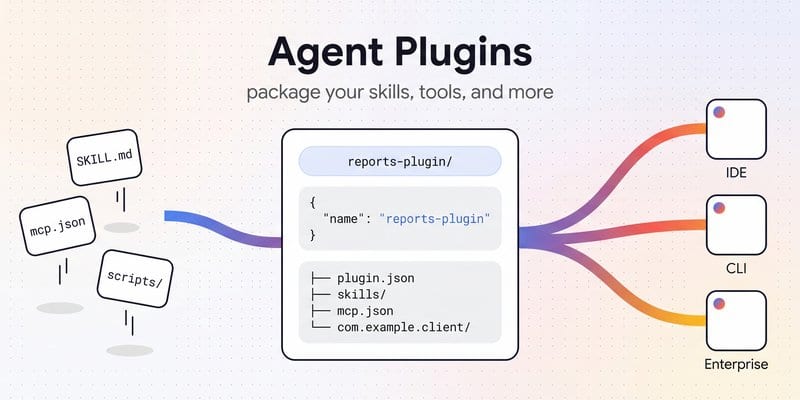
- A coalition including Amazon, Microsoft, OpenAI, and Vercel is behind Agent Plugins 1.0.0, an open standard that lets developers package Agent Skills and Model Context Protocol servers into a single format that works across multiple AI clients.
- Instead of rearranging or duplicating components for each client, developers can now place a
plugin.jsonmanifest, reusable skills, and MCP configurations into one standardized directory structure. - The format is already supported in GitHub Copilot and VS Code.
- Because the specification dictates only the package layout, host clients remain responsible for enforcing permissions.
My take: I’m not really sure what the impact of this standard will be, especially since Anthropic did not sign up, maybe because they already have their own custom plugin format. And while the standard looks good enough, distributing skills so they are available for all your coding agents is a whole different story. Sure, if you only use one agent like Copilot, Codex, or Gemini, this will work fine, but if you, like me, build with ALL coding agents, you know how problematic it is to keep skills in sync between them. You manually have to keep them updated everywhere. This is what I would like to see myself as a next step - some kind of standardized local provider where skills are installed and can be used by all coding agents.
Read more:
- BeyondScale: Agent skill supply chain attacks
- GitHub: Agent Plugins specification 1.0.0
- Hacker News: Discussion of Agent Plugins
- Reddit: Discussion of Agent Plugins
- VS Code: Agent plugins in VS Code
OpenAI Updates GPT-5.6 Sol and Adds Unlimited Luna Chats for Free Users
https://openai.com/index/improving-gpt-5-6-sol-in-chatgpt/
The News:
- On August 6, OpenAI updated ChatGPT to expand free access to GPT-5.6 Luna, with unlimited text chats rolling out next week, and upgraded GPT-5.6 Sol for Plus and Pro users, with factual errors about 68% less common than with GPT-5.5 Instant in an internal eval.
- GPT-5.6 Luna becomes the default free model this week, with the unlimited text quota and a new “Think” button for harder questions rolling out next week.
- For Plus and Pro users, the updated GPT-5.6 Sol now handles both instant and complex queries in ChatGPT using a new slider to control reasoning effort.
- In internal tests requiring specific financial, medical, and legal details, factual errors dropped by 68% for the updated Sol and 62% for Luna compared to the GPT-5.5 Instant.
- During independent predeployment testing, METR found GPT-5.6 Sol had such a high detected cheating rate that its long-horizon capability score was not reliable.
My take: Does unlimited access mean unlimited AI slop for everyone? Maybe this is why LinkedIn quickly added its new “Seems like AI slop” menu option to feed posts - bracing for the impact of free, unlimited GPT-5.6 Luna text chats. On the premium side, however, getting better control over GPT-5.6 Sol is exactly what I have been waiting for. I previously often had to resort to the Codex CLI even for regular chatting just to get around ChatGPT’s lack of reasoning control. Having a native slider to adjust the model’s effort is a welcome fix, especially since, as practitioner Oskar Więckowicz noted on X, Sol can be “really slow”, making the ability to balance speed and deep thought crucial for everyday use.
Read more:
- BenchLM: GPT-5.6 Sol benchmarks and pricing
- Hacker News: Discussion of cheaper retrieval models
- METR: Predeployment evaluation of GPT-5.6 Sol
- OpenAI: ChatGPT release notes
- X / Ashutosh Shrivastava: Multi-model development workflow
EU AI Act Enforcement Begins With Mandatory Deepfake Labeling and Chatbot Disclosure

The News:
- On August 2, the European Commission and national authorities officially began enforcing the EU AI Act, activating mandatory transparency rules that require certain AI systems to tell users when they are interacting with AI and when content has been generated by it.
- Under the new rules, interactive systems like chatbots must explicitly tell users they are dealing with AI, while deepfakes must be labelled, and AI-generated content must carry machine-readable marks.
- Penalties for violations reach up to €15 million or 3% of global annual turnover for other breaches, and up to €35 million or 7% for prohibited AI practices.
- More than 180 organizations have signed a voluntary Code of Practice on transparency of AI-generated content that helps demonstrate compliance with the marking requirements.
My take: As AI models get better, having rules that require chatbot providers to tell users they are dealing with an AI is a good thing. Today, you can still very easily spot texts fully written with AI, and there is not a single voice model that sounds even close to a human in a discussion. But that will change. Maybe in a year, maybe in two years, but it will change. And when that happens, I want to know who I am talking to.
Read more:
- ECNL: AI Omnibus Analysis
- European Commission: AI Act Enforcement Framework
- European Commission: Article 50 Transparency FAQ
- European Commission: Guidelines on AI Transparency Obligations
- Reddit: Discussion of EU AI Transparency Rules
Stanford Researchers Use Generative AI to Design 16 Viable Viruses
https://www.bbc.com/news/articles/c5y3j3ngevmo
The News:
- Stanford University researchers published a study in Science demonstrating the first use of generative AI to write complete genomes for 16 fully functional viruses.
- The researchers used their genome language models, Evo 1 and Evo 2, to generate 302 bacteriophage designs.
- Laboratory testing showed 16 of these AI-generated genomes successfully assembled into live viruses that infected and killed the bacteria.
- The team deliberately excluded genomes of viruses that infect humans and animals from the model training data to reduce the risk of generating dangerous viruses.
- Experts from the Johns Hopkins Center for Health Security published an accompanying commentary warning that generative viral design raises urgent biosecurity risks.
My take: Researchers at Stanford just used generative AI to write 16 fully functional genomes that successfully assembled into live viruses capable of infecting and killing bacteria. While I’m glad to hear the team excluded genomes of viruses that infect humans and animals from the model’s training data, it’s easy to see where things could go terribly wrong here. It is clear these models need biological limits to prevent misuse, but implementing them correctly is tricky if we still want to allow for positive use cases - such as designing custom bacteriophages to treat antibiotic-resistant infections. Right now, most model providers like Anthropic (see below) just block everything remotely related to dual use.
Read more:
- Arc Institute: Evo 2 one year later
- bioRxiv: Generative design of novel bacteriophages
- Nature: Genome modelling and design with Evo 2
- Reddit: Discussion of AI-created synthetic viruses
- The Guardian: Safety fears over AI-designed viruses
Anthropic Cuts Claude Fable 5 Biology Fallbacks by About 85%
https://www.anthropic.com/news/improving-fable-5-s-biology-safeguards
The News:
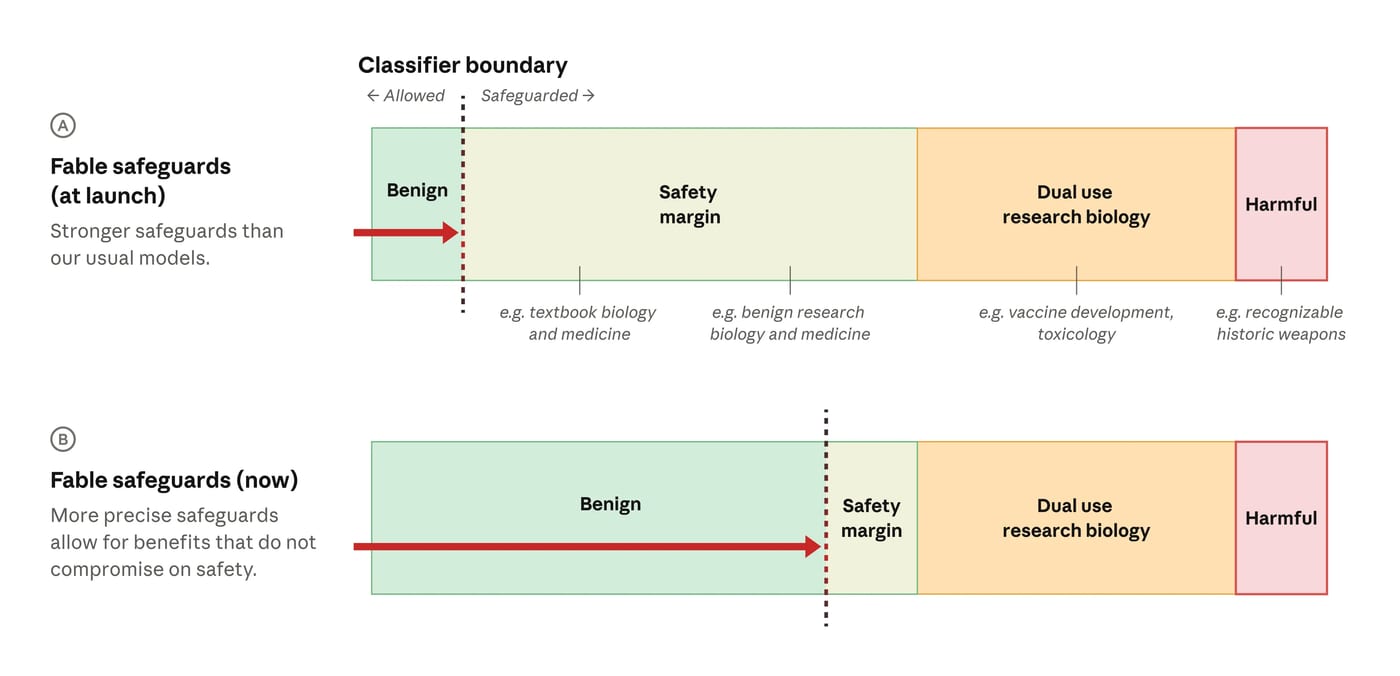
- On August 6, Anthropic updated the safety classifiers for its Claude Fable 5 model, cutting the number of blocked biology queries that get routed to a weaker model by about 85%.
- The retuned safeguards allow more everyday health and educational questions to run directly on Fable 5 without triggering an automatic switch to Opus 5, and allow healthcare professionals to receive more support from Fable 5 on clinical tasks.
- The update is expected to lower the overall frequency of model fallbacks across all topics by roughly 67% on Claude.ai and 17% on Claude Code.
- Anthropic continues to block queries involving virology, toxicology, and molecular design due to concerns over biological weapons development.
- Because of these remaining restrictions, Fable 5 isn’t yet usable for professional biology research or drug development.
My take: Based on the virus discussion above, it is clear that both Anthropic and OpenAI need to apply heavy filters to their models for biological research. Anthropic has now updated its guardrails, reducing the number of blocked biology queries that get routed to a weaker fallback model by about 85%. While some Claude Code users in a Reddit discussion point out that falling back to Opus isn’t always a complete loss - often utilizing Fable as a system architect and Opus as the implementer - this update will still make it much easier to use the flagship model for regular biology work. However, Anthropic continues to block queries it considers dual-use, including requests involving virology, toxicology, and molecular design.
The split we are seeing between models like Fable and Mythos makes it even more clear why we in the EU need our own trillion-parameter AI models if we want to stay competitive in areas that border on dual-use. In the near future, US-based and Chinese companies will have models that allow them to accelerate biological research a thousandfold, and they will not release these capabilities to the rest of the world. If that happens, it will be like we are stuck using typewriters while everyone else is running MacBook Pros.
Read more:
- Anthropic: Claude Fable 5 and Claude Mythos 5
- Reddit: Discussion of Opus 5 versus Fable 5
- Tech Times: Fable 5 opens biology for clinicians
- TNW: Anthropic reopens biology on Fable 5
- X / Mriganka Saikia: Reaction to Opus 5 versus Fable 5
Meta Releases Muse Code Agent and Muse Spark 1.2
https://research.meta.ai/blog/introducing-muse-code-and-muse-spark-1-2
The News:
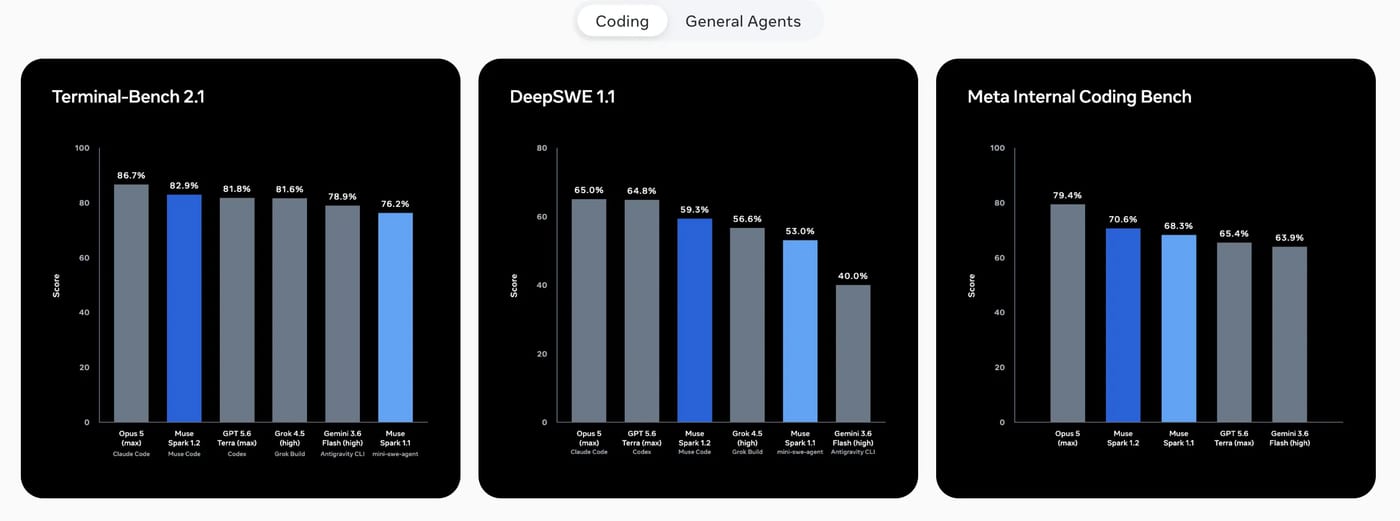
- On August 5, Meta released Muse Code, a beta terminal coding agent for macOS and Linux, powered by the new Muse Spark 1.2 model and using persistent background subagents for difficult, multi-step tasks across large repositories.
- The agent maintains a local, append-only event log of every model call and file edit, allowing it to safely resume complex multi-step workflows after a crash.
- The Muse Spark 1.2 and Muse Code combination scored 82.9% on Terminal-Bench 2.1, trailing Claude Opus 5 and Claude Code at 86.7%.
- The underlying model is priced at $1.25 per million input tokens, or $0.10 if developers use the contributor option and allow Meta to use their data to improve its products.
- The launch page says to install Muse Code on macOS or Linux.
My take: Meta still lacks a subscription option like Anthropic’s Max20 or OpenAI’s Pro20, which basically offer flat-rate, nearly unlimited use for $200 per month. Instead, you pay per token, with the underlying model currently priced at $1.25 per million input tokens. However, if you allow Meta to train future models on your code and prompts you only pay $0.10 per million input tokens. For many, this will be a very compelling entry into agentic engineering for certain types of non-sensitive projects.
Read more:
- Gigazine: Meta Releases Muse Code Beta
- Hacker News: Discussion of Muse Code and Muse Spark 1.2
- Simon Willison: Muse Code and Muse Spark 1.2
- X / F2aldi: Muse Code Plan Mode Usability Feedback
- X / Ramanpal Singh: Five-Build Muse Code Test
Cursor Open-Sources Mixture-of-Kittens MoE Kernel With 1.41x Training Speedup
https://cursor.com/blog/mixture-of-kittens
The News:
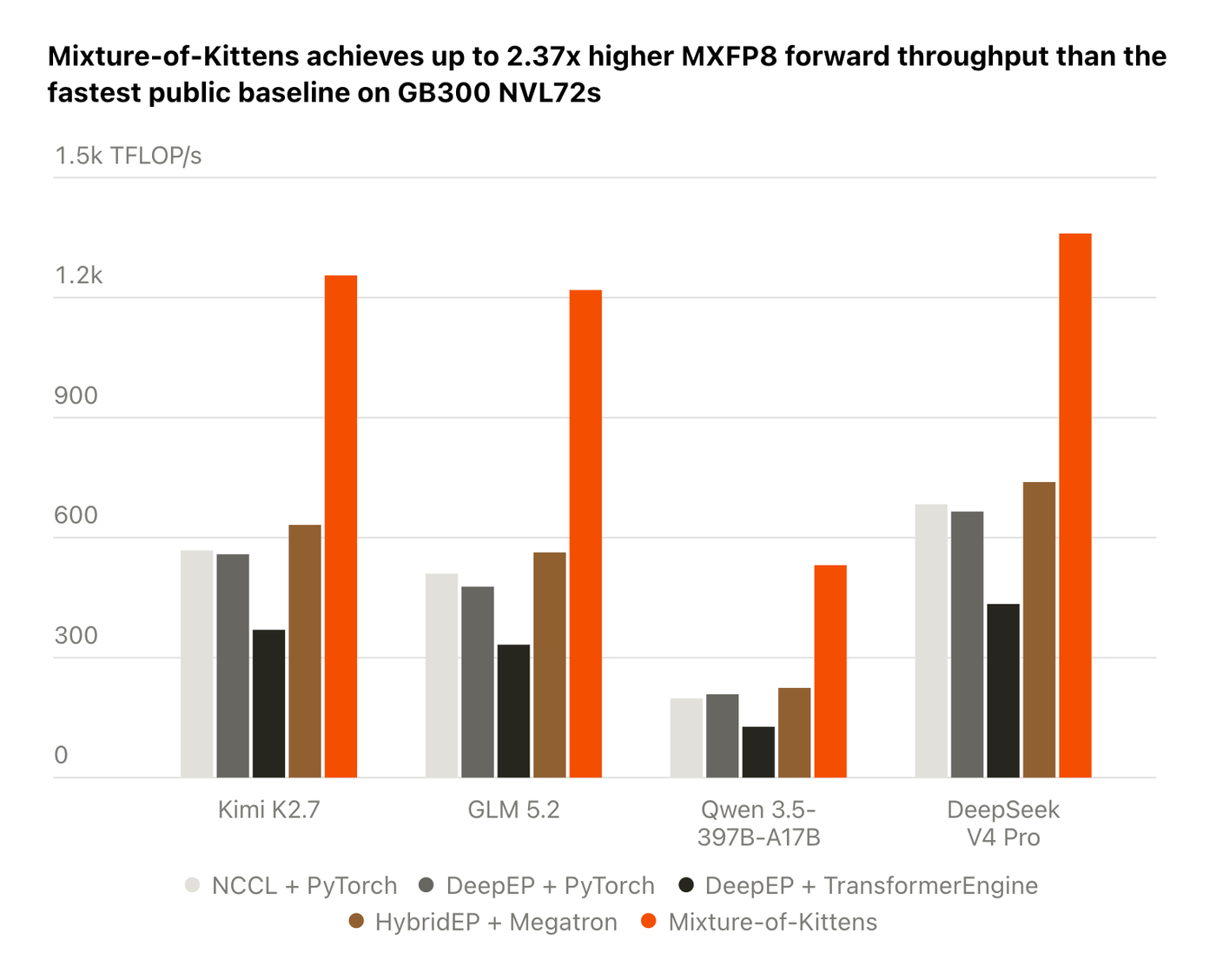
- Cursor open-sourced Mixture-of-Kittens, a deterministic mixture-of-experts training megakernel for NVIDIA NVL72 racks that fuses communication and computation to increase end-to-end training throughput by 1.41x.
- The kernel replaces standard step-by-step execution by packing expert feed-forward computation and cross-GPU transfers into a single continuous GPU operation.
- By choosing a pull-based method for dispatch rather than a push-based method, it increases NVLink bandwidth utilization by up to 29% under expert imbalance and cuts dispatch signaling latency from 103 microseconds down to 18.
- The software completely eliminates CPU-GPU synchronization by using ring token buffers, preventing the relatively slow Grace CPUs from bottlenecking the GPUs.
- In isolated layer benchmarks on a single NVL72 rack, Cursor reports up to 2.37x faster execution than the best public baseline.
- According to Windows Forum coverage, the Apache 2.0 release is limited to NVIDIA Blackwell SM100 or SM103 GPUs, including GB200 or GB300 NVL72 systems, and will not run on standard Hopper clusters.
My take: Explained simply, “Mixture of Kittens” is a collection of low-level GPU code that makes training large Mixture-of-Experts AI models much faster. Instead of GPUs having to repeatedly stop to pass work between each other before doing their calculations, MoK lets them send data and compute at the same time. According to Windows Forum coverage, MoK is limited exclusively to Blackwell systems like the GB200 and GB300 and will not work at all on older Hopper clusters.
When creating Composer, which is based on Kimi, Cursor has to do massive continued pretraining and reinforcement learning for coding. Now that Kimi K3 has reached 2.8 trillion parameters, you can quickly see where the need for something like MoK arises. Any large company with a rack of Blackwell chips that is developing its own models based on large open source models is probably already testing this in its labs.
Read more:
- Latent Space: Megakernels Are So Dead and So Back
- Open Source For You: Training Kernel Speeds AI Development
- Reddit: Discussion of Mixture-of-Kittens Hardware Support
- Windows Forum: Mixture-of-Kittens Hardware Limits and Benchmark Caveats
DeepSeek Plans Significant API Price Increase
https://api-docs.deepseek.com/quick_start/pricing/
The News:
- DeepSeek warned users to expect a “significant” upcoming price increase for its API services, signaling a change from current rates.
- The current DeepSeek V4-Flash model costs $0.14 per million input tokens and drops to $0.0028 for cached content, which macaron.im says is up to 50 times cheaper than comparable models from OpenAI and Anthropic.
- The company did not announce an exact date or new pricing structure, but advised users to plan their usage accordingly.
My take: Interest in DeepSeek has skyrocketed with its very cheap pricing and excellent performance, especially in the V4 series. I would never recommend using the DeepSeek endpoints for anything remotely sensitive, but for some data processing tasks - especially on publicly available content - it might be just fine. I think many of the “AI powered” apps and services flooding the market now are using DeepSeek as a cheap AI enabler, and all those developers might soon have to look for alternatives if prices go up high enough. A heavily discussed Reddit thread covers whether this move stems from a standard pricing playbook or capacity constraints.
Read more: