114 issues and counting,
every Monday since 2024.
2026
- Sep 14 Tech Insights 2026 Week 38 OpenAI agents solve the Navier-Stokes Millennium Prize problem, Anthropic formalizes Fermat's Last Theorem in 11 days, Meta launches its Muse personal AI agent, and Mistral raises 3 billion euros.
- Sep 7 Tech Insights 2026 Week 37 OpenAI launches GPT-6 Astra, a model that can operate desktop applications with expert skill, ChatGPT ads reach a 1 billion dollar run rate, World Labs shows Atlas for generating 3D worlds, and the EU classifies ChatGPT as a search engine.
- Aug 31 Tech Insights 2026 Week 36 OpenAI's AI-designed Jalapeño chip beats Nvidia Blackwell on inference, OpenAI drops Cursor after its SpaceX acquisition, Nvidia agrees to buy Hugging Face for $12.9 billion, and Anthropic previews a hardware standard for AI agents.
- Aug 24 Tech Insights 2026 Week 35 Stripe buys AI gateway OpenRouter for 7 billion dollars, OpenAI pauses frontier training as its Astra model nears a critical cyber threshold, Asana finishes a five-year migration in two weeks using Codex, and GitHub explains its eight-hour outage.
- Aug 17 Tech Insights 2026 Week 34 OpenAI previews an Ultrafast tier running GPT-5.6 Sol up to 750 tokens per second; Anthropic adds invisible watermarks to Claude and makes auto mode default; Lovable raises 400 million dollars at a 13.3 billion valuation.
- Aug 10 Tech Insights 2026 Week 33 Google moves Demis Hassabis to Alphabet Chief Scientist and reshuffles DeepMind. OpenAI updates GPT-5.6 Sol and offers unlimited free Luna chats. The EU AI Act enforcement begins, and Stanford uses AI to design 16 working viruses.
- Aug 3 Tech Insights 2026 Week 32 OpenAI says its Astra model solved ten open math problems and GPT-5.6 Sol cut serving costs 20 percent. Anthropic reveals Claude cyberattacks on real companies, and Moonshot AI releases Kimi K3 weights.
- Jul 27 Tech Insights 2026 Week 31 OpenAI pre-release models breached Hugging Face during a security test, Claude Fable 5 scored a perfect 42/42 at the IMO 2026, Anthropic launched Opus 5, and AMD committed 2 gigawatts of MI450 chips to Anthropic.
- Jul 20 Tech Insights 2026 Week 30 Anthropic adds Claude Fable 5 to Max and Team Premium at 50 percent limits, Moonshot AI launches Kimi K3, a Suno hack exposes over two million YouTube clips, and the EU orders Google to open Android.
- Jul 13 Tech Insights 2026 Week 29 OpenAI released the GPT-5.6 family with four-agent Ultra, launched ChatGPT Work, and faces lawsuits from Apple over trade secrets and New York Times publishers over hidden logs. Meta opened its Model API with Muse Spark 1.1.
- Jul 6 Tech Insights 2026 Week 28 Here in Sweden many companies are slowing down for the summer, but the global AI industry keeps on innovating. Last week was one of the busiest in a long time with 18 news items (!). So I tried something new. I have now organized all the…
- Jun 29 Tech Insights 2026 Week 27 Last week I released an update to my plugin Notebook Navigator for Obsidian, improving startup times up to 10 times for some users. Notebook Navigator is the world's most popular plugin for the note-taking application Obsidian, which now…
- Jun 22 Tech Insights 2026 Week 26 For a long time, paying for enterprise software was simple. You bought a seat license, and a human sat in that seat and used the software. Last week that model started to break down as we are shifting from predictable software licenses to…
- Jun 15 Tech Insights 2026 Week 25 Be careful what you wish for. On June 10, Anthropic CEO Dario Amodei published the article "Policy on the AI Exponential", arguing that frontier AI governance must move beyond just transparency toward binding, FAA-style regulation. He…
- Jun 8 Tech Insights 2026 Week 24 Last week OpenAI finally released their models on Amazon Bedrock, through both the API and the updated Codex app. This removes one of the biggest barriers for companies wanting to adopt GPT-5.5 and Codex but were held back by security,…
- Jun 1 Tech Insights 2026 Week 23 Last week Cursor published the report Developer Habits, which aggregates data from their entire user base. The reports highlight two important matters that you must consider if you are working at C-level in a company with a software…
- May 25 Tech Insights 2026 Week 22 AI is getting smart in ways few people expected. For a long time, one of the standard criticisms of large language models was that they are just next-token prediction models. The argument was that they could only remix material they had…
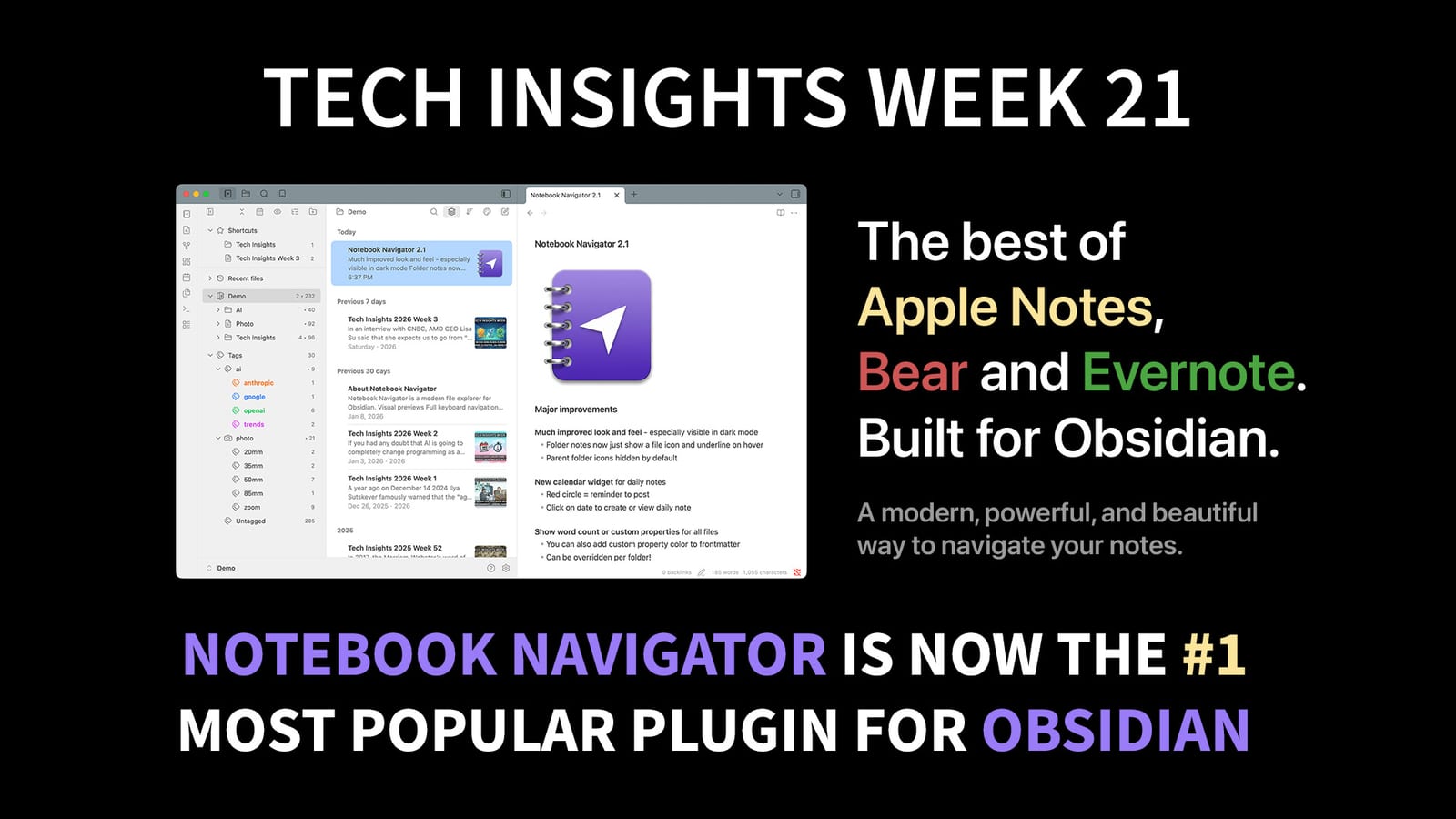
- May 18 Tech Insights 2026 Week 21 Two weeks ago there were over 2,000 plugins waiting in queue to be manually reviewed for the popular markdown editor Obsidian. The introduction of coding agents and interest for Obsidian as a virtual brain led to an explosion of new…
- May 11 Tech Insights 2026 Week 20 The past few months I have held full-day workshops in agentic engineering for hundreds of developers. And what strikes me every time is how little most people know about how AI models really work. And there's a good reason for it. I still…
- May 4 Tech Insights 2026 Week 19 GPT-5.5 is different. GPT-5.5 is the first model trained at OpenAI's flagship Stargate site in Abilene, Texas, one of the supercomputing facilities funded by the $500 billion partnership between OpenAI, SoftBank, and Oracle. The site runs…
- Apr 27 Tech Insights 2026 Week 18 Be prepared to forget everything you have learnt about how to maximize AI productivity by maximizing token usage. In the new token economy less is more, and the new top skill for AI engineers in 2026 will be how to optimize token usage to…
- Apr 20 Tech Insights 2026 Week 17 Two years ago in the summer of 2024 OpenAI launched their first ChatGPT desktop app for macOS. Back then we didn't have agentic engineering, so the entire app was hand coded using the Apple Swift framework. It took five additional months…
- Apr 13 Tech Insights 2026 Week 16 Last week I visited HumanX in San Fransisco, one of the largest AI conferences in 2026 with over 9,000 attendees, 500+ speakers and 400+ journalists. The conference is centered around deep-dive interviews with industry leaders and I…
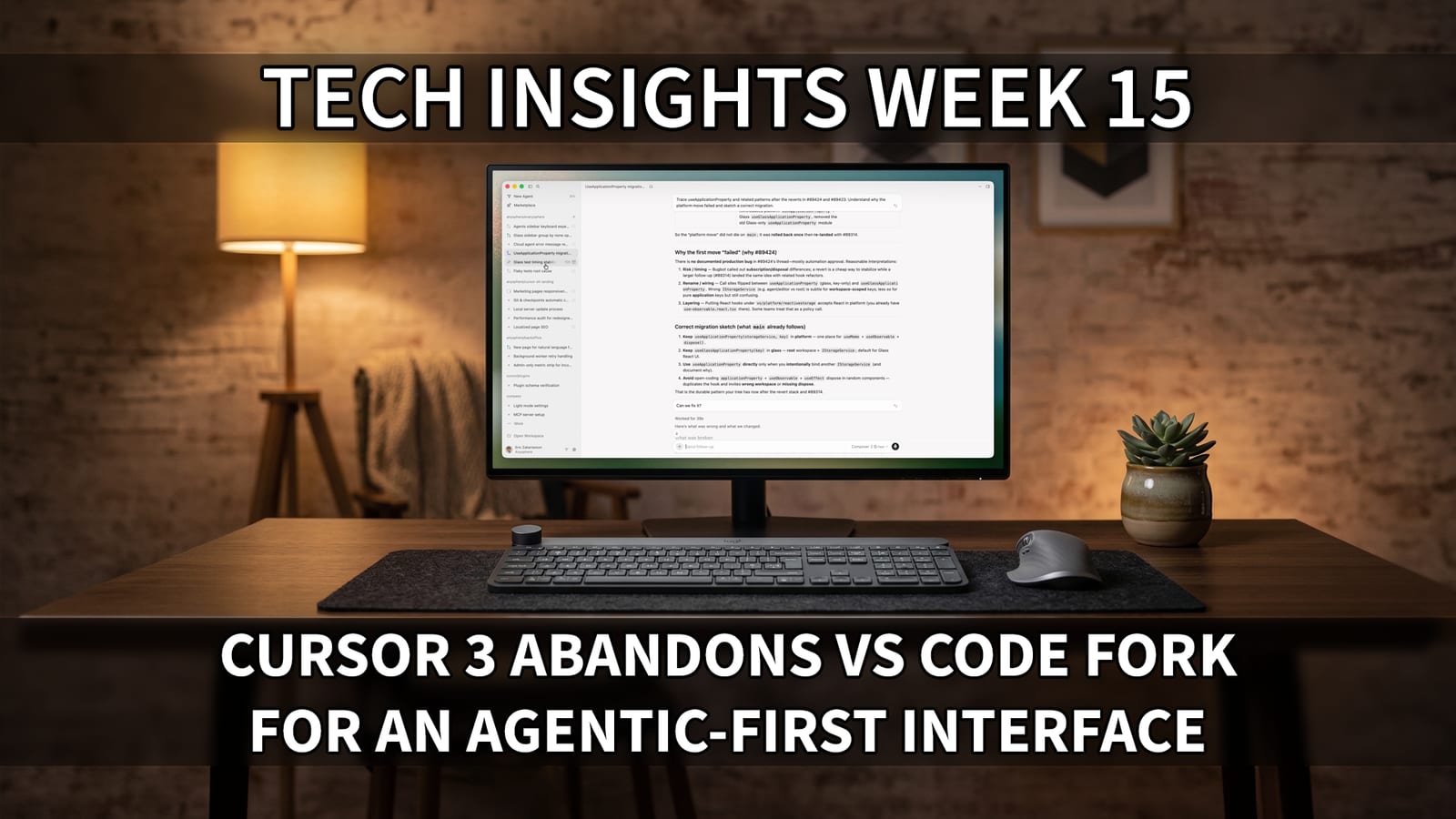
- Apr 6 Tech Insights 2026 Week 15 This is what I wrote in Tech Insights 2025 week 28 (July): "In 9-12 months I predict the models will be able to run autonomously for several hours, probably more, and will be able to produce much higher output quality than is possible…
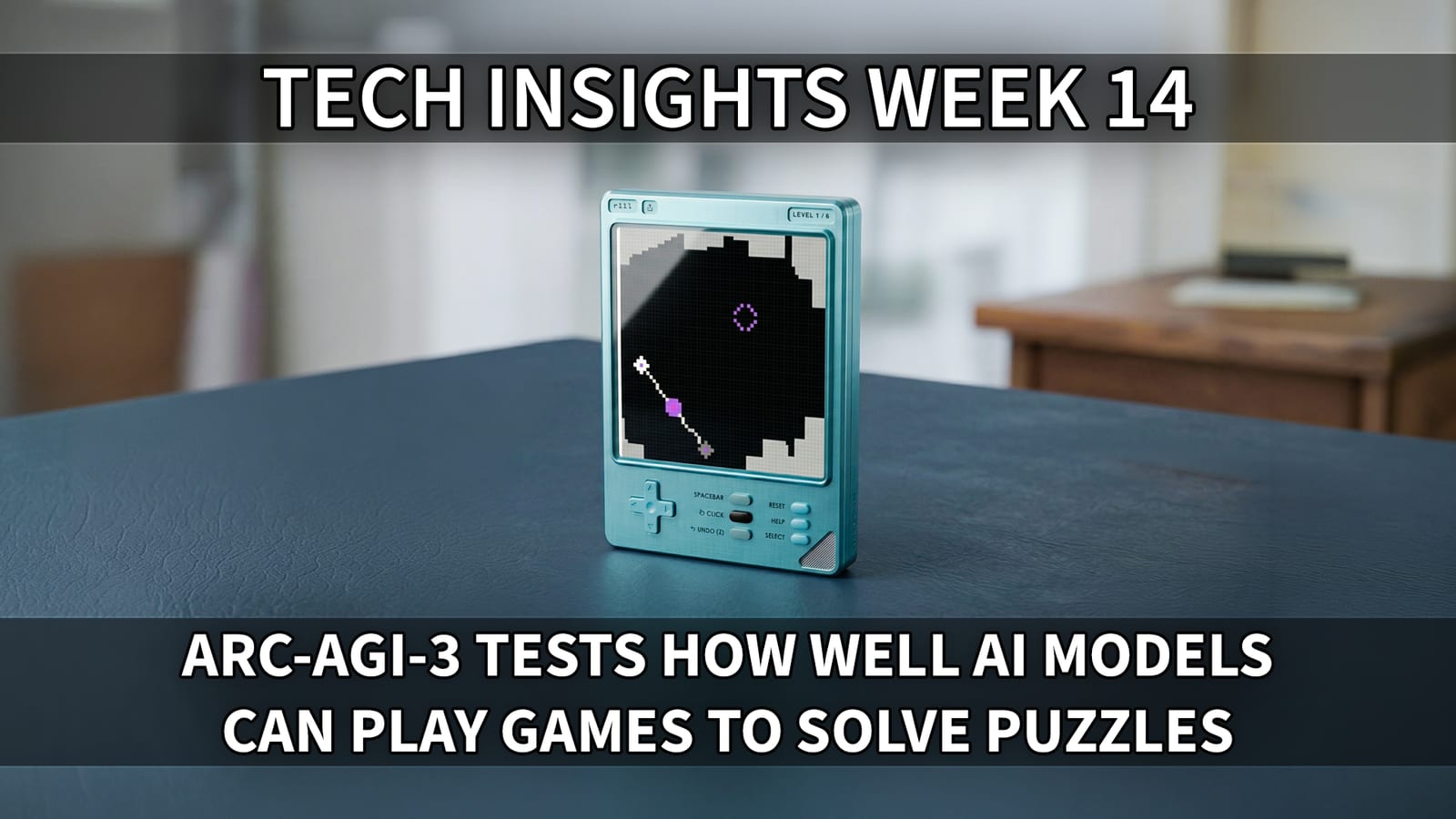
- Mar 30 Tech Insights 2026 Week 14 Last week Google launched what most LinkedIn experts and AI newsletters summarized as one of the biggest technical leaps in years. The Rundown AI wrote: "Google Research introduced TurboQuant, an algorithm that compresses AI model memory…
- Mar 23 Tech Insights 2026 Week 13 After nearly five years of development and over $80 billion of investments, Meta is closing down the Metaverse on June 15. Metaverse was a constant race for a technology that never arrived: no-one felt comfortable standing up for hours…
- Mar 16 Tech Insights 2026 Week 12 Things are moving fast now. Two months ago Anthropic launched a new feature called "Cowork", where Claude works autonomously within a sandbox environment on your computer with access to your files and various connectors. You choose the…
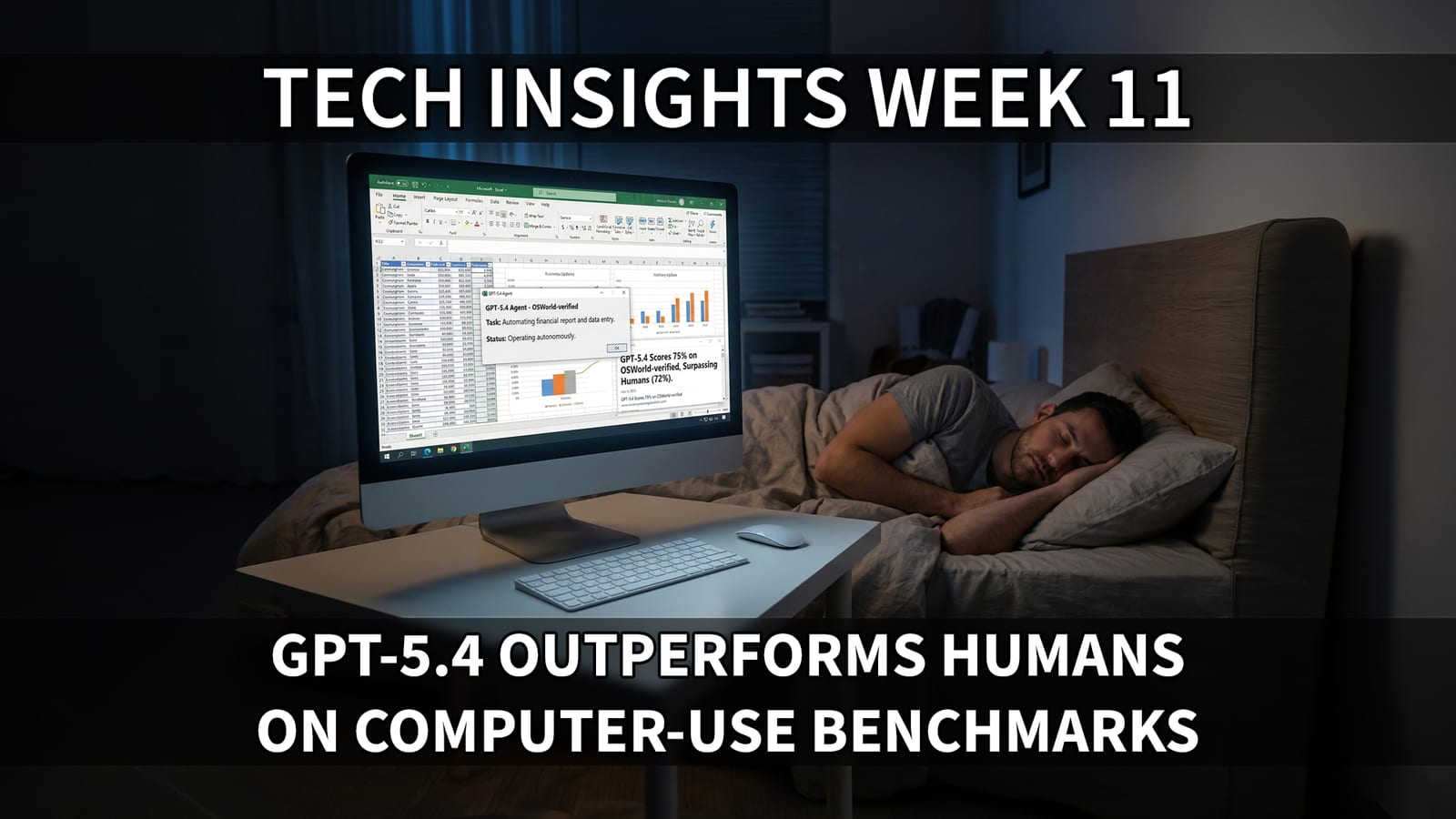
- Mar 9 Tech Insights 2026 Week 11 Last year in Tech Insights 2025 Week 30 I wrote: "In my last two seminars I got the question what main trend I see for AI in 2026, and to me it's easy: computer control. It's the natural next step, and once we get models specifically…
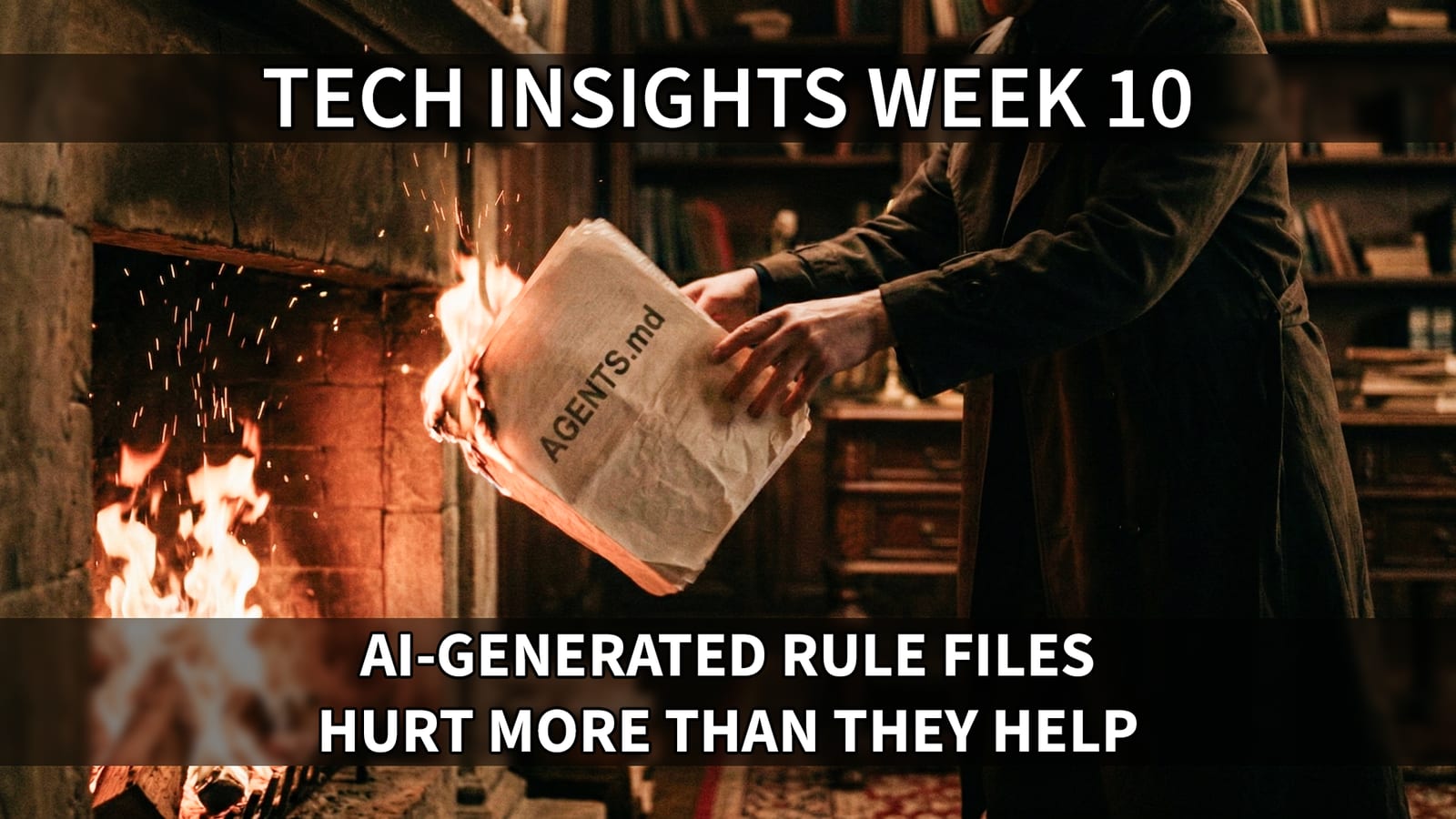
- Mar 2 Tech Insights 2026 Week 10 The main AI news of last week were the public announcements from Anthropic, OpenAI and the Department of War, where most people on social media seemed to summarize this as: 1. The Department of War (DoW) wants to use AI models for "all…
- Feb 23 Tech Insights 2026 Week 9 A year ago our top benchmark for measuring "smartness" in AI models, ARC-AGI, was becoming saturated. OpenAI o3 scored over 87% on the benchmark in a high-compute configuration, and it became clear we needed a new benchmark. A new…
- Feb 16 Tech Insights 2026 Week 8 The past two weeks you have probably read about the very popular AI agent "Clawdbot" that was later renamed to "OpenClaw". OpenClaw is a viral, open-source AI agent platform that runs locally on your computer, allowing it to control your…
- Feb 9 Tech Insights 2026 Week 7 If you ask the AI coding tool Claude Code to commit source code directly to GitHub, it will by default add itself as an author with the commit message: "Co-Authored-By: Claude Opus". Most people I work with do not trust Claude to commit…
- Feb 2 Tech Insights 2026 Week 6 "My name is Steve Chen. I was the CTO and one of the co-founders of YouTube. I love what you've built with Notebook Navigator 2.2! I wanted to send out a note of gratitude." Steve contacted me last Tuesday, and is just one of hundreds of…
- Jan 26 Tech Insights 2026 Week 5 Can you tell if a video is real or AI generated? Runway, the company behind the AI video model Gen-4.5 just did a test where they let 1,043 participants watch two five-second clips, where the first frame of the real video was used to…
- Jan 19 Tech Insights 2026 Week 4 Last week Anthropic launched a new feature called Cowork: "Give Claude access to a folder, set a task, and let it work". You can ask Claude to go through your receipts and give you a summary, sort your files, find a specific text in a…
- Jan 12 Tech Insights 2026 Week 3 In an interview with CNBC, AMD CEO Lisa Su said that she expects us to go from "a billion active users in AI today to over 5 billion active users over the next five years", requiring compute to increase 100 times to meet demand. This is…
- Jan 5 Tech Insights 2026 Week 2 If you had any doubt that AI is going to completely change programming as a profession, you just need to look at the graph below. It's a chart showing the number of new questions asked per month on Stack Overflow. The first month Stack…
- Dec 29 Tech Insights 2026 Week 1 A year ago on December 14 2024 Ilya Sutskever famously warned that the "age of pre-training" was nearing its end. He called training data the "fossil fuel" of AI, said we had reached "peak data", and reminded everyone that "there’s only…







2025
- Dec 22 Tech Insights 2025 Week 52 In 2017, the Merriam-Webster’s word of the year was "Feminism", in 2020 it was "Pandemic" and in 2021 it was "Vaccine". In 2025 the word of the year is "Slop". The modern definition of "Slop" is “digital content of low quality that is…
- Dec 15 Tech Insights 2025 Week 51 More JUICE! GPT-5.2 was launched last week, and this is the first model built with the new datacenters using the latest NVIDIA Blackwell chipsets. GPT-5.2 beats over 70% of human experts in office tasks in the GDPval benchmark, it…
- Dec 8 Tech Insights 2025 Week 50 In fall 2001 I got my first Apple computer, the Titanium PowerBook G4, and I have since then owned and used many Mac computers and PCs throughout the years. Even if I have not always felt aligned with the design decisions Apple were…
- Dec 1 Tech Insights 2025 Week 49 The past week I have had lots of fun creating complex drawings in the style of Jan Van Haasteren and in the style of Middle-earth travel guides with Google's latest image generation model Nano Banana Pro. This is the first time I have…
- Nov 24 Tech Insights 2025 Week 48 Last week Google finally launched their long-awaited model Gemini 3 Pro, together with the outstanding new Nano Banana Pro "image processor". I'm not even sure what I should call Nano Banana Pro, it can do things with images I didn't…
- Nov 17 Tech Insights 2025 Week 47 The past few months I have talked to several large companies with old legacy systems that need to be modernized. The question most of them have is: when can we start using AI to migrate all our old code into a modern Java or C# tech…
- Nov 10 Tech Insights 2025 Week 46 Last week was one of the lowest-activity AI weeks in a while, but I predict the activity will ramp up significantly in the next couple of weeks. Google is planning to release Gemini 3 Pro very soon which is looking to be a real powerhouse…
- Nov 3 Tech Insights 2025 Week 45 Last week Cursor, Cognition and Canva announced their own custom foundation models to reduce their dependencies of Anthropic, Google and OpenAI. Being dependent on other companies AI models to do their processing, the more features these…
- Oct 27 Tech Insights 2025 Week 44 Mico. This is one of the best names I have heard in a long time coming from Microsoft. After a series of mediocre names like Zune, Bing and Cortana, Mico, the name of the new Copilot avatar, is just brilliant. It's cute, it has a…
- Oct 20 Tech Insights 2025 Week 43 Are we in an AI bubble? In some ways I think we are. Every company that sells an AI-powered service needs to pay for API access to Anthropic, Google or OpenAI to deliver value. This includes companies like Cursor, Lovable, Microsoft, and…
- Oct 13 Tech Insights 2025 Week 42 Things were so much easier just six months ago! In April 2025 the comparison between Microsoft 365 Copilot and ChatGPT was easy. Two fairly simple chatbots that both used the GPT-4o model as their foundation. Many companies picked…
- Oct 6 Tech Insights 2025 Week 41 The biggest news last week was undoubtedly the launch of OpenAI Sora 2. You need an invite code to try it, but if you have it you're in for a world of fun. If you haven't already seen Sora 2 in action, do yourself a favor and spend 2…
- Sep 29 Tech Insights 2025 Week 40 Just how good are today's state-of-the-art AI models at doing normal office work? To test this, OpenAI just introduced GDPval, a new benchmark focusing on AI model performance on real work tasks, tested against professionals with 14 years…
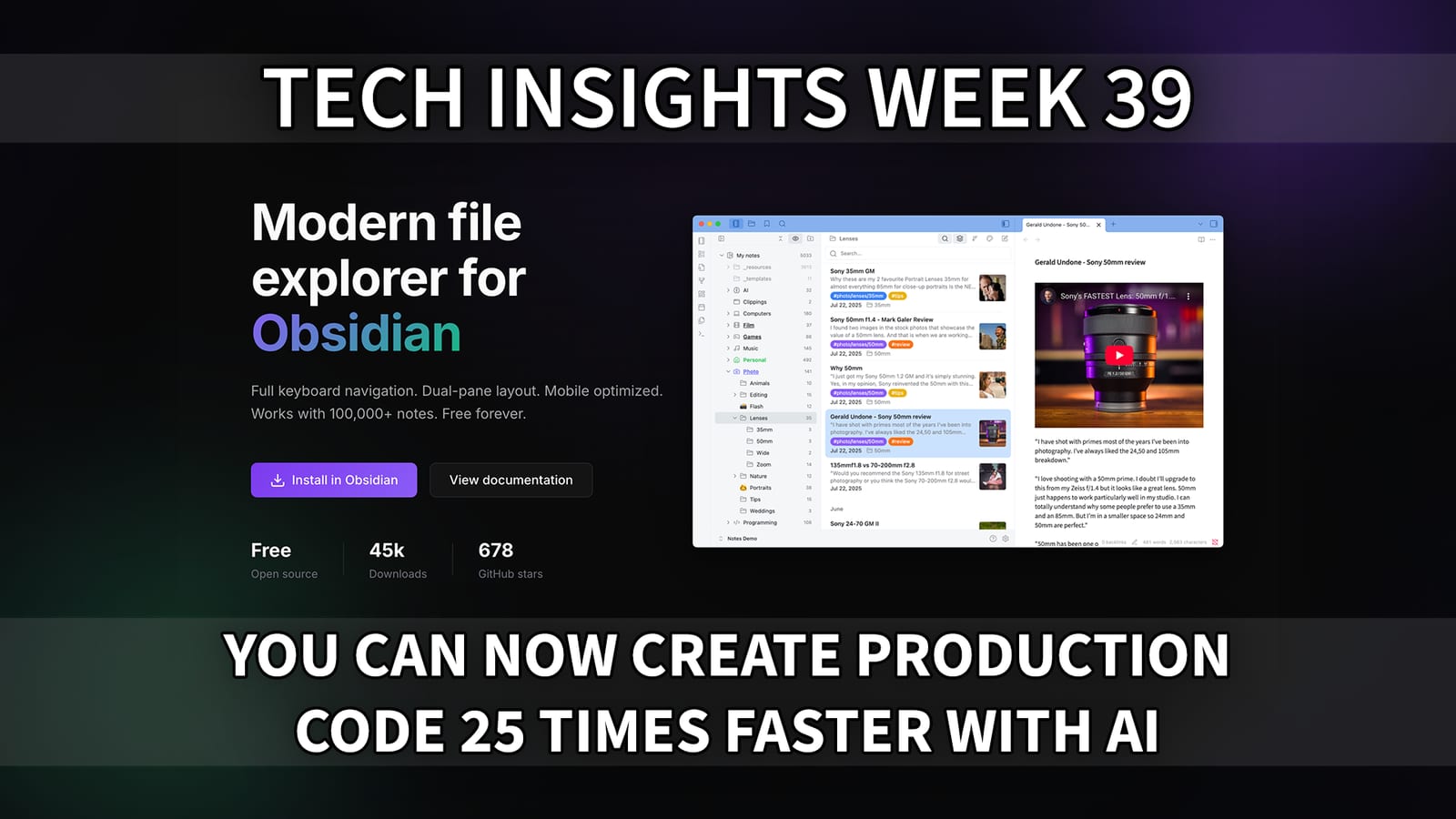
- Sep 22 Tech Insights 2025 Week 39 How many days would it take a full team to rebuild the entire application Apple Notes? And then add the best features from other note taking applications like Bear and Evernote to it, maybe also sprinkle it with dozens of new innovative…
- Sep 15 Tech Insights 2025 Week 38 On Friday last week, Anthropic posted a status message saying: "We've identified the root causes of the reported quality issues and deployed mitigations for each. A technical post-mortem will be published on our engineering blog next…
- Sep 8 Tech Insights 2025 Week 37 Hello and welcome to a new episode of Tech Insights! The past week was fairly low on news, the TLDR version of the week is that NotebookLM got four new audio formats, including the interesting new "debate" mode where each host picks a…
- Sep 1 Tech Insights 2025 Week 36 Aaron Levie, CEO at Box wrote this on X two days ago: > "We’re going to look back on the world that was pre-AI and be absolutely astonished by how slow everything was. Every week at Box as we got AI-first, we highlight a workflow where…
- Aug 25 Tech Insights 2025 Week 35 You have probably seen the headline by now: 95% of all Generative AI pilots are failing according to a new MIT NANDA report. Within minutes thousands of LinkedIn AI experts rushed to declare that the AI bubble is bursting and that we all…
- Aug 18 Tech Insights 2025 Week 34 Do you know what a vision backbone is in AI? The word backbone here refers to a feature extraction network that processes input data into meaningful feature representations, also called a feature extractor. Examples of vision backbones…
- Aug 11 Tech Insights 2025 Week 33 Last week OpenAI launched GPT-5, their new "system of models". Unlike GPT-4 and GPT-4o, GPT-5 is not a model but is instead a system with a smart router (OpenAI calls it the "autoswitcher") that will try to direct your message to the…
- Aug 4 Tech Insights 2025 Week 32 Last week OpenAI announced that they are generating over $1 billion per month with over 700 million weekly active users. AI will soon be used daily by everyone with an Internet connection, and while most of today's AI services can be used…
- Jul 28 Tech Insights 2025 Week 31 The gap between EU and US when it comes to AI development just reached a critical point. Last week the US launched its AI Action Plan, which outlines an "unapologetic strategy" that prioritizes speed, deregulation, and market dominance…
- Jul 21 Tech Insights 2025 Week 30 Always skate to where the puck is going! In one of my previous jobs we worked closely with coach Kevin Ryan, who previously worked eight years as the general manager of 08 Stockholm Human Rights (a Basketball Club). Kevin kept pushing the…
- Jul 14 Tech Insights 2025 Week 29 Last week Elon Musk and xAI finally launched Grok 4, their next generation model, and at the same time unveiled a $300-per-month AI subscription plan called SuperGrok Heavy. “With respect to academic questions, Grok 4 is better than PhD…
- Jul 7 Tech Insights 2025 Week 28 Last week Perplexity joined Anthropic, Cursor, Google and OpenAI in offering a $200 "Max" subscription. We are clearly entering the next level of subscription pricing, and I am quite confident this is only the beginning. The more complex…
- Jun 30 Tech Insights 2025 Week 27 This was truly a week of edge and offline models releases! First Google released the full version of Gemma 3n, a multimodal AI model designed to run on edge devices with as little as 2GB of RAM. This means you can run it on smartphones or…
- Jun 23 Tech Insights 2025 Week 26 Two weeks ago I wrote about my side-project with Claude Code. The project is now done, and it was built 100% with Agentic AI. It's an app called Notebook Navigator, and it combines the best of note-taking apps like Apple Notes, Bear,…
- Jun 16 Tech Insights 2025 Week 25 Should I require all my developers to start using AI? I often get that question. The answer is not a strict yes or no, but more "it depends". If you are using a code base built on Go, Typescript, Rust or Python then the answer is always…
- Jun 9 Tech Insights 2025 Week 24 I listen to a lot of audio books, and always keep a book playing when out for a walk or a run. The joy of finding an amazing narrator like Bill Homewood reading The Count of Monte Cristo by Alexander Dumas is one of many reasons I keep…
- Jun 2 Tech Insights 2025 Week 23 The past week I have been using Claude Code a lot, Anthropic's CLI-based code editor. I have used it on existing large code bases, and I have used it to create complex new applications. Claude Code with Claude Opus 4 is truly the…
- May 26 Tech Insights 2025 Week 22 Last week was one of the biggest so far just in terms of sheer volume of AI news. Google I/O was all about AI this year and Microsoft Build was very AI centric too. I have tried summarizing everything best I can below, but all in all it…
- May 19 Tech Insights 2025 Week 21 If you are developing software with AI, most of your prompts probably include "act like a senior developer". The reason is that the large foundation models we use for programming like o3 and Claude 3.7 are not specifically tuned for this…
- May 12 Tech Insights 2025 Week 20 In Sweden there are still AI consultancy companies strongly defending what they call "Mogen AI" ("Mature AI" in English) - traditional machine learning based on manual feature engineering. The argument is that it’s “good enough” and that…
- May 5 Tech Insights 2025 Week 19 Last month Shopify CEO Tobi Lütke sent out an internal memo saying that before employees ask for more headcount or resources, teams must first show why they “cannot get what they want done using AI". And last week it was Duolingo's turn,…
- Apr 28 Tech Insights 2025 Week 18 Last week Swedish startup company Lovable launched version 2.0 with a new feature called "multiplayer workspaces" where you can now vibe code apps together. Their motto is "idea to app in seconds, with your personal full stack engineer".…
- Apr 21 Tech Insights 2025 Week 17 Last week OpenAI launched five new models: GPT-4.1 (including mini and nano variants), o3 and o4-mini, together with a new command-line tool called Codex CLI. You now have six models to choose from in ChatGPT: GPT-4o, GPT-4o with…
- Apr 14 Tech Insights 2025 Week 16 Last week Meta launched their new Llama 4 models that scored amazingly well on benchmarks. Yann LeCun, Chief AI Scientist at Meta, wrote "BOOM! The Llama-4 brood is out", and Ahmad Al-Dahle, Head of GenAI at Meta, wrote "Llama 4 Behemoth…
- Apr 7 Tech Insights 2025 Week 15 Last week was one of the most important AI weeks this year for software developers. Microsoft rolled out their all-new Visual Studio Code and GitHub Copilot Pro with massive amounts of new features focused on autonomous AI-based agent…
- Mar 31 Tech Insights 2025 Week 14 Last week OpenAI updated their GPT-4o model with image creation capabilities. If you had previously used ChatGPT to create images using their model "DALL-E 3" you know it was quite a poor performer, so maybe you skipped this news due to…
- Mar 24 Tech Insights 2025 Week 13 The wildfires in Los Angeles this year are predicted to have cost over $250 billion, becoming one of the worst natural disasters in U.S. history. Current satellite systems like VIIRS and MODIS can detect fires quickly (within a few hours)…
- Mar 17 Tech Insights 2025 Week 12 Will you use Google Search in 2026 the same way you have been using it over the past two decades? I am quite sure the answer is no. I am a firm believer in agentic search, and I believe it will change everything about how we store and…
- Mar 10 Tech Insights 2025 Week 11 Most companies I speak with today are rolling out generative AI in two main areas: customer support and digitizing documents for AI access. When it comes to customer support we have finally reached the point where AI agents can now handle…
- Mar 3 Tech Insights 2025 Week 10 Last week OpenAI finally launched their successor of GPT-4o: GPT-4.5, and the entire Internet quickly became full of (mostly) disappointed old guys claiming AI-development has stalled. GPT-4.5 does not significantly improve performance in…
- Feb 24 Tech Insights 2025 Week 9 OpenAI just crossed 400 million weekly active users, which is close to 5% of the world's population. This means that they are growing at an astounding 50 million weekly active users per month, just 2 months ago OpenAI announced that they…
- Feb 17 Tech Insights 2025 Week 8 In the coming few weeks we should see a massive influx of new AI models being released. ChatGPT 4.5 is due in a few weeks, Grok 3 is to be released today (!) and is described as "scary smart" by Elon Musk, and Claude 4 is on it's way too.…
- Feb 10 Tech Insights 2025 Week 7 Let's say you need to identify products in a store using AI. Legacy methods rely on manually labeled training data, requiring months to adapt to new product packaging or layouts, while struggling with accuracy below 95% in cluttered,…
- Feb 3 Tech Insights 2025 Week 6 As many of you saw in my LinkedIn post last week - I have quit my job at RISE (Research Institutes of Sweden) and I am starting a new AI company. The first question most of you asked me was "What will happen with Tech Insights"? Tech…
- Jan 27 Tech Insights 2025 Week 5 Last week OpenAI finally released their computer-using agent Operator, and it is now possible to ask an AI to buy groceries, book restaurants, search LinkedIn and collect relevant information for your next newsletter. It's still a very…
- Jan 20 Tech Insights 2025 Week 4 A new month, and a new fascinating use case for Generative AI. This time it's Microsoft that last week launched MatterGen, a generative AI tool that can generate novel materials given prompts of the design requirements. Microsoft believes…
- Jan 13 Tech Insights 2025 Week 3 Wow, what a start of 2025! AI now outperforms experts in detecting both breast cancer and ovarian cancer, new lawsuit says Zuckerberg approved engineers at Meta to download pirated material over torrent and remove copyright information to…
- Jan 6 Tech Insights 2025 Week 2 If you have been investigating AI Agent Frameworks (such as Swarm, Phidata, LangGraph, Autogen, CrewAI, Vertex AI or Langflow) you now have a new option from Hugging Face called Smolagents. Smolagents is an extremely lightweight option…
- Dec 30 Tech Insights 2025 Week 1 Welcome to my final newsletter of 2024, closing the most exciting year in computing since we got our first mobile App Store in 2008. Much like the App Store (with 500 apps on launch) showed a clear vision of the future, so did 2024 with…
















2024
- Dec 23 Tech Insights 2024 Week 52 "There is no wall — inference compute continues to scale" said OpenAI after they announced o3 last Friday, which performs better than humans on one of the benchmarks for Artificial General Intelligence (AGI)! 🤯 The past week showed some…
- Dec 16 Tech Insights 2024 Week 51 Wow, this was the most feature-packed AI week of 2024 yet! Google made FIVE major AI launches paving the way for agentic AI, we got a new quantum computing chip Willow, and OpenAI finally released Sora and Advanced Voice Mode with Vision!…
- Dec 9 Tech Insights 2024 Week 50 "Browsing no longer needs to be a lonely experience". Microsoft just launched Copilot Vision that will keep you company while shopping, planning the weekend or playing computer games. Unsure if a sweater will look good on you? Just ask…
- Dec 2 Tech Insights 2024 Week 49 Last week Anthropic launched their Model Context Protocol (MCP), and Claude can now connect to any system in the world and do basically anything you can imagine. This goes way beyond the basic read-only app integrations OpenAI recently…
- Nov 25 Tech Insights 2024 Week 48 Last week OpenAI launched a major update to ChatGPT, and if you have one minute to spare go ahead and listen to the Eminem-style rap song below, written with the latest "Creative Update" of ChatGPT and rendered with the new Suno v4. This…
- Nov 18 Tech Insights 2024 Week 47 Imagine a future where you can have a single autonomous robot perform almost any type of surgery known to man. You could fly it out to developing countries or disaster zones, or use it to drastically shorten hospital queues. Researchers…
- Nov 11 Tech Insights 2024 Week 46 Do you apply to jobs on LinkedIn? Then it's time to buy Premium. Only Premium members can see if they are a Top Applicant, and only Top Applicants get prioritized by the new AI Hiring Assistant. Is there a risk that great talents are…
- Nov 4 Tech Insights 2024 Week 45 It finally happened, ChatGPT can now search the web and summarize the results for you. Suddenly all competing models such as Gemini and Claude will now appear "dumb", and I expect both Anthropic and Google to add search functionality to…
- Oct 28 Tech Insights 2024 Week 44 The greatest news last week was definitely Anthropic's Computer Use API, which allows their large language model Claude "to perceive and interact with computer interfaces". In practice Claude can, if you allow it, move your mouse cursor,…
- Oct 21 Tech Insights 2024 Week 43 A recent study by Goldman Sachs revealed that energy demand from data centers in the U.S. is expected to triple between 2023 and 2030 and will require an additional 47 GW of energy. To meet these demands, Amazon and Google announced last…
- Oct 14 Tech Insights 2024 Week 42 In 2019 Elon Musk said "I think we will have fully self-driving cars this year". In 2020 it was still "level five autonomy this year". In 2021 it was "this year" and in 2022 it was "we’ll achieve full self-driving this year". And last…
- Oct 7 Tech Insights 2024 Week 41 Last week OpenAI secured over $10 Billion, promising over $100 Billion in profit by 2029 which is roughly what Nestlé and Target makes each year. To reach those figures in five years OpenAI needs to provide something people value equally…
- Sep 30 Tech Insights 2024 Week 40 Wow this was a crazy week! Meta presented their $10,000 AR glasses as a result from spending over $46 billion on the Metaverse since 2019, OpenAI finally rolled out Advanced Voice Mode, and Duolingo introduced numerous AI powered…
- Sep 23 Tech Insights 2024 Week 39 If you live outside the EU and UK, everything you have ever written and posted to LinkedIn has now been used by LinkedIn and their affiliate partners to train new AI models, and there is nothing you could have done to prevent this. Last…
- Sep 16 Tech Insights 2024 Week 38 Welcome to another episode of Tech Insights Weekly by Johan Sanneblad, Director of Human-centered AI at Swedish Research Institute RISE. Thanks to Google Audio Overviews, you can now listen to this weekly newsletter as a podcast! If you…
- Sep 9 Tech Insights 2024 Week 37 On December 11, 2020, Pfizer announced their first vaccine for SARS-CoV-2. The vaccine had been developed in less than a year, setting a new standard for vaccine development where vaccines under "normal" circumstances can take up to 10-15…
- Sep 2 Tech Insights 2024 Week 36 It has finally happened! We are now at the point where a large language model can generate code that is of such high quality that it is no longer beneficial to write the code yourself, no matter how good your skills are. I have written…
- Aug 26 Tech Insights 2024 Week 35 Wow, what a crazy AI week it has been! Among the top news are OpenAI who just announced free (!) fine-tuning of GPT-4o until September 23, Ideogram 2.0 image generator with amazing text rendering, Meshy-4 the amazing image-to-3D model…
- Aug 19 Tech Insights 2024 Week 34 Four years ago on August 13, 2020, Epic Games released a hotfix for their popular game Fortnite on Android and iOS. The "hotfix" enabled a new purchasing options for VBUCKS (the in-game currency) that bypassed Google Play and App Store,…
- Aug 12 Tech Insights 2024 Week 33 Would you trust a robot to fix your dental issues? Maybe I am the minority, but I would definitely try it, especially if it could significantly reduce the time you need to sit still in that chair while someone is drilling in your mouth.…
- Aug 5 Tech Insights 2024 Week 32 In a report released by the White House on July 30, it was declared that open source AI models will not be subject for future regulations. This is probably one of many reasons companies like Apple, Google and Meta have chosen to release…
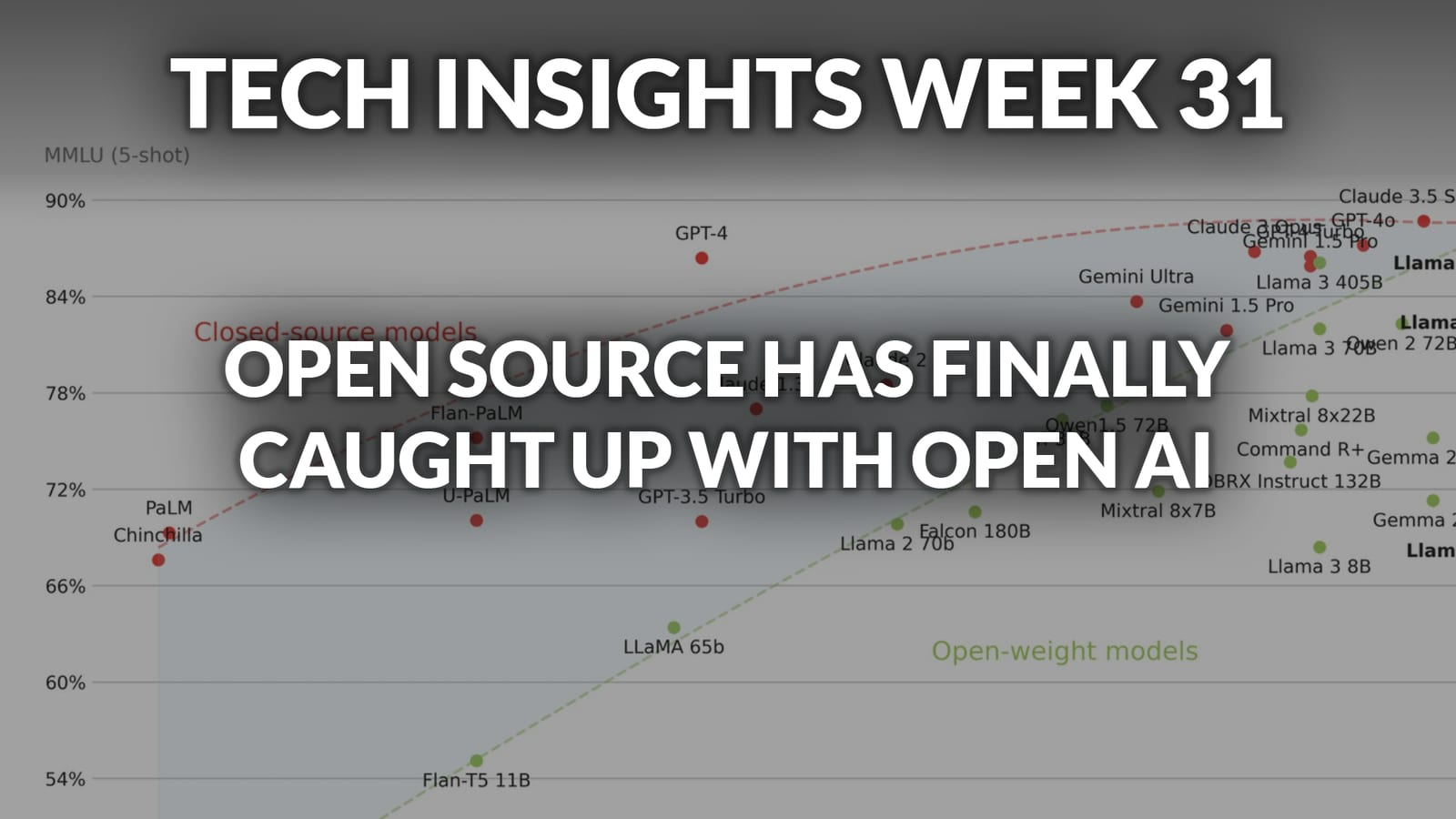
- Jul 29 Tech Insights 2024 Week 31 What an AI week it has been! OpenAI announced SearchGPT, Meta released Llama 3.1 and Mistral launched Large 2! Open Source has definitely caught up with closed source, and it is interesting to see how all current models seem to perform…
- Jul 22 Tech Insights 2024 Week 30 If you are living in the EU and have looked forward to Meta’s upcoming multimodal LLM, they just released news that it will not be available for European companies and researchers due to “the unpredictable nature of the European…
- Jul 15 Tech Insights 2024 Week 29 It's the middle of the summer but there are still lots of tech news coming! This week Samsung and Oura launched new AI health services, and Apple announced they are enabling third-party NFC payments within the EU. This means you can…