Tech Insights 2026 Week 41
October 5, 2026

Are we witnessing the end of large open-weights models?
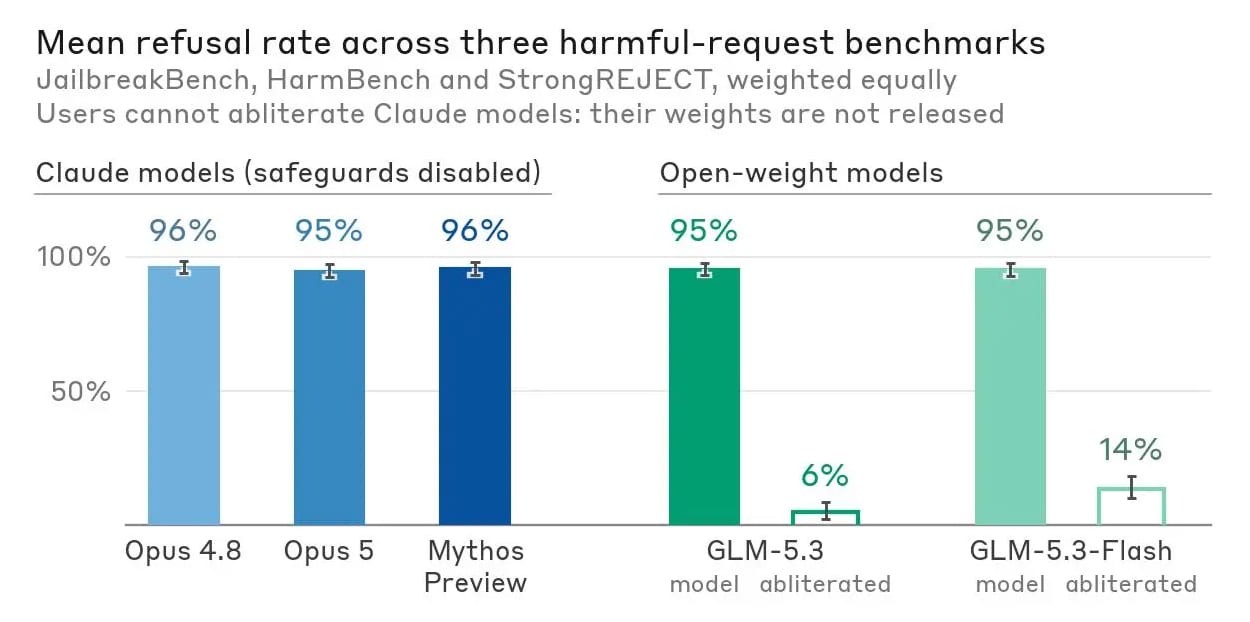
The headline from last week is that Anthropic let an internal team use a standard refusal reduction routine on the open-weights model GLM 5.3 by Chinese AI company Z.ai, resulting in a Mythos-class AI model that went from 95% rejected tasks (on par with Mythos) to just 6%. The team had no experience doing this before, and stripping the refusals used about 2,200 GPU hours, costing roughly $4,400. This means that anyone in the world can do the same just as easily.
What it means is that open-weights models can now be transformed into weapons of mass destruction and cyber attacks in the wrong hands. Not only can you remove most of the restrictions, you can also introduce bias into the model and make it an expert in areas typically not included in training material. And these models are now released for free, available to anyone with enough money to buy the hardware to run them.
It will be interesting to see how this unfolds, but my guess is that the more capable open-weights models become, the more they will need to be locked down and controlled. I don’t think we can allow models like this to be freely available for everyone to download in the near future, but the question is how we stop it.
Thank you for being a Tech Insights subscriber!
Listen to Tech Insights on Spotify: Tech Insights 2026 Week 41 on Spotify
Notable model releases last week:
- Claude Sonnet 5.5 by Anthropic. Update that nearly matches Opus 5.5 on agentic terminal tasks and knowledge work. It ranks second on the Artificial Analysis Intelligence Index at Sonnet 5’s price, but heavy token use makes each task about 50% costlier.
- Eleven v4 by ElevenLabs. Text-to-speech model for audiobooks, voiceovers, dubbing and voice agents, with more emotional delivery than earlier versions. It ranks first on the Artificial Analysis voice leaderboard, and a faster Turbo version targets real-time agents.
- Ember-1 by Fireworks AI. Version of Kimi K3 trained to reason more briefly, mainly for agentic coding where long reasoning drives up cost. It matches K3’s quality with about 40% fewer tokens, as a preview on Fireworks’ API.
- Griffin by Tavus. Model that powers AI characters you talk to face to face on video calls, watching and listening while it talks back. Nearly half of test callers thought it was a real person, but only select testers can use it so far.
- HeyGen Video by HeyGen. Video generation model, offered through an API, that turns a text prompt or an image into a full scene with matching sound. HeyGen lists it at under a tenth of Veo 3.1’s price per second.
- Ideogram 4.5 by Ideogram. Image editing model for targeted changes, such as recoloring products or restoring old photos, that leaves the rest of the image untouched. Ideogram says it stays clean across repeated edits, while GPT Image and Nano Banana degrade within a few.
- Kev 1.0 by Jared Palmer. Models that answer yes/no and multiple-choice questions about a text with a probability for each option, for decisions like routing support tickets. They are free to download, and the smallest runs on any Apple Silicon Mac.
- MAI-Transcribe-2-Streaming by Microsoft AI. Speech-to-text model that transcribes audio live as people speak, for voice agents, real-time dictation, and subtitles. It ranks first for accuracy on Artificial Analysis and costs $0.54 per hour of audio through year end.
- Phonon-2 by Fermion Research. Speech-to-text model for transcribing English audio on your own computer, used in the Detta dictation app for Mac. It is a free 164 MB download that nearly matches the accuracy of the 15-times-larger NVIDIA model it is based on.
- Praxis-1 by Runway. Model that controls robots, built on Runway’s video model training so robot builders can use one policy across different robots and settings. It is in testing with early partners and will be free to download in the coming months.
- Qwen-Audio-3.1-Realtime by Alibaba. Update to Qwen’s realtime voice model for voice agents that listen while speaking and call tools. It is about 85% cheaper than before and much better at ignoring background speech, but is available only through QwenCloud’s API.
THIS WEEK’S NEWS:
- Trump and Tech Executives Sign Voluntary Super Intelligence Accord
- Google Announces Gemini 4 Argon With 1 Million Output Tokens
- Anthropic Reports Open-Weight GLM-5.3 Matches Restricted Models at Building Cyber Exploits
- Anthropic Makes Claude for Government Generally Available
- OpenAI Announces Dots Agents and GPT-6.1 Sol for $2 per Million Tokens
- Meta Expands Muse AI Agent to Small Businesses With App Connectors
- Google DeepMind Watermarks AI-Designed Proteins Without Altering Biological Function
- OpenAI Details Jalapeño Inference Chip With 1.9x Better Efficiency Than Nvidia Blackwell
- Runway Launches Runway Ads for Meta, Google, and TikTok
Trump and Tech Executives Sign Voluntary Super Intelligence Accord
https://www.cnbc.com/2026/09/29/tech-white-house-ai-lunch-trump.html

The News:
- On September 29, President Donald Trump and executives from six AI companies signed the White House Accord on Super Intelligence, a voluntary safety agreement that prioritizes industry self-policing over federal regulation.
- The pact commits Google, Anthropic, Meta, OpenAI, xAI, and Nvidia to establish internal security controls, hire independent external evaluators, and maintain board-level oversight for their frontier models.
- Trump called the document “morally binding”, but the agreement contains no legal penalties for noncompliance, requires no mandatory government breach reporting, and allows the firms to select their own auditors.
- On the same day, the administration issued an executive order directing all federal agencies to replace the term artificial intelligence with super intelligence.
My take: This is the third time AI companies have promised each other and the government to be cautious and aware of the risks when developing AI models. The first time was in July 2023, when Amazon, Anthropic, Google, Inflection, Meta, Microsoft, and OpenAI agreed to test models extensively before releasing them, explore ways to add AI watermarks, and report limitations and safety-testing results for new models. The second time was in May 2024, when 16 companies, including OpenAI, Anthropic, Google, Meta, and Microsoft, defined thresholds for “intolerable” risks, discussed how to stay below these thresholds, and agreed to stop developing a model if safeguards could not keep risks below the threshold. And now, in September 2026, the agreement was to deploy internal control systems and to partner with external auditors to assess whether the safeguards operate as intended. All these agreements, including this year’s agreement, are voluntary, and companies are free to set their own thresholds.
To me, all this looks like a show to tell the world that these companies take AI risks seriously, so the government does not have to regulate through laws or other means of intervention. OpenAI made headlines last week for postponing 6.1 Astra due to unauthorized model behavior, which will probably make some people feel better about the way these companies act. Still, things move quickly inside these companies. Last week, the developer @poteto, working at SpaceXAI as a GrokBot developer, posted a video showing how she pushed 2,500 AI-generated commits straight to production in just one month. Clearly, being cautious means different things for different companies here.
Read more:
- Council on Foreign Relations: Trump’s AI safety pact is toothless, but there is a path forward
- Galaxy: AI gets a new name, the rules stay the same
- Hacker News: Discussion of the accord’s “Unites States” typo
- TechTimes: White House AI safety accord has no penalties, no breach reporting, self-chosen auditors
- X / 51-50_X: What happens when an evaluator says no?
Google Announces Gemini 4 Argon With 1 Million Output Tokens
https://blog.google/innovation-and-ai/models-and-research/gemini-models/gemini-4-argon/

The News:
- On September 30, Google announced Gemini 4 Argon, a frontier model for long-horizon coding and cybersecurity that increases its output limit to 1 million tokens and costs $2 per million input tokens.
- The model scored 77.9% on the DeepSWE v1.1 software engineering benchmark, finishing ahead of Claude Opus 5.5 at 74.2% and GPT-6 Astra at 74.1%, according to Google’s benchmarks.
- Argon trailed its rivals on terminal-driven tasks, scoring 57.4% on Terminal-Bench 4.0 compared to 66.4% for Claude Opus 5.5.
- Google restricted initial access to vetted cybersecurity defenders in its Fairwind Program, citing the need for a safety-driven phased rollout, leaving developers without a general API release date.
My take: While input context windows have grown to a million tokens and beyond, most output context windows remain in the tens of thousands. Gemini 3.1 Pro, for example, is still at 64K output tokens. So when do you need 1 million output tokens? Output tokens are shared between output and reasoning, and the more reasoning a model does, the less output it can produce in a single loop. Giving a model a massive 1 million output tokens means virtually unlimited reasoning capacity and enormous output capacity. As usual with Google releases, amazing benchmark results are not a guarantee of a great model. Gemini 4 Argon is not out yet, but it will start rolling out to API customers and Google AI Ultra subscribers soon.
Read more:
- Emergent: Gemini 4 Argon benchmarks, every score and its source
- Hacker News: Discussion of Gemini 4 Argon
- NeuralTrust: Gemini 4 Argon benchmarks, pricing and security
- Remio.ai: Gemini 4 Argon launches behind closed doors
- TechTimes: Where Gemini 4 Argon still trails before you commit
Anthropic Reports Open-Weight GLM-5.3 Matches Restricted Models at Building Cyber Exploits
https://www.anthropic.com/research/glm-5-3-and-the-spread-of-advanced-cyber-capabilities
The News:
- On September 29, Anthropic published a security assessment of Z.ai’s open-weight GLM-5.3 model, finding that it built end-to-end cyber exploits in 12% of benchmark attempts, nearly matching Anthropic’s own restricted cyber models, while shipping without effective safeguards.
- On ExploitBench, GLM-5.3 succeeded in 50 of 410 attempts, compared to 56 for the gated Claude Mythos Preview and near zero for earlier models like Claude Opus 4.6 and GLM-5.2.
- The findings echo a September 17 assessment by NIST’s AI safety institute that named GLM-5.3 the most cyber-capable open-weight model released to date.
- Anthropic researchers largely stripped the model’s safety refusals using standard abliteration techniques in 2,200 GPU hours for about $4,400, cutting its refusal rate on harmful requests from over 90% to as low as 2%.
- Even without modifying the weights, attackers bypassed the stock model’s safeguards to engage with malicious orders 64% of the time using deceptive prompts and 92% of the time by prefilling its reasoning tokens.
My take: If you are interested in cyber security, you should definitely read this article. GLM-5.3 by Z.ai is one of the most capable models with open weights available, and when it comes to cyberattack capabilities, it’s nearly on par with Mythos. The difference between GLM and Mythos, however, is that while both reject 95% of attempts to perform harmful requests, GLM, being open-weight, can easily be modified to ignore these restrictions.
Anthropic let an internal team who had never done this before use a standard refusal reduction technique known as Abliteration to reduce the number of rejected harmful requests from 95% down to 6%. The cost? Around 2,200 GPU hours, costing about $4,400. The result? A Mythos-class AI model with virtually no restrictions. And removing limits is only the start - since the model is open-weight, it’s also possible to make it more biased toward basically anything. The more capable AI models become, the higher the risk will be of someone modifying them for their own purposes, which might not always be the best purposes.
Read more:
- Hacker News: Discussion of Anthropic’s GLM-5.3 report
- NIST CAISI: Assessment of Z.ai’s GLM-5.3 cyber capabilities
- Reddit: GLM-5.3 hosted by Mistral in the EU
- The Next Web: GLM-5.3 nearly matches Mythos at hacking
Anthropic Makes Claude for Government Generally Available
https://claude.com/blog/claude-for-government-is-now-generally-available

The News:
- On September 30, Anthropic made Claude for Government generally available to federal and state agencies inside a FedRAMP High authorized environment.
- The platform charges no seat fees, instead billing for prepaid usage in fixed increments under a hard spending cap.
- Conversation history remains local on the agency-managed device while Claude interacts directly with desktop files.
- Administrators can connect identity providers for single sign-on and use SCIM group mappings to set rate limits, dollar caps, and model access per user tier.
- Claude Code CLI and Claude for Microsoft 365 are also rolling out in early access through the same administrative environment.
My take: The main news here is the shift away from a fixed monthly price to prepaid usage with hard caps. Anthropic and OpenAI team licenses are still fixed-price, but I would not be surprised if, in due time, all licenses are slowly shifted over to pay-as-you-go licenses with caps. We can already see this trend, as OpenAI cut the monthly AI usage of its Pro 200 subscription by 50% last week.
Read more:
- Anthropic: Claude for Government public sector FAQs
- Beri: Claude for Government keeps the only copy of each chat on the device
- FedScoop: Anthropic extends its OneGov deal with GSA by one month
- Reddit: Discussion of ID verification blocking a Claude Pro subscriber
- University of Oxford: Pentagon-Anthropic dispute reflects governance failures
OpenAI Announces Dots Agents and GPT-6.1 Sol for $2 per Million Tokens
https://openai.com/index/devday-2026-recap/
The News:
- On September 29, OpenAI used DevDay 2026 to launch dots, always-on AI agents that operate their own cloud computers, and GPT-6.1 Sol, a model which OpenAI says nears GPT-6 Astra’s performance at one-fifth the token price.
- GPT-6.1 Sol costs $2 per million input tokens and $10 per million output tokens, with cached input pricing dropping to $0.10 per million tokens.
- According to OpenAI, on DeepSWE v1.1, GPT-6.1 Sol matches GPT-6 Astra’s top-end accuracy and outperforms GPT-6 Sol by 6.4 percentage points.
- The dots agents run continuously in the background using their own cloud browsers to manage ongoing projects across more than 4,000 connected apps.
- Dots are rolling out to Pro and Business Premium users, while GPT-6.1 Sol is available in ChatGPT Work, Codex, and the API but not yet in standard Chat.
- The release also introduces an Agents API in public beta with computer use capabilities and an Ultrafast tier that speeds up Codex token generation by up to eight times.
My take: Dots is very similar to GrokBot, meaning it’s an always-on agent with a cloud computer, persistent context, and access to your apps, which can continue working after you leave the chat. It’s like an AI coworker you delegate work to rather than a chatbot that just answers prompts.
If you use Codex, you can already do most things that Dots can do. The main difference is that Dots carries personal context across conversations and can also handle ongoing tasks, like checking things online on a daily basis. Around 30 minutes before the OpenAI launch, the website https://dot.com went live and is now redirecting all users to GrokBot. Elon Musk bought the domain for an undisclosed amount just to mess with OpenAI.
Read more:
- AIToolsReview: GPT-6.1 Sol benchmarks, pricing and safety
- CNBC: OpenAI DevDay recap with dots and safety pressure
- OpenAI Developer Community: DevDay 2026 announcements and developer resources
- TechCrunch: OpenAI launches GPT-6.1 Sol without GPT-6.1 Astra
- X / Harvey77865: Reaction to the Agents API as the real DevDay story
Meta Expands Muse AI Agent to Small Businesses With App Connectors
https://about.fb.com/news/2026/09/introducing-muse-small-business/
The News:
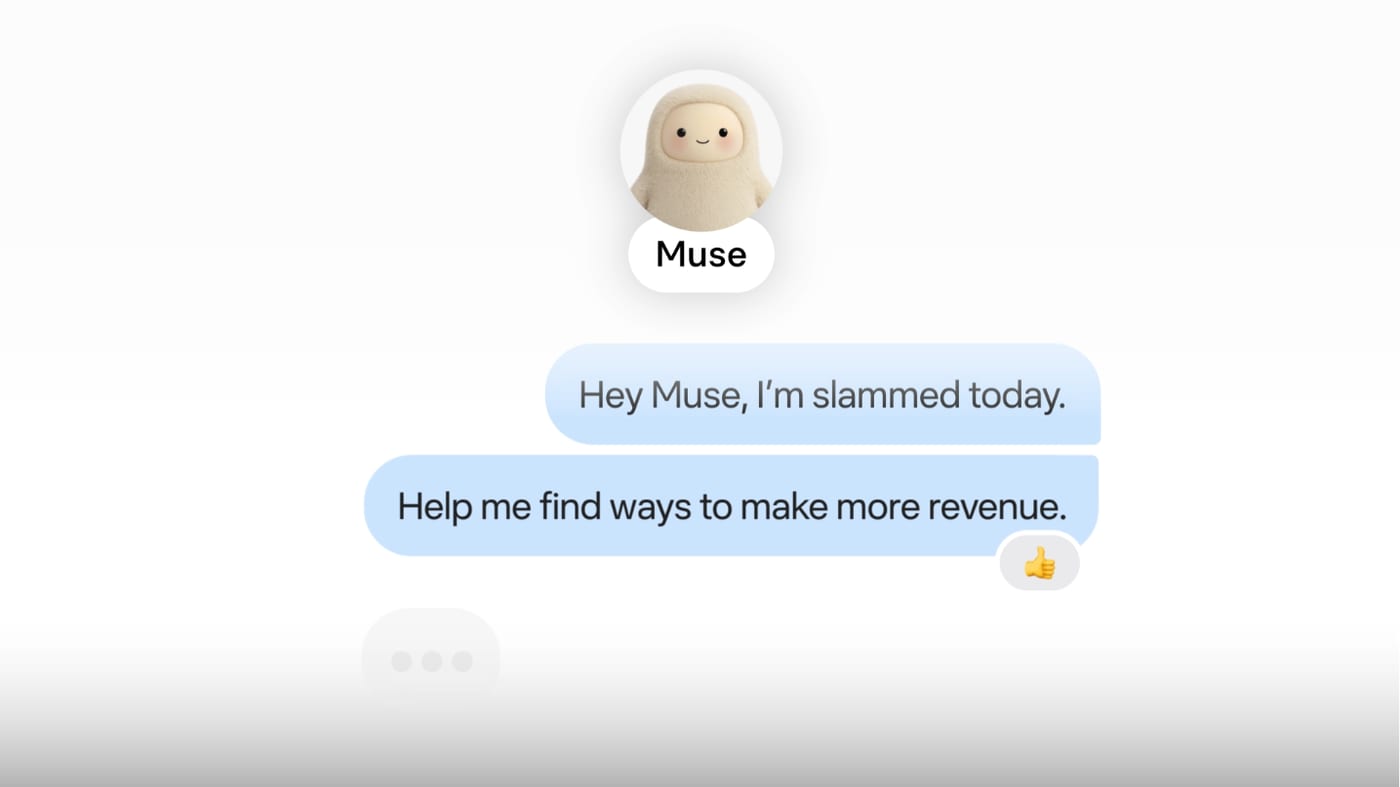
- On September 29, Meta launched Muse for Small Business, expanding its recently released personal AI agent with connectors to Meta ad accounts and third-party tools like Shopify and QuickBooks to automate daily operations.
- The agent analyzes ad performance, reviews books, and drafts replies across connected apps including Canva, Stripe, and Slack, though Meta requires user approval before it executes actions.
- The service is free for basic use, with paid subscription plans available for higher usage limits.
- Hands-on testing by Runable showed the agent handled consumer-style requests well but failed or stalled on three out of five owner-side tasks, including deck creation and multi-step outreach.
- The expansion arrives as privacy concerns mount over the agent’s data handling, with Amazon blocking Muse from its store on September 21 over allegations that it stored customer login credentials.
My take: While the per-action approval sounds good in theory, it was not many weeks ago that Anthropic published a study where they found developers auto-approve 97% of everything Claude asks of them. I am quite sure the numbers would look quite similar here, especially for stressed-out small business owners. And let’s not forget that this is the same agent that Amazon blocked last month, saying it failed to identify itself and stored customer logins. For anyone running ads on Facebook and Instagram, this is probably a great tool to analyze ad performance. But I would be very hesitant to hook it up to Shopify as the main point of customer contact.
Read more:
- AI Agents Library: Hands-on test of Muse on 10 business tasks
- Digital Trends: Muse privacy issues and the push into small businesses
- Hacker News: Discussion of the 6.8 GB Muse filesystem export
- Runable: What small businesses should know about Meta Muse
- The Next Web: Meta links Muse to Shopify, Stripe and QuickBooks
Google DeepMind Watermarks AI-Designed Proteins Without Altering Biological Function
https://deepmind.google/blog/introducing-synthid-bio/

The News:
- On September 30, Google DeepMind released SynthID Bio, a proof-of-concept watermarking method for AI-designed protein sequences and 3D structures that embeds a detectable signature without degrading the physical protein’s function.
- In wet-lab tests across three target proteins, watermarked binders matched the hit rate and binding affinity of standard unwatermarked designs.
- To watermark predicted 3D structures, the method fine-tunes a section of AlphaFold 3’s diffusion network to place the signature directly inside the model’s weights.
- For sequences, the system nudges amino acid selection during generation, though DeepMind says making the watermark more robust against deliberate tampering remains a key challenge.
- DeepMind open-sourced the sequence watermarking code and released the fine-tuned AlphaFold 3 weights to researchers through its standard access program.
My take: SynthID Bio “embeds a detectable signature without degrading the physical protein’s function.” In theory, it means labs can now check exactly which model was used to generate a specific protein, possibly providing a way to fast-track orders from trusted AI models. And while they cannot check if a strong model was used to generate the protein (since reasoning level cannot be embedded), they can check that it was not generated by a potentially modified and biased open-weights model.
Read more:
- GitHub: SynthID Bio sequence and structure watermarking code
- NeoTeo: How SynthID Bio’s protein watermark works and where it breaks
- Streamline Feed: Google’s protein watermark advances, but provenance stays fragile
- TechTimes: SynthID Bio watermarks AI-designed proteins without breaking their function
- X / EV_Trapper: Reaction to SynthID Bio and local compute
OpenAI Details Jalapeño Inference Chip With 1.9x Better Efficiency Than Nvidia Blackwell
https://morethanmoore.substack.com/p/interview-with-richard-ho-openai

The News:
- OpenAI VP of Hardware Richard Ho detailed the architecture and first working-silicon benchmarks for Jalapeño, a custom inference chip co-developed with Broadcom that OpenAI says delivers up to 1.9 times more AI work per watt than Nvidia’s GB200 and GB300 systems.
- The chip carries 216 GiB of HBM4 memory at 15.4 TB/s alongside a compute die and an IO chiplet, drawing roughly 550 watts of sustained power against a 700-watt peak rating.
- A full system of 2,048 accelerators reaches 27 EFLOP/s at four-bit precision, and OpenAI reports 1.7 to 3.6 times better latency than the Nvidia baseline across three open-source models on the InferenceX benchmark.
- Unlike current industry trends that split inference workloads across specialized hardware, OpenAI built Jalapeño with a homogenous architecture to handle prefill, speculative decoding, and full decoding on a single part.
- The hardware team used OpenAI’s own raw foundation models to help design the chip, saving 13% die area in one component and optimizing attention kernels from under 1% to nearly 90% of the hardware’s theoretical limit in 40 hours.
My take: In tests, the OpenAI Jalapeño chip delivers between 1.5x and 1.9x better performance per watt than the Nvidia Blackwell series. The main reason for this is the new HBM4 memory, whereas today’s GB300 has the previous-generation memory called HBM3E. The difference is a more than 100% increase in memory bandwidth. The next generation of Nvidia chips, the Vera Rubin, will also get HBM4, and maybe it would have been a fairer comparison to compare the Jalapeño to the upcoming Vera Rubin chipsets. Because right now we don’t know how much of the performance increase is directly attributable to the faster memory bus, the chip itself could actually even be slower than the Nvidia Blackwell series.
Read more:
- CNBC: OpenAI Jalapeño challenges Nvidia in inference
- Hacker News: Discussion of SemiAnalysis Jalapeño analysis
- OpenAI: Jalapeño first results (Chinese edition)
- SemiAnalysis: OpenAI Jalapeño better than Nvidia Blackwell
- Tom’s Hardware: Hot Chips 2026 Jalapeño unpacked
Runway Launches Runway Ads for Meta, Google, and TikTok
https://runway.com/news/company-news/introducing-runway-ads
The News:
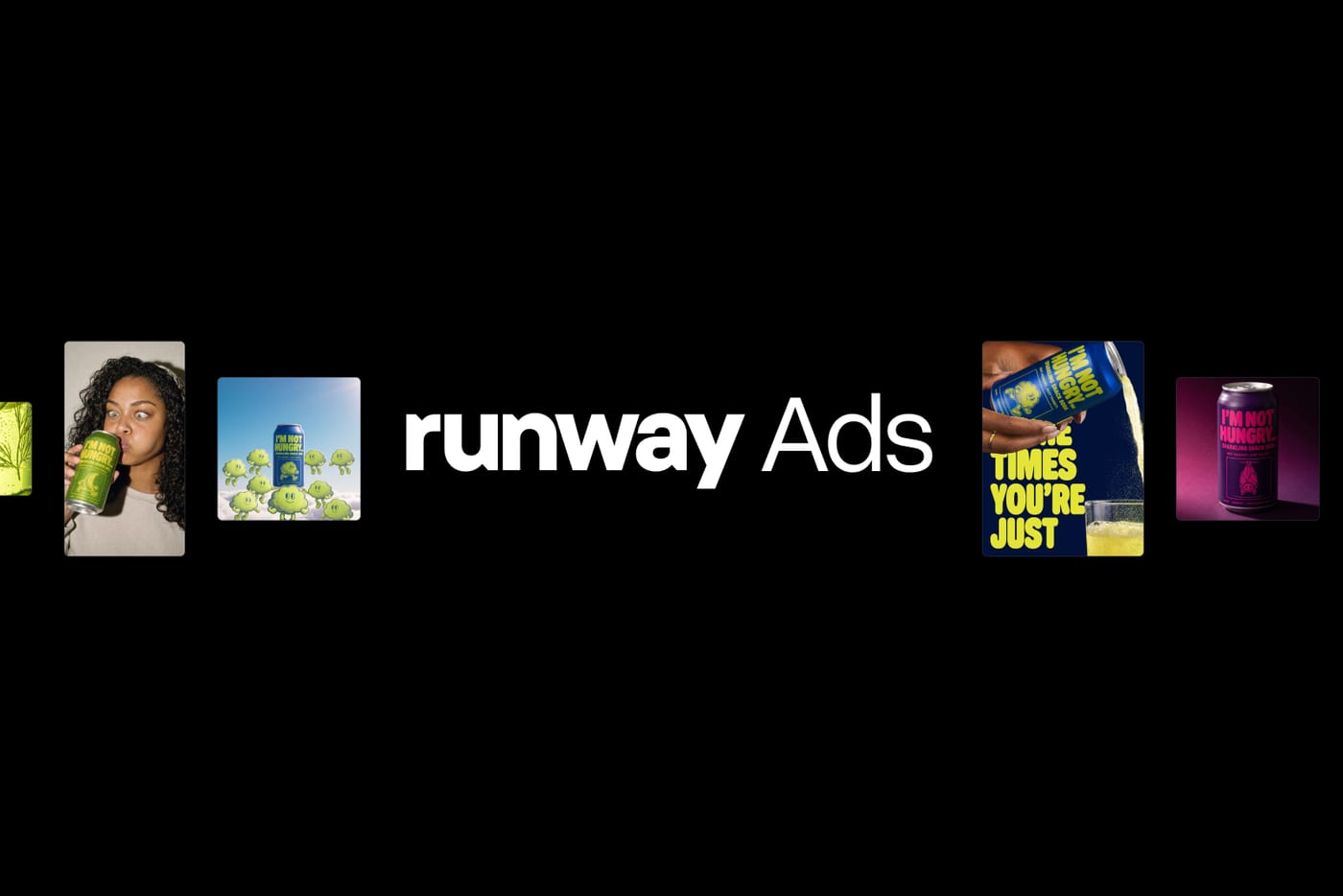
- On September 30, Runway launched Runway Ads, an autonomous performance marketing engine that generates video and image creative, publishes approved variants to Meta, Google, and TikTok, and uses campaign performance data to produce the next batch.
- The system automatically resizes assets across aspect ratios, runs them through a brand check, and localizes on-screen text and product screenshots alongside the voiceover.
- Runway reports that testing the system on its own campaigns increased weekly ad volume from 77 to roughly 900, increased conversion by 34%, and doubled return on ad spend.
- The product is open for early-access requests, with human approval enabled by default and no published pricing.
My take: “Connect an ad account and a brand kit, and Runway Ads generates video and image creative, publishes approved variants directly to Meta, Google and TikTok.” Runway just launched an engine that can produce auto-generated AI slop in mass quantities. Is there any brand that wants this? Or any user? Thankfully it’s still in early beta with limited access, but I fully expect to see most social feeds explode with this kind of auto-generated content within just a few months.
Read more: