Tech Insights 2026 Week 2
January 5, 2026
If you had any doubt that AI is going to completely change programming as a profession, you just need to look at the graph below. It’s a chart showing the number of new questions asked per month on Stack Overflow. The first month Stack Overflow launched they got 3 749 questions, and last month they landed on 3 862 questions. They have gone full circle.
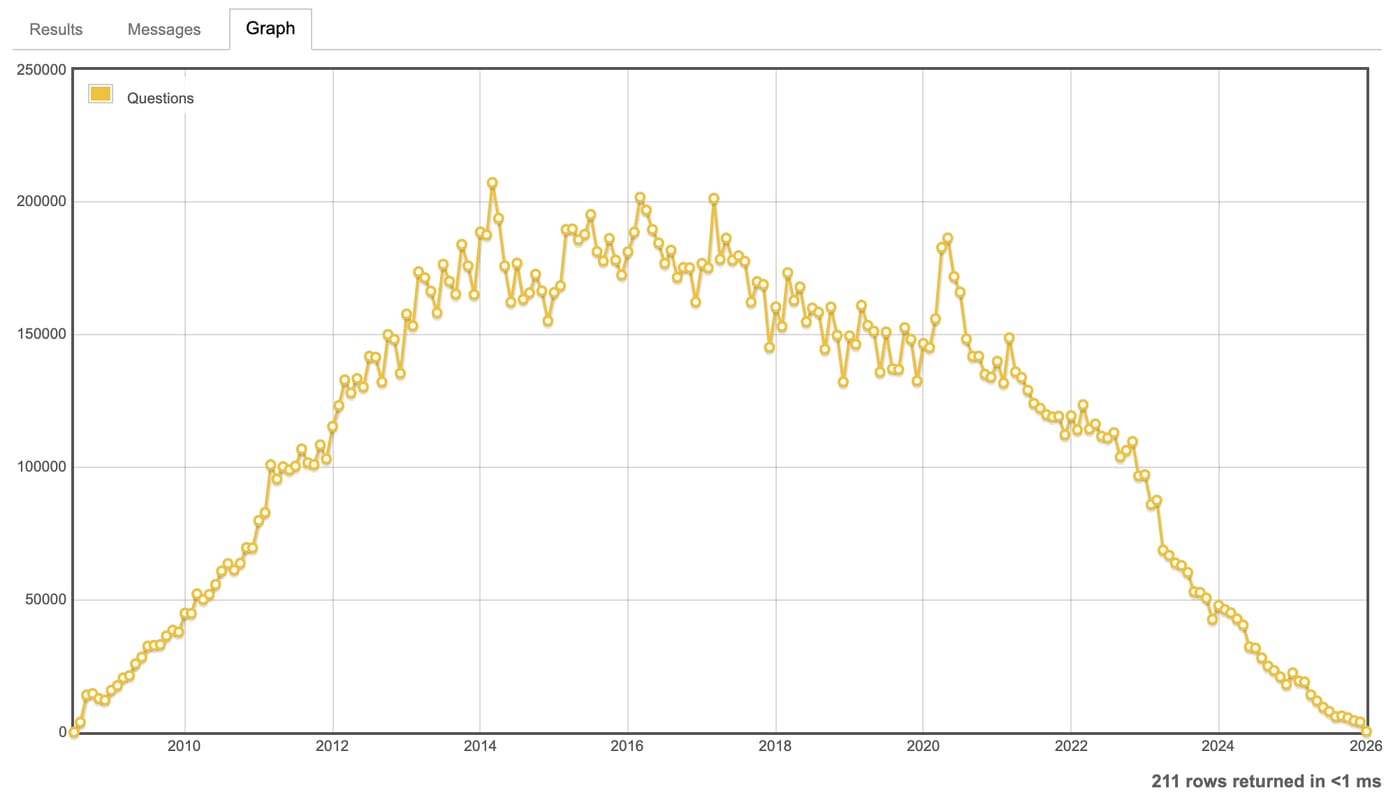 Source: StackExchange.com
Instead of trying to find solutions for problems by searching, programmers are now exclusively turning to AI for answers. The job of a programmer has evolved from problem solver to prompter, and the number of prompts needed for high quality results are quickly diminishing. State-of-the-art models like GPT-5.2-extreme-high is so good at reasoning and programming that it outperforms the best programmers in the world, which really makes you think about the future of programmer as a profession. Will companies even hire people that are “just” programmers in 2-3 years? At the current rate of AI progress I’m actually not so sure anymore. Programmers need to evolve into architects, and those who do that will be able to achieve extraordinary outcomes.
Other than that it was a week of not-so-many AI news. So enjoy your holiday time and I’ll see you next week with a new Tech Insights with the usual 10-or-something news items.
Listen to Tech Insights on Spotify: Tech Insights 2026 Week 2 on Spotify
THIS WEEK’S NEWS:
- SoftBank Completes $41 Billion Investment in OpenAI
- Meta Acquires Manus AI for Over $2 Billion
- Cursor Acquires Graphite
- Google Engineer Reports Claude Code Recreated Year-Long Project in One Hour
- Claude Opus 4.5 Achieves Highest METR Time Horizon Score
- Boris Cherny Shares Claude Code Workflow
- Adobe and Runway Partnership Brings Gen-4.5 Video Model to Firefly
SoftBank Completes $41 Billion Investment in OpenAI
https://www.cnbc.com/2025/12/30/softbank-openai-investment.html
The News:
- SoftBank finalized a $41 billion investment in OpenAI on December 26, 2025, giving the Japanese conglomerate an 11% ownership stake in the ChatGPT developer.
- The investment consisted of three tranches: an initial $7.5 billion direct investment, $11 billion from third-party co-investors, and a final $22.5 billion transfer completed in late December.
- SoftBank’s March 2025 commitment stipulated that the full investment was contingent on OpenAI restructuring from a nonprofit with a for-profit arm into a standalone public benefit corporation, which was completed.
- The funding values OpenAI at $300 billion on a post-money basis, though secondary market transactions later in October placed the company’s valuation closer to $500 billion.
- SoftBank sold $5.8 billion in Nvidia stock and $4.8 billion in T-Mobile shares, plus secured an $11.5 billion loan against Arm Holdings shares to fund the deal.
- The investment ties into SoftBank’s broader AI infrastructure strategy, including its $4 billion acquisition of DigitalBridge, a data center investment company.
My take: Microsoft remains OpenAI’s largest investor, holding approximately 27% of the company after investing $13 billion since 2019. If OpenAI does go public with an IPO in early 2027 at valuations potentially exceeding $1 trillion, then both SoftBank and Microsoft are going to be quite happy with their investments. The current valuation of OpenAI at $500 billion represents 167x projected 2025 revenue, an astronomical figure.
Read more:
Meta Acquires Manus AI for Over $2 Billion
https://manus.im/blog/manus-joins-meta-for-next-era-of-innovation
The News:
- Meta acquired Manus, a Singapore-based AI startup that builds general-purpose AI agents for task automation and research.
- The deal closed at over $2 billion and marks one of Meta’s largest AI acquisitions, following its $14.3 billion investment in Scale AI earlier in 2025.
- Manus reached $125 million in annualized revenue within eight months of launch and serves millions of users through subscription services.
- The platform has processed 147 trillion tokens and powered 80 million virtual computers since launch.
- Meta will continue operating Manus as a subscription service while integrating its team into Meta AI and business offerings.
- CEO Xiao Hong stated the company will maintain operations from Singapore with no disruption to existing customers.
My take: Manus CEO Xiao Hong was offered $30 million for Manus from ByteDance in early 2024. Now twenty months later he sold to Meta for $3 billion. But the journey wasn’t easy. Manus relocated to Singapore, dissolved their Beijing team, and bought out Tencent before the deal.
I have used Manus as an example in many of my presentations, since it’s a very good example of how good agentic systems can be when they have few limits. Manus runs within virtualized servers and can write and run code, create and run web servers, and run lots of tools. You can ask it virtually any office worker task and in many cases it will deliver above expectations. The main issue is that it currently runs Anthropic Claude Sonnet, and API access like we know it is expensive. So the deal makes sense, Meta will soon have new models to be released, and Manus needs a custom model without paying expensive API fees.
Cursor Acquires Graphite
https://cursor.com/blog/graphite
The News:
- Cursor signed a definitive agreement to acquire Graphite, a code review platform used by hundreds of thousands of engineers at companies including Shopify, Snowflake, Figma, and Perplexity.
- The deal involves a mix of cash and equity, with Axios reporting Cursor paid “way over” Graphite’s last valuation of $290 million from a $52 million Series B round in March 2025.
- Graphite will continue operating as an independent product with the same team and brand.
- The acquisition brings together Cursor’s AI-powered code generation with Graphite’s specialized code review capabilities, addressing the bottleneck that occurs after writing code.
- Graphite’s stacked pull request feature lets developers work on multiple dependent changes simultaneously without waiting for sequential approvals, a workflow that GitHub does not natively support.
- The companies plan to integrate local development environments with pull requests, combine Graphite’s AI Reviewer with Cursor’s Bugbot, and build context-aware code reviews.
- This marks Cursor’s third acquisition following Supermaven in November 2024 and talent from Koala in July.
My take: In Tech Insights 2025 Week 51 I wrote: “If you thought Cursor was part of an AI bubble then you should probably reconsider”. And this week’s news make this even more clear. Cursor is quickly growing from “just” a Visual Studio Code fork into an advanced software development platform, with millions of active users. With tools like advanced visual editing and now code reviews I believe it’s going to become the de facto VSCode alternative most developers will go to in 2026, transitioning away from the now ubiquitous VSCode / Copilot combo.
Google Engineer Reports Claude Code Recreated Year-Long Project in One Hour
https://x.com/rakyll/status/2007239758158975130
The News:
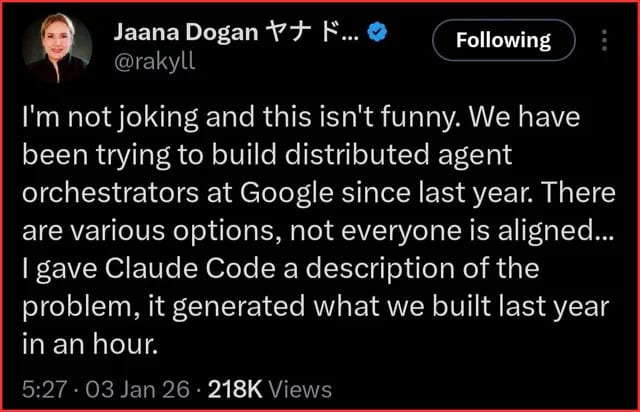
- Jaana Dogan, a Principal Engineer at Google, stated that Claude Code reconstructed a distributed agent orchestrator system in one hour based on a problem description.
- The original system took Google engineers approximately one year to build, with multiple team alignment issues during development.
- Claude Code generated the solution independently from a problem description, not from implementation specifications of the completed system.
- The tweet received 1.6 million views and sparked discussions about AI coding capabilities versus organizational development velocity.
- Claude Code operates as an agentic tool that can read and modify multiple files, run commands, interact with Git, and maintain project structure awareness.
My take: Curious about what skills programmers need to have in the future? I predict it’s going to be able to write solid English with high quality and being able to communicate requirements so other people and AI agents understand what you mean. The better you are at communicating the more effective you will be as a programmer. 2026 will be the year most programmers switch from writing code to writing prompts, and some will have a much more difficult time with this transition than others.
Read more:
Claude Opus 4.5 Achieves Highest METR Time Horizon Score
https://x.com/METR_Evals/status/2002203627377574113
The News:
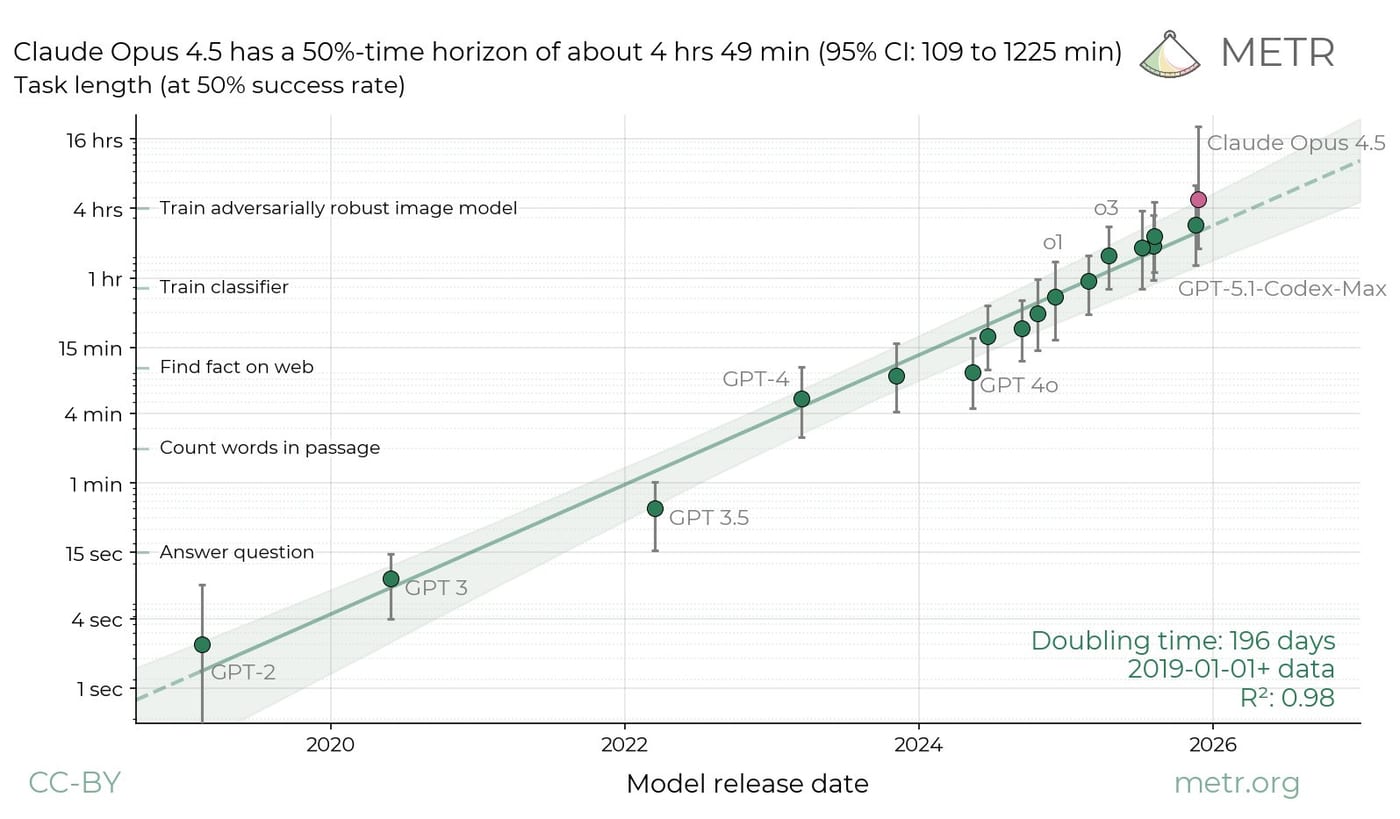
- METR evaluated Claude Opus 4.5 and measured a 50 percent time horizon of 4 hours 49 minutes on autonomous software engineering tasks. This represents the highest published time horizon score to date on METR’s HCAST benchmark suite.
- The 50 percent time horizon metric indicates that Claude Opus 4.5 succeeds at tasks requiring approximately 4 hours 49 minutes of human work at a 50 percent success rate. The 95 percent confidence interval ranges from 1 hour 49 minutes to 20 hours 25 minutes.
- METR notes the wide upper confidence bound does not reflect actual capabilities, as their current task suite lacks sufficient long-duration tasks to establish a reliable upper bound. They are updating the task suite to address this limitation.
- The 80 percent time horizon for Claude Opus 4.5 measures only 27 minutes, similar to previous models and below GPT-5.1-Codex-Max’s 32 minutes. This gap between 50 percent and 80 percent horizons indicates a flatter success curve where Opus performs better on longer tasks than shorter ones.
- The evaluation uses 14 samples in the 1-4 hour range where the model showed progress. The time horizon metric measures autonomous agent capabilities on self-contained software engineering tasks from METR’s HCAST suite.
My take: To understand what this means you first need to understand how the test is done. METR has a suite of software engineering tasks that vary in how long they take humans to complete. These tasks range from seconds to 32+ hours of human work time. The full suite contains many tasks, but in the specific 1-4 hour range where Claude Opus 4.5 showed improvement, there are only 14 task samples.
METR runs Claude Opus 4.5 on all these tasks and records which ones it succeeds at, and then plot the results against how long each task takes humans to complete. What’s interesting about the results, which also matches my experiences with Claude Opus, is that Claude Opus 4.5 performs inconsistent across different task durations. It succeeds more often on 8-16 hour tasks than on 2-4 hour tasks.
As far as I have concluded this is because Claude Opus usually wings it and often try out things without basing it on facts or logic. This is almost the opposite to how GPT-5.2-extreme-high works. This means that if you give it enough time, it will sooner or later be able to try enough different solutions to finally end up with something that works. If you’re considering to use Claude Opus for vibe coding an app without working iteratively with the generated code base, this report should really make you think different.
Boris Cherny Shares Claude Code Workflow
https://x.com/bcherny/status/2007179832300581177
The News:
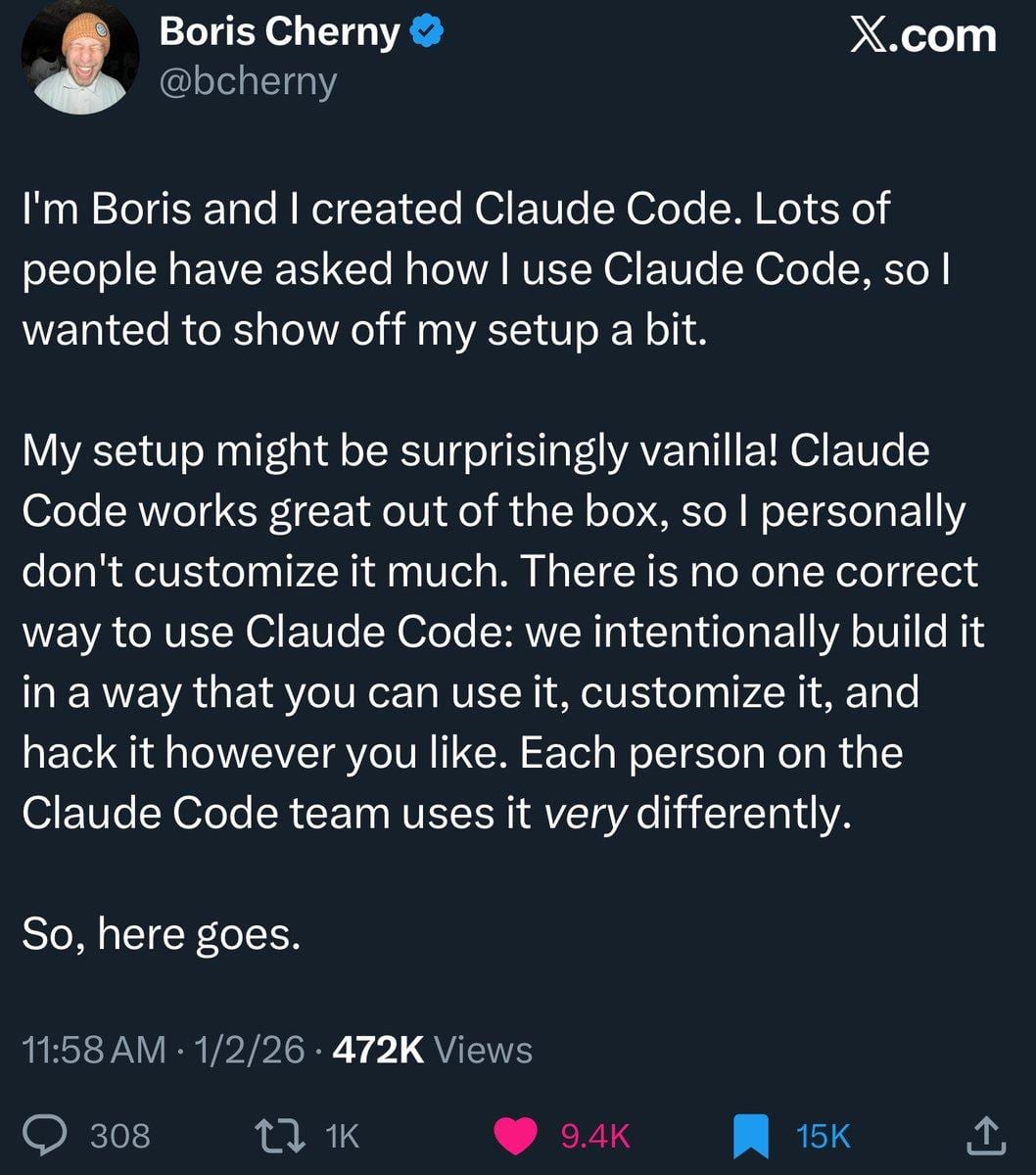
- Boris Cherny, creator of Claude Code, shared his complete development workflow on January 1, 2026, demonstrating how he uses the AI coding assistant across 15 parallel sessions spanning terminal, web, and iOS platforms.
- He runs 5 terminal instances with numbered tabs, 5-10 web sessions on claude.ai/code, and iOS app sessions that sync across devices, using commands like —teleport to move sessions between platforms.
- Cherny uses Opus 4.5 with thinking mode for all tasks, arguing that slower per-request processing results in faster total completion time due to fewer iterations and less human steering required.
- The Claude Code team maintains a shared CLAUDE.md file in git where developers document patterns, anti-patterns, and conventions multiple times per week, creating a compounding knowledge base that prevents repeated mistakes.
- A GitHub Action automatically extracts new patterns from pull requests when tagged with @.claude, updating CLAUDE.md without manual intervention.
- Cherny employs a two-phase workflow: interactive planning mode followed by auto-accept execution mode, investing time upfront to create detailed plans before allowing Claude to execute autonomously.
- He creates custom slash commands for frequent workflows like /commit-push-pr, using inline bash commands to pre-compute context and avoid back-and-forth exchanges.
- PostToolUse hooks automatically format code with Prettier after every Edit or Write operation, eliminating the last 10% of formatting issues that cause CI failures.
- The workflow includes MCP (Model Context Protocol) integration for external tools like Slack, BigQuery, and Sentry, allowing Claude to post updates, run analytics queries, and fetch error logs directly.
- For long-running tasks, Cherny uses three approaches: background agent verification, Stop hooks that block exit until tests pass, and the Ralph Wiggum technique that iterates up to 50 times until a completion promise is detected.
- Cherny emphasizes that giving Claude verification mechanisms produces 2-3x better quality results, noting he completed a $50k contract for $297 in API costs and generated 6 repositories overnight during a Y Combinator hackathon using these techniques.
My take: If you use Claude Code today - do not miss this post! It’s a gold mine with information on how a 100% prompter works with Claude Code producing a tool that is used daily by millions of users. Reading through the posts you get a glimpse into how most programmers will work in 1-2 years, where time is increasingly spent with planning and requirements and nothing typing the actual source code.
Read more:
Adobe and Runway Partnership Brings Gen-4.5 Video Model to Firefly
https://news.adobe.com/news/2025/12/adobe-and-runway-partner
The News:
- Adobe and Runway announced a multi-year partnership where Adobe becomes Runway’s preferred API creativity partner, giving Firefly users early access to new Runway models outside of Runway’s platform.
- Runway’s Gen-4.5 model became available in Adobe Firefly on December 18, 2025, with unlimited generations through December 22 for Firefly Pro subscribers.
- Gen-4.5 features improved motion quality, prompt adherence, and temporal consistency, allowing creators to stage multi-element scenes with realistic physics and character gestures that maintain coherence across shots.
- Adobe Firefly now offers creators access to models from multiple providers including Adobe’s own Firefly models, Runway, Black Forest Labs, ElevenLabs, Google, Luma AI, OpenAI, and Topaz Labs.
- Adobe added Prompt to Edit controls using Runway’s Aleph model, allowing creators to make surgical edits to generated videos with commands like “remove the person on the left side of the frame” without regenerating the entire clip.
- The partnership includes plans to develop specialized AI capabilities exclusively for Adobe applications, starting with Adobe Firefly.
My take: Runway is getting some strong partnerships here, a year ago they partnered with Lionsgate and now Adobe. Their models are good, especially Gen 4.5, but it’s not really Cinema-production-ready yet. But I have no doubt it will be, it’s just a question of if it’s one or two years away. And then it’s easy to see why Adobe signs all these partnerships. The future is AI, even for creative people.
Read more: