Tech Insights 2026 Week 28
July 6, 2026
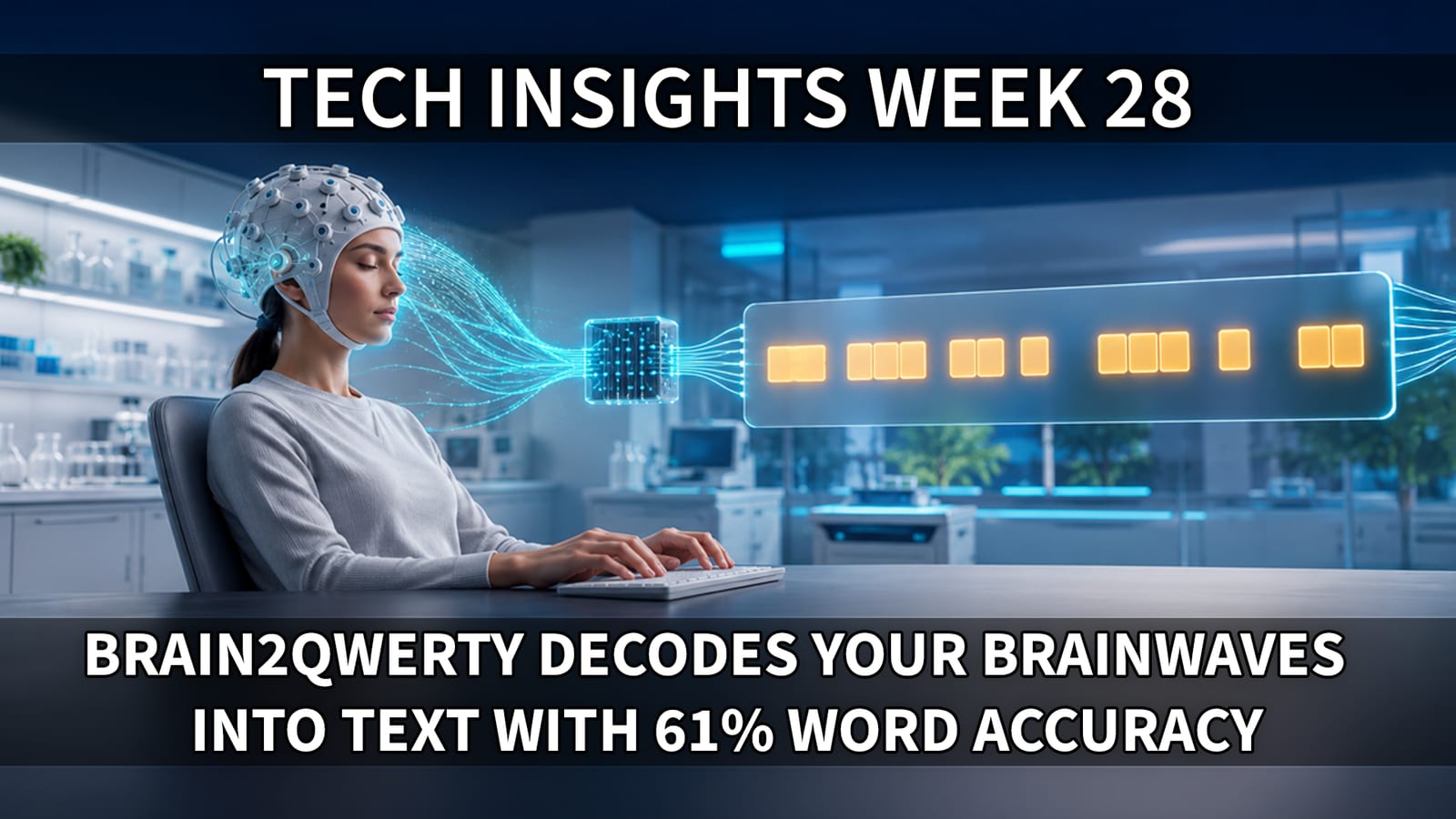
Here in Sweden many companies are slowing down for the summer, but the global AI industry keeps on innovating. Last week was one of the busiest in a long time with 18 news items (!). So I tried something new. I have now organized all the news into categories. If you are mainly interested in Enterprise AI, you can jump straight to that section and read about Microsoft’s new Frontier company. And if you are mainly interested in AI research, you can jump to Frontier Signals and read about Meta’s new brain-to-text interface Brain2Qwerty.
In February this year, Arthur Mensch, CEO at Mistral, mentioned how a large portion of their employees are working as “Forward Deployed Engineers”, helping customers to integrate and create value with their AI models. “We bring the mindset change by bringing our forward deployment engineers that show the way and do iconic use cases”, he said. Three months later in May (Tech Insights 21), both Anthropic and OpenAI announced that they will start their own consultancy companies. Last week it was Microsoft’s turn. They announced they are investing $2.5 billion to launch the Microsoft Frontier Company. The goal is to embed 6,000 industry and engineering experts at customers to co-design, co-innovate, deploy and continuously improve AI systems at scale based on measurable business outcomes.
If you have not yet fully grasped what is happening, we are witnessing the successor of the “IT” sector emerging. AI was never going to be just a SaaS game. You cannot just deploy a tool inside an organization and call it transformation. Someone has to go inside, redesign the processes, and build new AI-native systems from scratch. This is not done by the companies themselves, and it is not something traditional IT consultants are capable of. It requires a broad skillset with both management skills and deep technical skills combined with GenAI expertise. Today this skillset is extremely rare, but in 3-5 years time I believe it will build an industry much larger than today’s IT sector.
When someone asks me what we do at TokenTek, this is how I typically describe it. And right now we are the only AI company in Sweden I am aware of doing this as our primary business. The challenge is not getting the AI to produce lots of things at high speed. It is getting the AI to do the right things with high quality and with a measurable outcome. And very few people know how to do that.
Thank you for being a Tech Insights subscriber!
Listen to Tech Insights on Spotify: Tech Insights 2026 Week 28 on Spotify
Notable model releases last week:
- Claude Sonnet 5 by Anthropic. Agentic model for coding, tool use, and multi-step workflows.
- Gemma 4 12B by Google DeepMind. 12B multimodal model for local audio, vision, and text agents on laptops.
- Nano Banana 2 Lite and Gemini Omni Flash by Google DeepMind. Image and video models for fast visual drafting, generation, and conversational editing.
THIS WEEK’S NEWS:
Enterprise AI
- Microsoft Frontier Company Launches With $2.5 Billion and 6,000 Experts
- Ramp and Revelio Find 10.2% Headcount Growth After AI Adoption
Agents & Software Development
- Cognition Introduces Devin Fusion, 35% Cheaper on FrontierCode
- CursorBench 3.1 Ranks Fable 5 Max First at 72.9%
- Cursor Releases iOS App in Public Beta
- Z.ai Offers ZCode Harness for GLM-5.2
- Obscura Opens Cloud Waitlist at 10,000 GitHub Stars
Models & Infrastructure
- Anthropic Restores Claude Fable 5 Worldwide
- Anthropic Launches Claude Science Beta for Scientists
- Meituan Unveils LongCat-2.0, a 1.6T Coding Model
- DeepSeek Open-Sources DSpark With Up to 85% Speedup
Market & Vendor Moves
- Kling AI Raises Initial $2 Billion at $15 Billion Pre-Money Valuation
- Qualcomm Agrees to Acquire Modular
- Palantir’s Alex Karp Calls AI Industry “Effing Insane”
Policy & Risk
- OpenAI in Talks to Give Trump Administration 5% Stake
- ITU Launches AI for Good Global Commission With 44 Founding Members
Frontier Signals
- Meta Releases Brain2Qwerty v2 With 61% Word Accuracy
- IBM Debuts 0.7 nm Nanostack Chip Technology
Enterprise AI
Microsoft Frontier Company Launches With $2.5 Billion and 6,000 Experts

The News:
- On July 2, Microsoft introduced Microsoft Frontier Company, a new operating business backed by a $2.5 billion investment to help customers co-design and deploy AI systems for measurable business outcomes.
- Microsoft says 6,000 industry and engineering experts will work with customers and continuously improve those systems.
- Its platform is positioned as model-diverse, with support for OpenAI, Anthropic, Microsoft AI, open source, and specialized models.
- The company says customer data and IP will not be used to train models in ways that commoditize what differentiates them.
- Microsoft cites early work with LSEG, Land O’Lakes, Unilever, and Novo Nordisk.
My take: Two months ago in Tech Insights 21 I wrote about reports of Anthropic and OpenAI exploring joint ventures with private equity firms to embed AI experts inside enterprise clients. This month it is Microsoft. We are witnessing the successor to the IT industry emerge, where the work is no longer the coding, container orchestration, test cases, and debugging. This will all be done by AI. But the AI agents need to be configured and integrated in a way that gives a measurable return on investment, optimally set up for minimum token spend and the highest possible quality. And this is quite hard.
This is where Microsoft, like Anthropic and OpenAI, sees its future business. As usual with this type of announcement, it is quite vague. For example, where will Microsoft find these 6,000 forward-deployed industry and engineering experts? This is a difficult skillset to recruit, and it is not clear if Microsoft intends to buy companies, recruit, or reorganize current employees. Also, Microsoft is actively developing its own models. And while they say their new operating business will be model-diverse, the entire idea behind this approach is to make sure the companies you work with use your models. I think this makes it less interesting for many companies to work with Anthropic, OpenAI, and Microsoft directly compared to third-party independent experts doing this work.
Read more:
- Directions on Microsoft: Microsoft launches its own forward deployed engineering unit
- GeekWire: Microsoft unveils $2.5B Frontier Company
- OpenAI: OpenAI launches the Deployment Company
- Times of India: OpenAI, Anthropic, Amazon and now Microsoft
Ramp and Revelio Find 10.2% Headcount Growth After AI Adoption
https://ramp.com/data/ai-jobs-impact
The News:
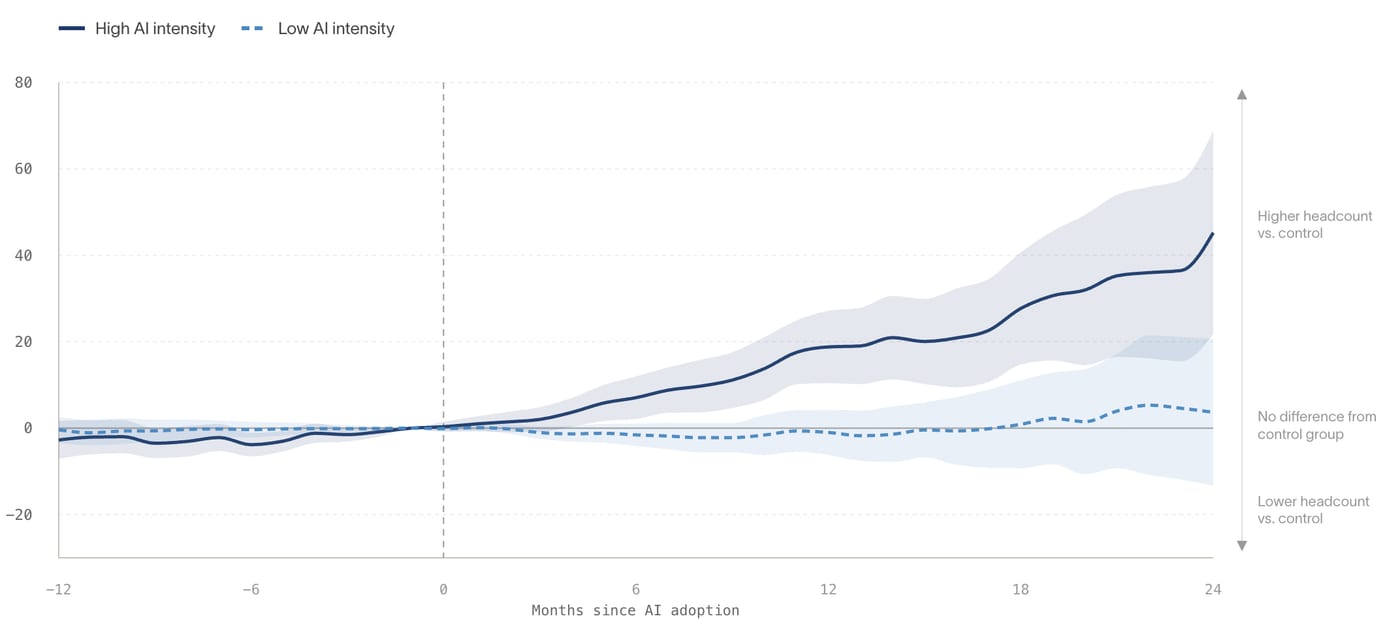
- On June 30, Ramp Economics Lab published a paper co-authored with Revelio Labs that links observed AI spending to workforce records and finds 10.2% headcount growth over two years after AI adoption, with the gains driven by high-intensity adopters.
- The paper links Ramp card and bill-pay AI spend to Revelio workforce records for 21,559 U.S. firms.
- Entry-level headcount rose 12% at high-intensity adopters.
- Low-intensity adopters saw no statistically significant employment change.
- High-intensity means the top tercile of AI spend per baseline employee in the first three months after adoption, averaging $33.67 per employee per month.
My take: Ramp presented these figures at HumanX in San Francisco earlier this year, and the figures are astonishing. Ramp sees actual corporate card and bill-pay spending in companies, and the high-intensity adopters spending the most on AI services on average grew in headcount by roughly 10% over two years.
My perspective after meeting many C-level executives over the past year is that companies adopting AI are actively recruiting people who can get the most value out of it. It is actually much harder than most think. Anyone can ask Claude Code to wrap up a test prototype, but if you want to produce content that is better than if an expert human wrote it, you have to work quite hard on your prompting and integration skills. And this takes time. Most companies simply cannot afford to wait until most of their office workers get good at it. It takes months. For some, years.
Read more:
- PR Newswire: Ramp Economics Lab finds heavy AI investors hire more
- Ramp: Does AI eliminate jobs?
- Reddit: Discussion of AI adoption and employment
- Revelio Labs: Greater AI investment, more hiring
- The Register: Companies that add more AI also add more people
Agents & Software Development
Cognition Introduces Devin Fusion, 35% Cheaper on FrontierCode
https://cognition.com/blog/devin-fusion
The News:
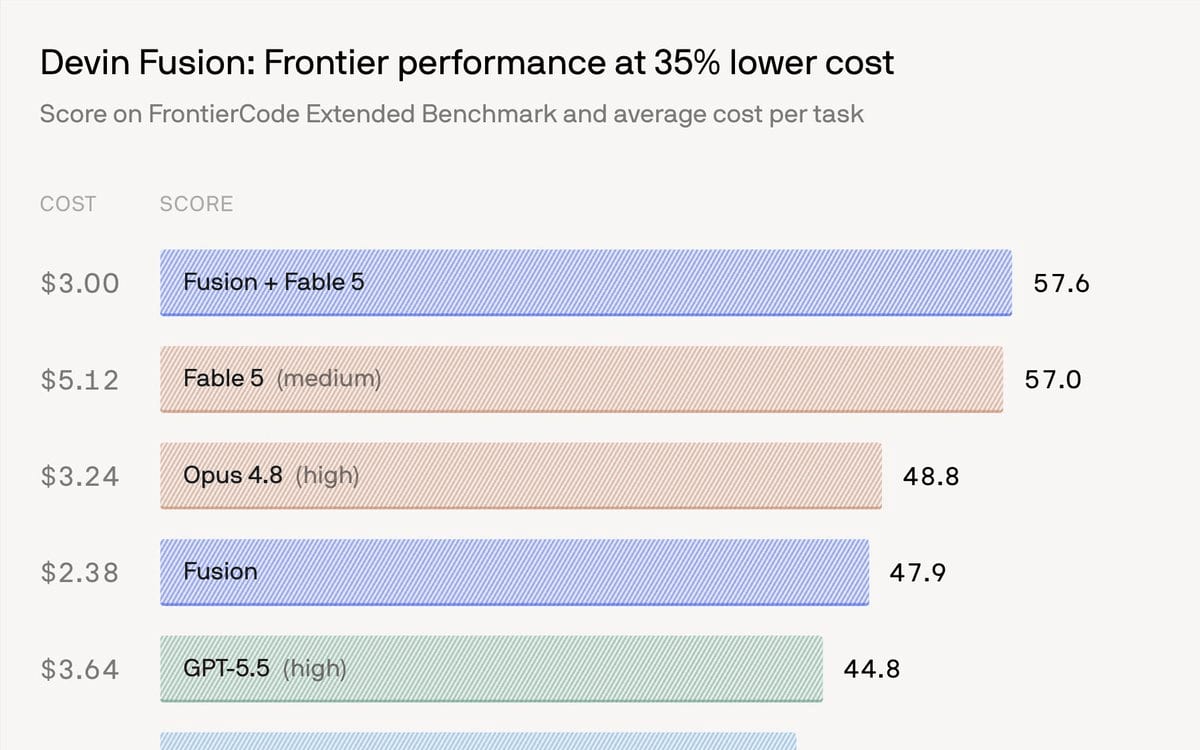
- On June 29, Cognition introduced Devin Fusion, a preview multi-model harness for Devin that pairs a frontier agent with a cheaper sidekick and, on FrontierCode, matched frontier-model performance at 35% lower cost.
- It runs two parallel agents, one frontier and one more cost-effective, and each keeps its own cached context.
- Model handoffs happen during context compaction, so the active model can change without extra cache penalty.
- On FrontierCode Extended, Fusion scored 47.9 at $2.38 per task, versus 48.8 and $3.24 for Opus 4.8(high) and 44.8 and $3.64 for GPT-5.5(high).
- In an internal rollout, Cognition says 88% of merged PRs from the test group were driven entirely by the automated Fusion router.
My take: These multi-model harnesses are getting popular. Last week I wrote about Sakana Fugu, their multi-agent orchestration system that to the user behaves like a single model but internally routes traffic to multiple foundation models. And the week before that we got Fusion from OpenRouter, which does the same thing. What makes Devin Fusion different is that it pairs a frontier main agent with a cheaper sidekick, with the main goal of cutting costs while maintaining benchmark performance. And it seems to work, as Cognition says frontier performance is maintained at a 35 percent lower cost on FrontierCode. Cognition also figured out a clever way to avoid the extra cache penalty of switching models mid-task, since it does the switch at the exact moment context compaction happens.
I believe both Anthropic and OpenAI will go this way if they can figure out a good way to do it without affecting quality and latency. I still have not been able to test any of these orchestration systems myself, but for me any measurable impact to output quality would make this a no-go, despite saving a bit of token spend.
Read more:
- AI Insiders: Cognition ships a dual-agent cost cutter for Devin
- Digg / Walden Yan: Reaction to Devin Fusion
- OpenRouter Docs: Fusion Router
- Requesty: Inside Sakana Fugu Ultra
CursorBench 3.1 Ranks Fable 5 Max First at 72.9%
The News:
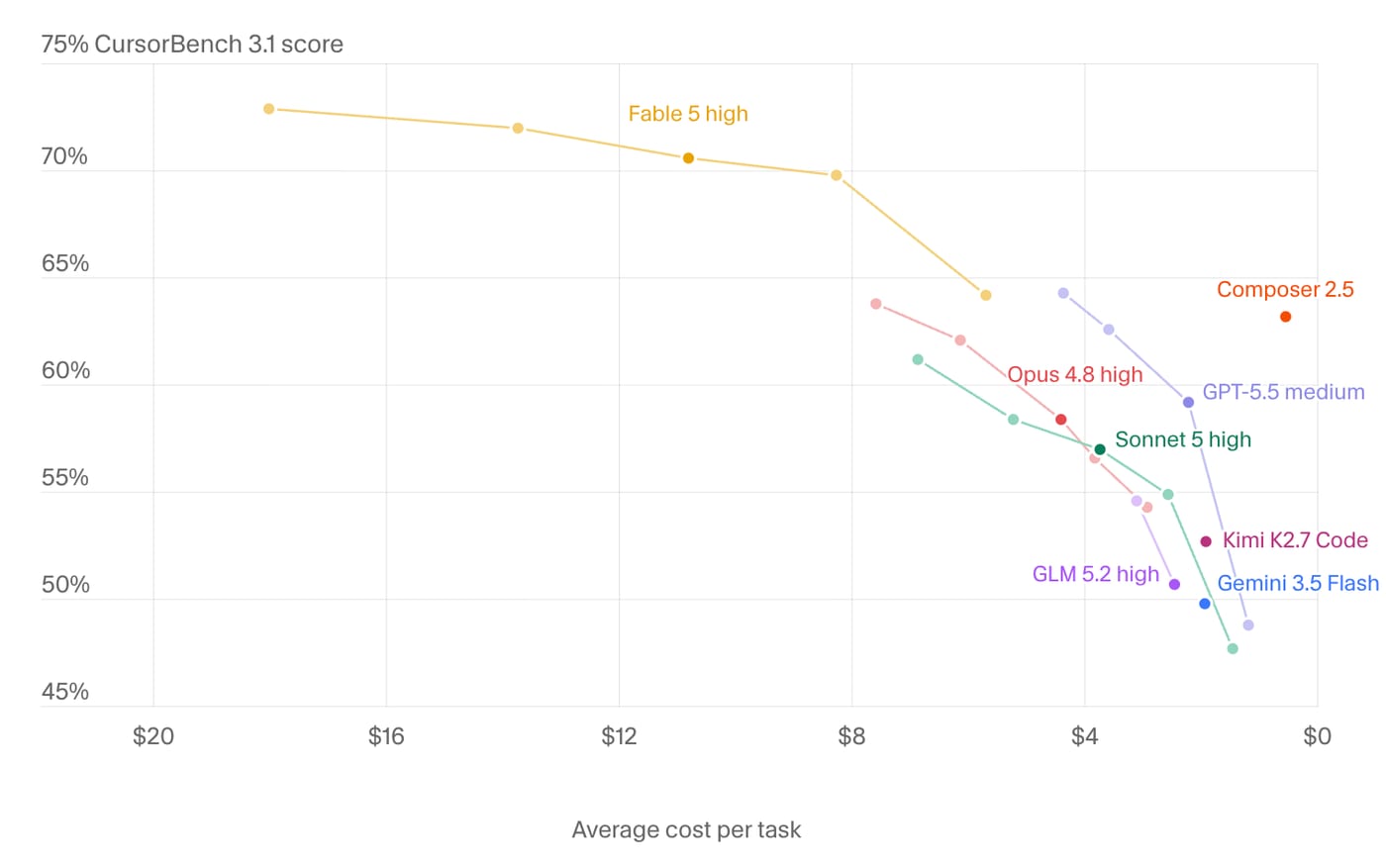
- Cursor published CursorBench 3.1 results for its internal coding-agent benchmark, with Fable 5 Max topping the table at 72.9% on ambiguous, multi-file tasks drawn from real Cursor sessions.
- The next highest score shown is Opus 4.7 Max at 64.8%, followed by GPT-5.5 Extra High at 64.3% and Opus 4.8 Max at 63.8%.
- Composer 2.5 reaches 63.2% at an average cost of $0.55 per task, versus $18.02 for Fable 5 Max.
- Version 3.1 adds problems focused on codebase understanding, bugfinding, planning, and code review, and it improves grading criteria for some edit tasks.
- Cursor says average cost per task is computed from published per-million-token pricing, and it warns that small score differences may not be statistically meaningful.
My take: CursorBench is still internal at Cursor, and it is still a mystery exactly how it works. All we know is it measures code-related tasks, and Cursor’s own model Composer 2.5 is both among the cheapest and highest performers, scoring 63.2% at an average cost of $0.55 per task. And Composer 2.5, as you know, is the Chinese model Kimi 2.5 that has been fine-tuned by Cursor.
Fable 5 Max scored extremely high on this benchmark, topping the table at 72.9%. I have been using Fable myself every day for the past week now, and I have to agree with these figures. In my testing, Fable is even better than GPT-5.5 on complex codebases. It is just going to be expensive once they remove it from the $200 Max20 subscriptions.
Read more:
- BenchLM: CursorBench v3.1 benchmark snapshot
- Cursor: How we compare model quality in Cursor
- Hacker News: Discussion of CursorBench 3.1
Cursor Releases iOS App in Public Beta
https://cursor.com/blog/ios-mobile-app
The News:
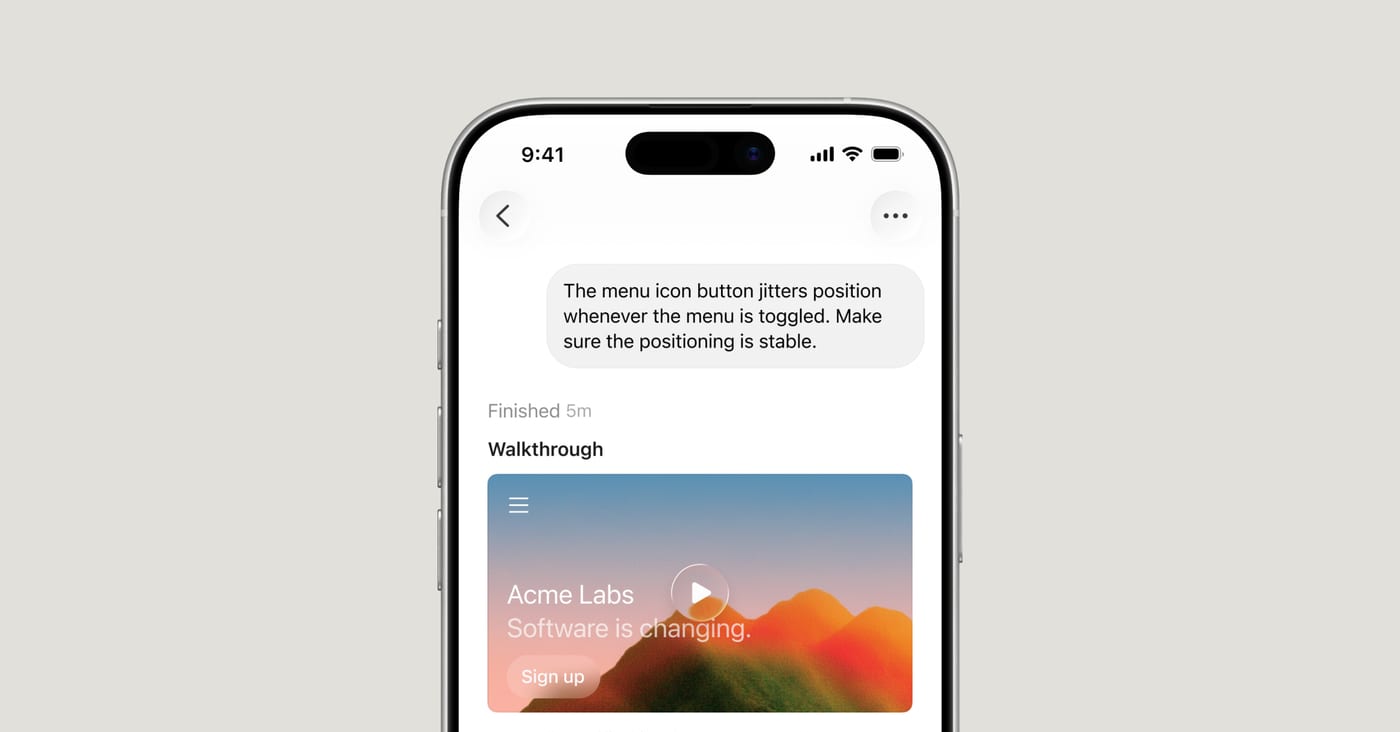
- Cursor released a public beta of its native iOS app for all paid plans, letting developers launch cloud agents or control agents running on their computer from their phone, with 75% off Composer 2.5 runs in the mobile app through July 5.
- Developers choose a repo, start an agent as they would on desktop, use voice input, and guide it with slash commands.
- Live Activities on the lock screen and push notifications show when an agent finishes, needs input, or is ready for review.
- Finished runs expose demos, screenshots, logs, and diffs in the app, where users can leave follow-up instructions or merge the PR.
- Cloud agents run in isolated virtual machines and can iterate asynchronously toward merge-ready PRs without intervention.
- They are billed at API pricing outside standard plans, so on-demand billing and a spending limit are required before the first cloud agent runs.
My take: Cursor is clearly moving away from an AI-powered code editor toward an online agentic workspace. By using cloud-based agents to develop your software code, the idea is that you can keep the agents running and just give them input wherever you are, on your laptop or with your mobile phone. When an agent is done, Live Activities on the lock screen and push notifications alert you so you can take action and give it further directions.
I am really not a big fan of mobile phone programming. It encourages small and sloppy prompts, and it increases the disconnect between human domain knowledge and the actual source code. The more you let AI agents work by themselves, the more generic and less “you” the source code becomes. I do see the appeal however, and for many this will be an incredible productivity journey. For others it will just bring technical debt to their organization.
Read more:
- Cursor Docs: Background Agents
- Cursor Forum: Cloud Agents pricing structure
- LinkedIn / Alastair Paterson: Post about Cursor background-agent data-use concerns
- Reddit: Discussion of background-agent usage-based pricing
- X / Coded: Reaction to Cursor iOS as a harness remote
Z.ai Offers ZCode Harness for GLM-5.2
The News:
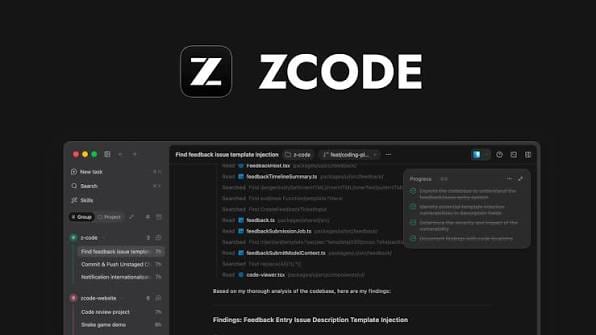
- Z.ai published ZCode, an Agentic Development Environment for GLM-5.2 with installers for macOS, Windows, and Linux, and listed GLM Coding plans starting at $16.20 a month.
- Docs describe it as a full Agent Development Environment with preview pages, browser context selection, and review of agent-generated changes in one window.
- Long-running “Goals” manage complex work with continuous planning, execution, and verification.
- Remote control works through WeChat, Feishu, or Telegram so long-running work can keep moving away from the desktop.
- Pricing runs from Lite at $16.20 to Pro at $64.80 and Max at $144 per month, with Pro at 5x Lite usage and Max at 20x.
My take: I think the main takeaway with this release is that agentic development environments are very easy to both create and deploy. Over the past few months we have gotten new desktop agentic editors from numerous companies like OpenAI, GitHub, and now Z.ai. If you wondered why Cursor is fully moving towards cloud-based agents, the reason is simple. Anyone can create an environment for agentic software development today, and the key selling features of the Cursor IDE like smart multi-line autocomplete are no longer used by anyone when AI agents write all the code.
Read more:
- Business Insider: Z.ai launches ZCode
- Hacker News: Discussion of ZCode
- Latent.Space: Cursor’s third era
- X / Tan Nguyen: Reaction to ZCode remote control
- Z.ai: ZCode ADE tools
Obscura Opens Cloud Waitlist at 10,000 GitHub Stars
https://github.com/h4ckf0r0day/obscura
The News:
- Obscura is an open-source Rust headless browser for AI agents and web scraping, with a README comparison table showing 30 MB of memory use versus 200+ MB for headless Chrome.
- That table also lists a 70 MB binary, 85 ms page loads, and instant startup, versus 300+ MB, about 500 ms, and about 2 seconds for headless Chrome.
- Chrome DevTools Protocol support lets it act as a drop-in target for Puppeteer and Playwright.
- Its built-in MCP server exposes navigation, clicks, form filling, and JavaScript evaluation to agents such as Claude Desktop and Cursor.
- When enabled, stealth mode randomizes GPU, screen, canvas, audio, and battery fingerprints per session and blocks 3,520 tracker domains.
- Obscura Cloud is in development as a hosted version with managed infrastructure, residential proxies, and dedicated support, while the engine stays fully featured under Apache-2.0.
My take: If you are creating autonomous AI agents that access the web, you want them to use as few computer resources as possible and respond as quickly as possible. This is Obscura. It is a headless browser engine written in Rust, built from the ground up for web scraping and AI agent automation. For agent builders, the browser becomes a lightweight automation component instead of a full desktop browser running without a UI.
Based on its README table, it uses roughly 85% less memory than headless Chrome, and latency is over 5x faster. The license is Apache-2.0 and it includes an MCP server that exposes browser navigation, snapshots, clicks, form filling, and JavaScript evaluation. It also has extensive stealth mode settings with per-session fingerprint randomization (GPU, screen, canvas, audio, battery) and properties simulating real user activities.
Read more:
- Discovery: Obscura headless browser overview
- GitHub: Obscura benchmark suite
- Obscura Docs: Use the MCP server
- X / Garry Tan: Reaction to Obscura and headless Chrome
Models & Infrastructure
Anthropic Restores Claude Fable 5 Worldwide
https://www.anthropic.com/news/redeploying-fable-5
The News:
- On July 1, Anthropic restored global access to Claude Fable 5 after export controls were lifted, bringing it back to Claude Platform, Claude.ai, Claude Code, and Claude Cowork.
- Paid plans include Fable 5 for up to 50% of weekly usage through July 7, after which Pro, Max, Team, and select Enterprise access shifts to usage credits.
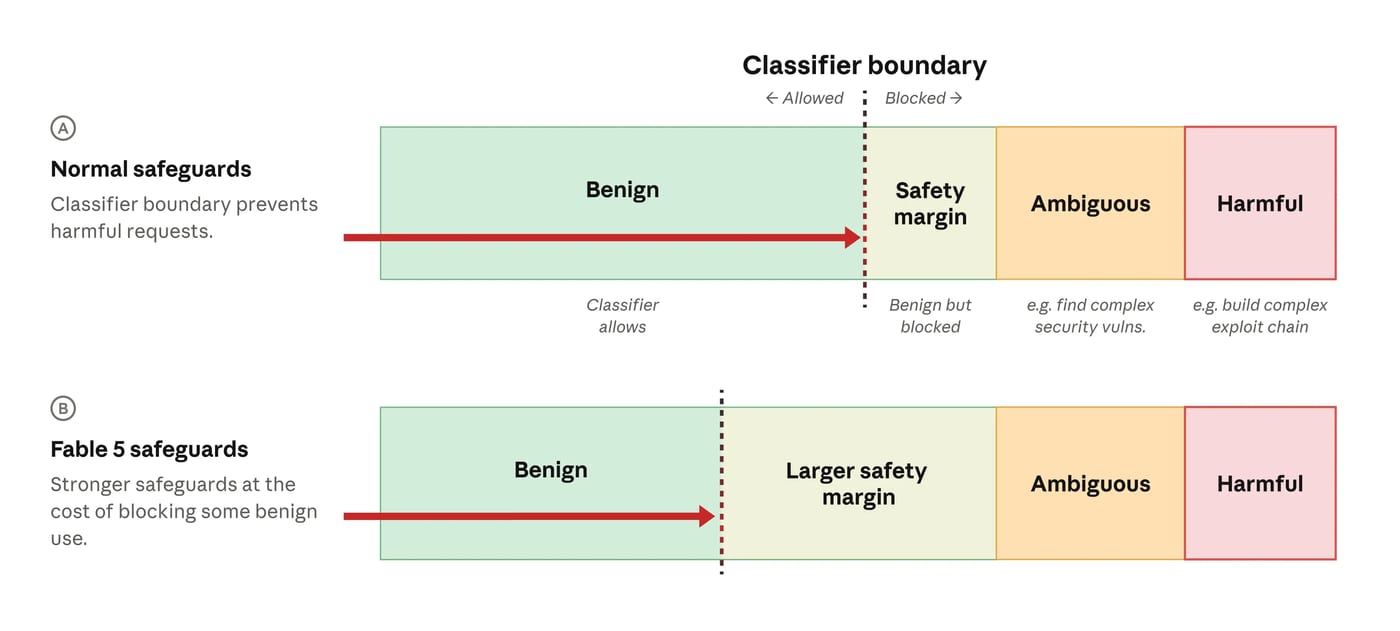
- Anthropic says the June 12 order followed a report from Amazon researchers showing a way to bypass Fable 5’s safeguards to identify software vulnerabilities and, in one case, produce exploit code.
- A new safety classifier blocks the reported technique in more than 99% of cases, and blocked requests fall back to Opus 4.8.
- Anthropic is also drafting a four-part jailbreak-severity framework with Amazon, Microsoft, Google, and other Glasswing partners.
My take: Fable 5 is a very, very good model. I have used it extensively the past week and it is able to find things in larger code bases not even GPT-5.5 could detect. You feel it’s a much larger model when you work with it. My biggest concern is that it’s also very, very expensive, twice the cost of GPT-5.5 and Opus 4.6. Is it worth it? For many use cases, yes absolutely. I use it to identify and specify work tasks that I let cheaper models like GPT-5.5 implement.
But this is not your daily driver like Opus or GPT, and probably won’t be until Anthropic manages to optimize it to get it more performant. With paid plans shifting to usage credits for Fable 5 after July 7, it will also be interesting to see if Fable and Mythos will return to the $200 per month subscriptions, or if this is an indication that we have reached the end of flat-rate near-unlimited AI usage for $200 per month.
Read more:
- Anthropic: Claude Fable 5 and Claude Mythos 5
- Anthropic: More details on Fable 5’s cyber safeguards and jailbreak framework
- Claude Platform Docs: Pricing
- Reddit: Discussion of Fable 5 and Mythos 5 coming back
Anthropic Launches Claude Science Beta for Scientists
https://claude.com/product/claude-science

The News:
- Anthropic made Claude Science available in public beta as a macOS and Linux app for researchers, combining analysis tools, compute integrations, and access to 60+ scientific databases in one environment.
- It is not a new model: the app uses the same Claude models your plan already includes and is currently in beta on Pro, Max, Team, and Enterprise.
- Every figure, table, and notebook keeps the exact code, environment, and conversation that produced it, and a background reviewer flags incorrect citations, untraceable numbers, and figure/code mismatches.
- Analyses can run on a laptop, Linux box, HPC cluster over SSH, or a Modal account, while raw datasets and compute stay local and prompt content is processed by Anthropic under standard retention.
- Anthropic is also offering up to $30,000 in credits for up to 50 AI for Science projects, with applications open through July 15 and an early focus on biology and biomedical research.
My take: Claude Science is another pillar from Anthropic, adding to Claude Desktop, Claude Code and Claude Cowork. Where Claude Cowork is built around business outcomes like sorting files in a folder, Claude Science is built around reproducible scientific artifacts and reviewer workflows.
Like I wrote in the Z.ai ZCode post above, writing desktop software today is incredibly easy with modern AI. Expect to see more niche workbench applications like this one aimed at specific work categories. This just further increases my belief that any company whose sole proposal is a desktop application is going to fundamentally have to change their business strategy within the next one to two years.
Read more:
- Anthropic: Claude Cowork
- Anthropic: Claude Science AI workbench
- Reuters: Anthropic unveils Claude Science
- TechCrunch: Claude Science bets on workflow, not a new model
- X / Gail Weiner: Reaction to Claude Science’s local-first framing
Meituan Unveils LongCat-2.0, a 1.6T Coding Model

The News:
- Meituan published LongCat-2.0, a 1.6-trillion-parameter Mixture-of-Experts model built for autonomous software engineering.
- VentureBeat reports it was trained on more than 50,000 domestic Chinese ASICs rather than Nvidia GPUs.
- On SWE-bench Pro, it scored 59.5, edging GPT-5.5’s 58.6.
- Standard API pricing is $0.75 per million input tokens and $2.95 per million output tokens, while context-cache hits are free.
- The repository is under the MIT license, but the GitHub and Hugging Face pages still say the full model weights are “coming soon”.
My take: This is one of the models I have been looking forward to for a long time, since it was called “Owl Alpha” on OpenRouter. LongCat 2.0 is a 1.6-trillion-parameter Mixture-of-Experts model, MIT licensed, with full weights being published soon. It beats GPT-5.5 on SWE-bench Pro and costs just $0.75 per 1M input tokens, compared to $5 for GPT-5.5 and Opus 4.8. But here is the real kicker: cached API hits are free (!). If you are an experienced agentic user, you know when and how to use cached tokens, meaning that for many workflows the cost will be extremely cheap.
What makes this model truly unique, however, is that it was trained on more than 50,000 domestic Chinese ASICs rather than Nvidia GPUs. If China can ramp up production enough for these chips, they could well have models on par with Fable and Mythos within six to nine months. For companies in the EU and US that want to run LongCat 2.0 locally, you need at least eight NVIDIA H200 GPUs to run it at full precision, the same as DeepSeek V4-Pro.
Read more:
- Hugging Face: LongCat-2.0 model page
- Meituan LongCat: LongCat-2.0 blog post
- Reddit: Discussion of Owl Alpha on OpenRouter
- Reuters: Meituan says LongCat was trained on domestic chips
- The Synthesis: The Delivery
DeepSeek Open-Sources DSpark With Up to 85% Speedup
The News:
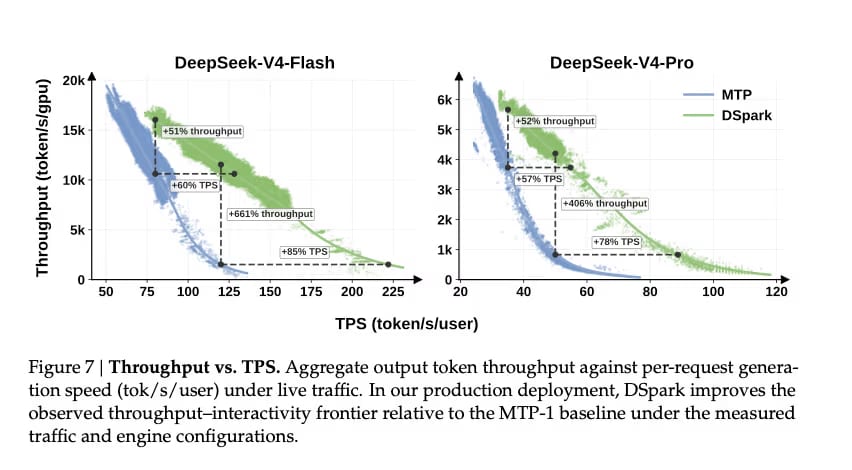
- DeepSeek released DSpark, an MIT-licensed speculative decoding system for its V4-Flash and V4-Pro models, and published the paper, checkpoints, and DeepSpec repo behind it, with DeepSeek reporting up to 85% faster per-user generation versus MTP-1 at matched capacity.
- In DeepSeek’s live production tests, the reported per-user speedups were 60% to 85% on V4-Flash and 57% to 78% on V4-Pro over the prior MTP-1 baseline.
- Aggregate throughput also rose 51% for V4-Flash at an 80 tokens-per-second-per-user target and 52% for V4-Pro at 35 tokens per second per user.
- DeepSeek said the method is not limited to DeepSeek-V4, and its own tests and released checkpoints also cover Qwen and Gemma.
- It is not an outside-API toggle, because the operator needs control over the weights, token verification loop, batching behavior, and serving scheduler.
My take: I think the graphs here are enough to show the importance of this discovery. DSpark uses speculative decoding in which a small draft component proposes next tokens and a larger target model verifies them in parallel. In DeepSeek’s reported tests, using DSpark made token generation 57 to 78% faster on DeepSeek-V4-Pro compared to the MTP-1 baseline. It can also be used on non-DeepSeek models like Qwen and Gemma.
However, this is not something you just plug in and use. It needs to be done at a low level by model providers. DeepSeek did open source the paper, model checkpoints, and the DeepSpec training and evaluation repo, so any other company can go ahead and implement it if they do not already have something similar in place.
Read more:
- AlphaSignal: How DSpark Speeds Up LLM Inference
- DeepSeek GitHub: DeepSpec Repository
- MarkTechPost: DSpark Overview
- Reddit: Discussion of DSpark in LocalLLaMA
Market & Vendor Moves
Kling AI Raises Initial $2 Billion at $15 Billion Pre-Money Valuation
https://finance.yahoo.com/technology/ai/articles/china-kling-ai-raises-2-151847318.html
The News:
- On July 2, Kling AI, Kuaishou Technology’s video AI spinoff that generates videos and short films from user prompts, raised an initial $2 billion to expand its video AI operations.
- Kuaishou said Kling was valued at $15 billion before the deal.
- The round could grow to about $3 billion as more investors join.
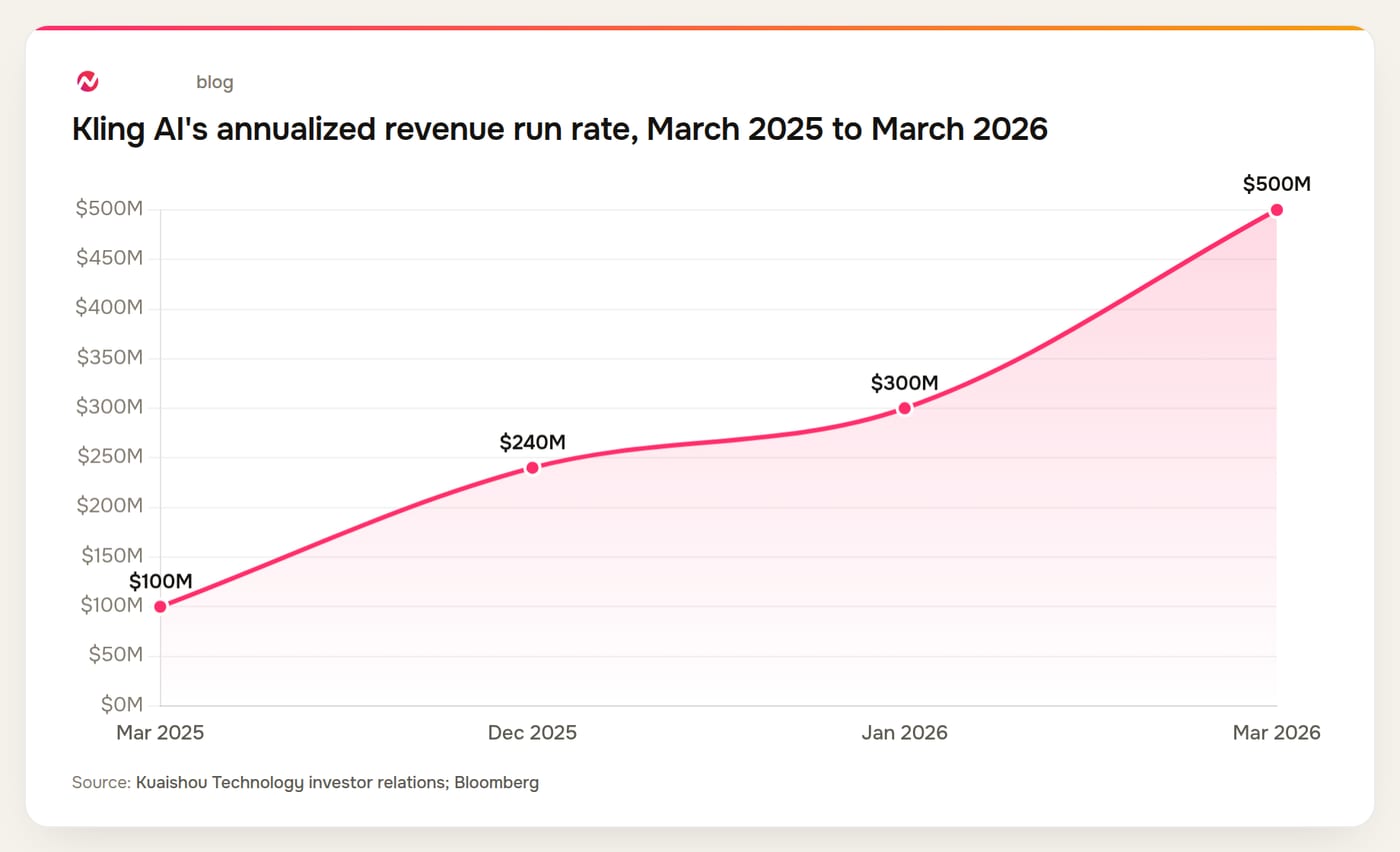
- Annual recurring revenue grew to about $500 million in March from $300 million in January, driven by Kling 3.0.
- First-quarter revenue was over 650 million yuan ($96.2 million), up more than 300% from a year earlier.
- Kling 3.0 extended video duration to up to 15 seconds and added native audio across multiple languages, dialects, and accents.
My take: With China ramping up production of their own custom chips, companies like Kling should be able to grow at a remarkable speed. Kling makes good money already. ARR is up to $500 million following the Kling 3.0 launch, up from $300 million in January. If China can just produce enough hardware chips to meet the demand from companies like Kling, I have no doubt they will have one of the strongest AI video propositions in the world next year.
Read more:
- CNBC: Tencent joins Kling AI funding round
- PR Newswire: Kling AI launches 3.0 model
- Reddit: Discussion of Alibaba and Tencent backing Kling AI
- Reddit: Discussion of Kling AI spinoff funding
- SCMP: Kling AI revenue jumps 300%
Qualcomm Agrees to Acquire Modular
The News:
- Qualcomm announced an agreement to acquire Modular, an AI software infrastructure company, to strengthen its software foundation for generative and agentic AI across data center and edge environments, with the deal expected to close in the second half of 2026.
- Its unified platform runs models across CPU, GPU, NPU, and custom ASIC architectures without rewrites for each accelerator.
- MAX exposes an OpenAI-compatible endpoint for open models including DeepSeek, Gemma, and Qwen.
- A free self-hosted Community Edition runs on NVIDIA, AMD, and Apple Silicon, according to Modular’s pricing page.
- In a vendor-reported benchmark, Modular said Gemma 4 on MAX was 15% faster than vLLM on NVIDIA B200.
My take: This news is interesting from two perspectives. First, it is a clear indication Qualcomm is moving towards being an AI inference platform provider, and increased competition in this area is always good to bring token prices down. Secondly, Modular’s platform in itself is interesting. In Sweden we have a few companies providing hosting of local models like Airon and Berget AI. Airon provides inference on NVIDIA stacks where Berget AI focuses on AMD infrastructure. Their USP is that they provide the full stack to host local models like Qwen, Gemma, DeepSeek and GLM, including the inference engine, optimizations, and API. Modular’s platform offers all of this, even exposing an OpenAI-compatible endpoint.
Modular’s platform lowers the bar to launch AI hosting by offering a full stack for local model providers. You just buy the hardware, plug in Modular, and you are well on your way to becoming an AI inference provider. Modular already has a free self-hosted Community Edition, and if Qualcomm continues to offer it for free or at least very cheap, this means we will soon start to see heavy competition in the local model hosting arena.
Read more:
- CNBC: Qualcomm Buys Modular to Bolster AI Software
- Modular: Editions and Pricing
- Modular: Gemma 4 on MAX Benchmark
- Modular: MAX Inference Framework
- Spheron Network: Modular MAX and Mojo on GPU Cloud
Palantir’s Alex Karp Calls AI Industry “Effing Insane”

The News:
- On July 1, Palantir CEO Alex Karp used a CNBC interview about Palantir’s Nvidia partnership, which aims to help the U.S. government use AI more securely, to call the industry “effing insane,” and Palantir shares rose more than 9% that morning.
- He said CEOs he speaks with are “livid” with leading AI companies, and that Palantir’s recent Nvidia deal was designed to relieve those concerns.
- Karp accused AI companies of imposing a “wealth tax” by charging high fees while collecting customer data that could improve their own models.
- On national security, he argued the U.S. should not rely on Silicon Valley AI companies for military technology, calling that “effing insane.”
- Palantir said the Nvidia initiative will run NVIDIA AI and Nemotron open models in sovereign environments for U.S. government agencies and critical infrastructure.
My take: Palantir’s core business is a vertically integrated data and workflow platform with services for government and large enterprises. They pitch themselves as a system of systems where you integrate data, build operational workflows, and then plug in whatever models you want on top, whether LLMs, ML, or heuristics. Palantir founded the now popular term “forward-deployed engineer” for consultants working on-site at their clients, integrating their platforms and experimenting with features that they later bring back to improve the core offering. The recent launch of massive consultant companies by Anthropic, OpenAI, and now Microsoft, however, is a direct hit against Palantir’s core business.
Anthropic, OpenAI, and Microsoft all have their own foundation models; Palantir does not. Of course their CEO will go out and say they are insane in their pricing, accusing them of imposing a wealth tax, and at the same time partner up with NVIDIA. However, there are no details at all on exactly how Palantir will work with NVIDIA. So far it is just a vague collaboration to help the U.S. government use advanced AI more securely. If you want to be a platform provider in the new economy, you also need to own your models. Palantir does not. Otherwise, your competitors will come from both sides: from the model providers themselves, and from independent consultancy companies without their own platforms that help customers build their own infrastructures. Building software platforms is becoming easier by the month now.
Read more:
- CNBC: Alex Karp on New Nvidia Deal
- eeNews Europe: Palantir and Nvidia Target Secure U.S. Agency AI
- GOV.UK Digital Marketplace: Palantir Foundry & AIP
- Palantir Investor Relations: NVIDIA Nemotron Open Models in Sovereign Environments
- Palantir: AIP Overview
Policy & Risk
OpenAI in Talks to Give Trump Administration 5% Stake
https://edition.cnn.com/2026/07/02/business/openai-trump-stake-intl

The News:
- CNN, citing the Financial Times, reported that OpenAI has discussed giving the Trump administration a 5% stake in the company amid growing government scrutiny of AI firms.
- CNBC said that holding would be worth about $42.6 billion at OpenAI’s March valuation.
- On March 31, OpenAI said it closed $122 billion in committed capital at an $852 billion post-money valuation.
- Intel announced in August 2025 that the U.S. government would buy 433.3 million shares, equal to a 9.9% stake, for $8.9 billion.
- OpenAI launched OpenAI for Government in June 2025, and said its first DoD pilot has a $200 million ceiling.
My take: Five percent does not sound like much, but at the current valuation, that equals around $42.6 billion. This would not be the first time the government took ownership in tech companies; in August last year, the U.S. government announced an agreement to buy a 9.9% stake in Intel. There are two sides to the discussions reported by CNN and the Financial Times. Owning part of a profitable company creates a clear conflict of interest for the government. Future decisions on antitrust, procurement, safety rules and export controls come into a direct clash with seeking financial upside. For example, OpenAI’s first Department of Defense pilot already has a $200 million ceiling. For OpenAI, there are probably mostly upsides to this, since the government will also have a financial interest in pushing AI development forward.
Read more:
- CNBC: OpenAI proposes 5% stake to Trump administration
- Facebook / Cato Institute: Reaction to OpenAI government stake
- Intel: Agreement to accelerate American technology and manufacturing leadership
- OpenAI: Introducing OpenAI for Government
- OpenAI: OpenAI raises $122 billion
ITU Launches AI for Good Global Commission With 44 Founding Members
https://www.itu.int/en/mediacentre/Pages/PR-2026-07-02-AI-for-Good-Global-Commission.aspx

The News:
- On July 2, ITU, the UN agency for digital technologies, launched the AI for Good Global Commission, a new multistakeholder AI body co-chaired by Rwanda’s President Paul Kagame and Salesforce CEO Marc Benioff with 44 founding members.
- The roster includes Andy Jassy, Jensen Huang, Brad Smith, Jack Clark, and multiple heads of state and government.
- A key focus is the digital divide, with ITU saying 2.2 billion people remain offline.
- ITU says the group is meant to strengthen trust, support responsible innovation, and ensure developing countries participate.
- Its inaugural meeting is scheduled during ITU’s AI for Good Global Summit in Geneva on July 7-10.
My take: This is a good initiative. It is easy to forget that we still have billions of people with internet access who still do not have access to AI. There are just so many questions. For example, among the list of participating companies we have Amazon, Nvidia, Microsoft, and Anthropic, but OpenAI and Meta are not on the published list of founding members. And Alphabet is represented by James Manyika, not Sundar Pichai.
There have been a few similar initiatives in recent years with little result, so hopefully this will actually lead to something positive for all, not just be a way for AI vendors to try to find new market opportunities.
Read more:
- AI for Good: UN AI Actions
- Axios: UN Launches AI for Good Commission
- ITU: AI for Good Global Commission
- Mint: Founding Members of Global Commission on AI
Frontier Signals
Meta Releases Brain2Qwerty v2 With 61% Word Accuracy
https://ai.meta.com/blog/brain2qwerty-brain-ai-human-communication/
The News:
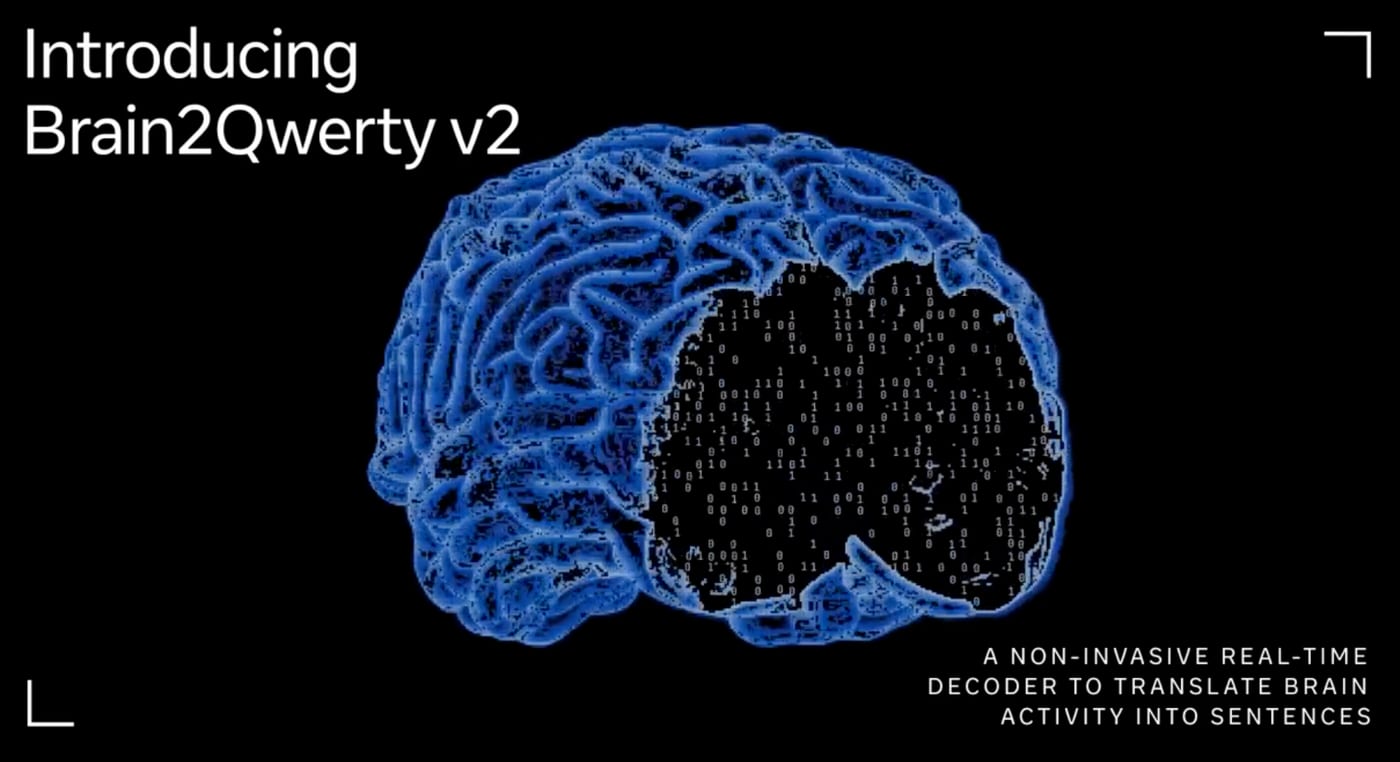
- Meta published Brain2Qwerty v2, a non-invasive MEG-based brain-to-text system that decodes sentences from brain recordings captured while people type, reporting 61% word accuracy.
- Training used about 22,000 sentences from nine volunteers, each recorded for 10 hours while actively typing.
- The best participant reached 78% word accuracy, versus 8% for other non-invasive methods cited by Meta.
- Meta released the full training code for Brain2Qwerty v1 and v2, and partner BCBL is releasing the v1 dataset.
- Meta says accuracy improved log-linearly with data volume, suggesting more training data could narrow the remaining gap with surgical approaches.
My take: Interesting research experiment, but this is not a system that is able to translate your random thoughts into text using just a MEG machine. Instead, they asked nine participants to type different sentences for 10 hours while at the same time measuring their brain activity. Then they asked them to type new sentences and were able to predict 61% of the words just by measuring their brain waves. We have seen similar systems before, so it is still unclear if this can be used for something useful like allowing paralyzed people to communicate by thought, but it is still an interesting experiment.
Read more:
- arXiv: Brain-to-Text Decoding: A Non-invasive Approach via Typing
- LinkedIn / Suk H.: Post About Brain2Qwerty Limitations
- Reddit: Discussion of Brain2Qwerty on r/singularity
- The Next Web: Meta’s Brain2Qwerty Reads Typed Sentences From the Brain
IBM Debuts 0.7 nm Nanostack Chip Technology
https://research.ibm.com/blog/sub-1nm-node-chips

The News:
- On June 25, IBM unveiled the world’s first sub-1 nanometer chip technology, a nanostack design that fits roughly 100 billion transistors on a fingernail-sized chip.
- IBM says the 0.7 nm, or 7 angstrom, node could offer up to 50% more performance or 70% greater energy efficiency than its 2021 2 nm chip.
- Nanostack bonds two wafers into a multilayer structure, creating a true 3D transistor design that increases density by stacking upward instead of only shrinking in 2D.
- IBM says 7 angstrom is a process-generation label, not the width of the chip’s contacted metal wires.
- The design scales SRAM by 40%, and IBM researchers estimate AI accelerators using the technology could reach about 9,000 TOPS versus about 1,500 TOPS today.
- IBM says it sees a path to production in as early as five years, while widescale 2 nm adoption is still closer to the end of the decade.
My take: This is a major step forward in chip technology, not only being able to reach below 1 nanometer, but also providing 70% better energy efficiency than their previous 2nm node. As with all chip technology, while it is branded at 0.7 nm, this refers to a process generation and is not really 0.7 nm in the physical width of the contacted metal wires.
It will take some time before this is launched though. Widescale adoption of 2nm chips is set for the end of this decade, with 1.4nm and 1nm nodes following after that. IBM sees a path to production in as early as five years, so we won’t be seeing these chips for at least 5 years or so. But if you thought hardware innovations would somehow plateau in the next 5 to 10 years, you now know that they won’t.
Read more: