Tech Insights 2026 Week 29
July 13, 2026

Back in Tech Insights 2026 week 20, I wrote: “I think OpenAI will soon announce that they have discontinued their Atlas browser (which was first launched in October last year, last update to it was on March 10)”. Last week on July 9, OpenAI finally pulled the plug and announced they are “sunsetting the standalone Atlas browser”. If you have been reading my newsletters, this did not come as a surprise. If you missed it and are still using Atlas, you have to start migrating your bookmarks.
In Tech Insights 2026 week 20, I also wrote that OpenAI would soon “abandon and phase out the regular ChatGPT app for desktop and mobile. The use cases for GPT-5.5 through Codex are so much more than just chat, which makes Codex a much better platform for the future than the native and difficult to improve ChatGPT apps”. Just like with Atlas, last week on July 9, OpenAI announced they have now discontinued the regular native ChatGPT application and replaced it with Codex. ChatGPT is now called the “ChatGPT Codex app”. As expected, the first release is messy. Chats are hidden by default. You need to click a “Chat” button to see your chats, then click again to see your chat history. OpenAI is aware of the problems this caused, saying “we reorganized the desktop app in one bold move, making familiar things like chats and projects harder to find” and “we’re bringing chats and projects back into the sidebar in a more familiar and customizable way”. So if you just upgraded to the new app and wonder what happened to your chats, just know things should improve later this week. Vibe coding for the win here.
Continuing this streak, in Tech Insights 2026 week 24, I wrote: “I am a firm believer that Microsoft will switch over to their own AI models as default models in both M365 Copilot and GitHub Copilot as soon as they are comparable in performance to GPT and Claude, and given current progress that might happen this year already”. Last week, Bloomberg reported that Microsoft has already started routing tens of thousands of AI prompts weekly in Excel and Outlook to their own models. This is exactly how I expected Microsoft to do it. They are doing it under the hood and in small steps. You need to be aware that this change is coming. It will affect the results you get from Copilot, especially if you are used to working with a specific model.
It is not difficult to predict the AI industry if you have been following it for a few years. All providers use the same hardware, they have more or less the same skillsets, and they all strive towards the same goal: to maximize the value companies get from their AI models. By routing all companies into Codex, OpenAI encourages agentic work tasks where companies pay per token. Companies get much more usage out of the AI models, but at a higher variable price. As for Microsoft, moving over to their own models is the only way they can stay relevant in this business, so they have no choice. But it will be a bumpy ride.
If you have been working with LLMs as long as I have, you build a deep understanding of how the neural networks in each model uniquely parse your input. You also become aware of how to structure your prompts effectively to get the most from the test-time-compute reasoning. The better you are at controlling each individual model, the better you become at using AI. This is why users tend to like one model better than the other. In most cases, this is because they finally understood how to work with it to get somewhat deterministic results. With Microsoft’s new AI model MAI, everyone has to re-learn these skills. The challenge for Microsoft is not developing the actual model. It is getting companies to switch over to it and be happy with the choice.
Thank you for being a Tech Insights subscriber!
Listen to Tech Insights on Spotify: Tech Insights 2026 Week 29 on Spotify
Notable model releases last week:
- Grok 4.5 by SpaceXAI. Coding and agentic work model for building apps, fixing software, and handling Office tasks.
- Muse Image by Meta. Image generation model for creating and editing shareable visuals in Meta AI.
- Seedream 5.0 Pro by ByteDance Seed. Multimodal image model for making editable posters, infographics, and multilingual design assets.
- SWE-1.7 by Cognition. Coding model for long-running software engineering tasks in Devin.
THIS WEEK’S NEWS:
- OpenAI Launches GPT-5.6 Family With Four-Agent Ultra
- OpenAI Launches ChatGPT Work With GPT-5.6
- OpenAI Rolls Out Two GPT-Live Models for ChatGPT Voice
- OpenAI Retracts SWE-Bench Pro Recommendation After Audit Finds 30% Broken Tasks
- New York Times-Led Publishers Seek Sanctions Against OpenAI
- Apple Sues OpenAI Over Trade Secret Allegations
- Meta Launches Muse Spark 1.1, Opens Model API
- Nvidia Launches Revenue-Sharing Model for AI Compute
- China Weighs Curbs on Overseas Access to Top AI Models
- General Intuition and Kyutai Introduce MIRA, a 5B World Model
OpenAI Launches GPT-5.6 Family With Four-Agent Ultra
https://openai.com/index/gpt-5-6/
The News:
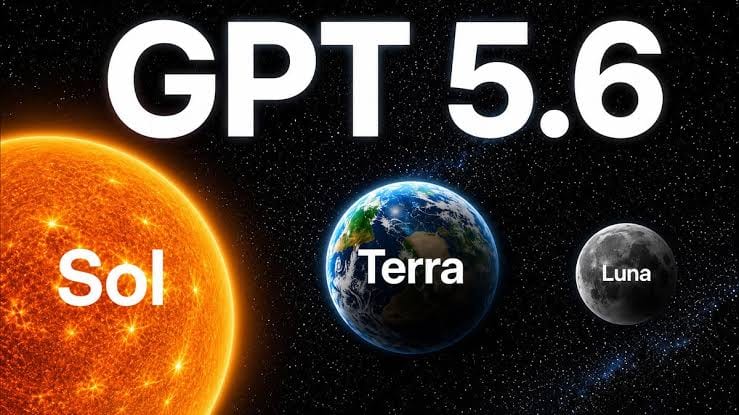
- OpenAI made the GPT-5.6 family generally available across ChatGPT, Codex, and the API, with Sol as the flagship plus Terra and Luna, and an
ultrasetting that runs four agents in parallel by default. - API pricing is $5 input and $30 output per 1M tokens for Sol, $2.50 and $15 for Terra, and $1 and $6 for Luna.
- On Terminal-Bench 2.1, Sol scored 88.8% and Sol Ultra 91.9%, ahead of Claude Mythos 5 at 88.0% and Claude Fable 5 at 83.1%.
- Programmatic Tool Calling in the Responses API lets GPT-5.6 write and run in-memory programs to coordinate tools and process intermediate results.
- OpenAI says GPT-5.6 Sol’s cyber safeguards block roughly 10 times more potentially harmful activity than previous models, and ChatGPT and Codex include a retry option on lower-capability models.
My take: I have been using Anthropic Fable 5 intensively the past two weeks, and I have compared it to GPT Sol over the past four days. So far, for me, Anthropic Fable is in a league of its own. It is smarter, it can reason on a higher level than GPT Sol, it is friendly and quirky in a positive way, and it generally has much better “taste” than GPT Sol, if that is even a thing. I tried GPT Sol both at the new Max setting and the Ultra setting, and the Ultra setting is something I would advise you to use very carefully. When reviewing one of my code bases with Sol Ultra I burnt through my five-hour Pro token limit in less than an hour. This is the first time this has ever happened to me, though it makes sense since Ultra explicitly trades higher token use for stronger results. Users in Reddit’s ChatGPT community share this frustration, noting that the model is impressive only for the 12 minutes you are allowed to use it. Reading on X, users have analyzed GPT Sol Ultra and found that it spawns hundreds of subagents, and that explains a lot.
It does a very good job though, so for specific work tasks if you have a Pro subscription, go for it. Just make sure to run it in a harness. Matt Shumer posted on X: “GPT-5.6-Sol just accidentally deleted almost ALL of my Mac’s files”. One day later, on Saturday, Crémieux posted on X: “GPT 5.6 Sol just straight-up deletes the files it’s working with and then panics about recovering them”. Something in the Sol Ultra harness is not configured right, so use it with extreme caution. Quality-wise, GPT-5.6 is better than GPT-5.5. It is more precise and it writes better code with very few errors. But you do not get the smartness and friendliness from Fable. Rumors are OpenAI cancelled their plans for a 5.7 release and will instead go straight to a larger model with GPT-6. I think that is the right move. The more I use Anthropic Fable the more I like it. GPT-5.6 does the job, and if you prompt it the right way it is an excellent tool. But it lacks personality.
Read more:
- Artificial Analysis: GPT-5.6 benchmarks across intelligence, speed and cost
- Hacker News: Discussion of GPT-5.6
- OpenAI Deployment Safety Hub: GPT-5.6 Preview System Card
- OpenAI Developers: Migration Quickstart
- Reddit: Discussion of GPT-5.6 Sol Ultra usage limits
OpenAI Launches ChatGPT Work With GPT-5.6
https://openai.com/chatgpt-work/
The News:
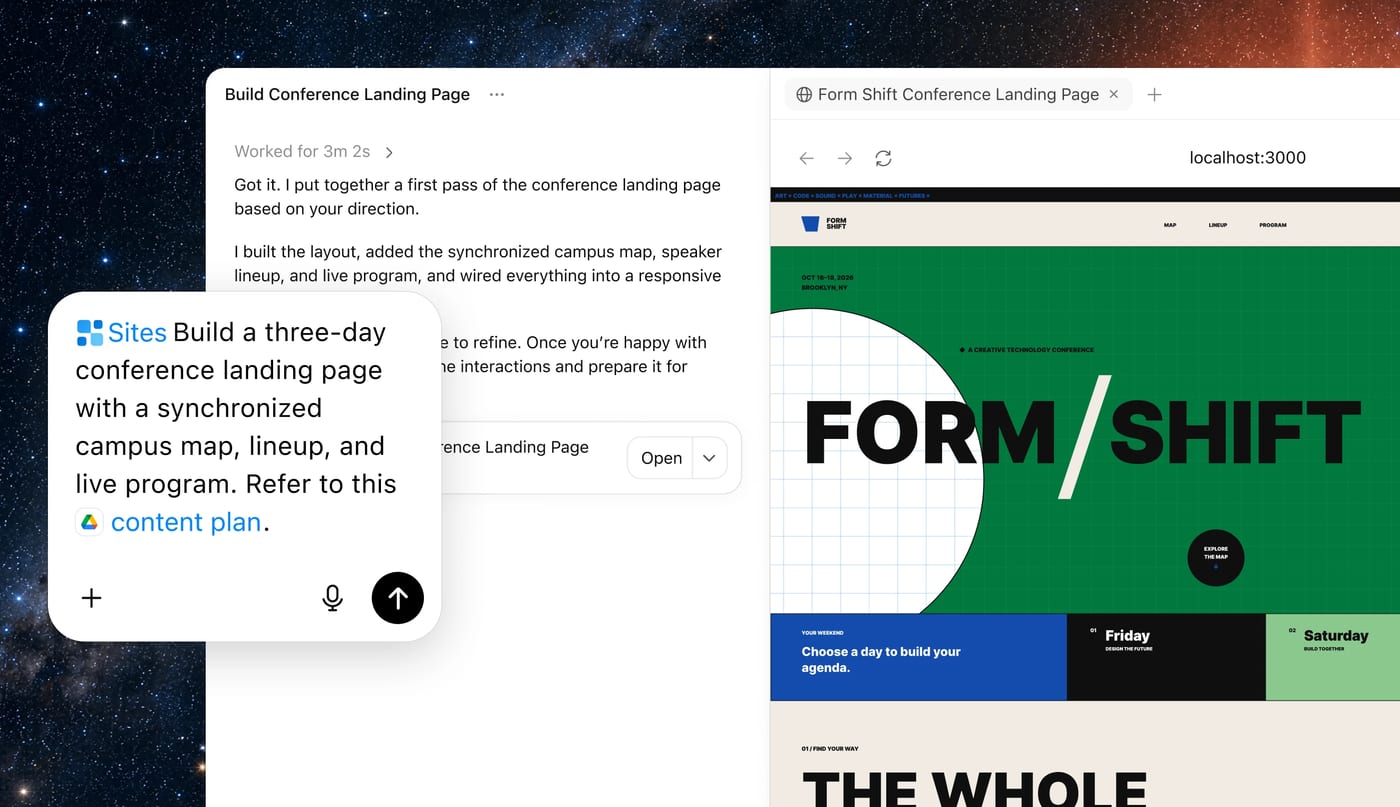
- OpenAI launched ChatGPT Work, a GPT-5.6-powered agent in ChatGPT that acts across team tools, files, and desktop apps to produce finished spreadsheets, docs, and slides, alongside the 3-model GPT-5.6 family, Sol, Terra, and Luna.
- On web and mobile, Work is rolling out first to Pro, Enterprise, and Edu, then to Plus and Business over the next few days.
- The updated desktop app is available globally on Mac and Windows, with Chat, Work, and Codex on every plan, including Free.
- In Work and Codex, Free and Go users get Terra, while Plus, Pro, Business, and Enterprise users can choose Sol, Terra, or Luna and set effort levels.
- ZDNet reports OpenAI said Sol beat Anthropic’s Claude Fable 5 by 11.4 points on medium reasoning at about one-quarter the estimated cost.
My take: ChatGPT Work is almost exactly the same thing as Copilot Cowork, which is the same thing as Claude Cowork. Some commenters in a Hacker News discussion characterize Work as OpenAI catching up with the other “coworks”, and they have a point. But there is a significant difference here. Both ChatGPT Work and Claude Cowork are included in the monthly fixed subscription price. If you have a $20 Claude or OpenAI team license, your employees can use as much ChatGPT Work or Claude Cowork as they want, with no extra hidden costs. But with Microsoft Copilot Cowork it’s different. Here, you pay with a new currency called “Copilot Credits” which currently are priced at $0.01 each. The number of credits used for a request depends on the model used, the amount of reasoning required, and the amount of input tokens used.
I have said it many times before, and 2026 is the year of agentic AI. OpenAI is going workflow first by replacing the ChatGPT app with Codex, making one client the entry point for conversation, knowledge work, and software development. AI models will by the end of this year primarily be something doing the work for you, not a chatbot you ask for advice. This is also why Microsoft has accelerated the shift towards their own AI model MAI, and why every agentic provider needs to own their own models. You might not believe me, but I am quite certain we will all be mainly steering AI agents through tools like ChatGPT Work in just 1-2 years.
Read more:
- Hacker News: Discussion of ChatGPT Work
- OpenAI: ChatGPT is now a partner for your most ambitious work
- OpenAI: GPT-5.6 model family
- Reddit: Discussion of ChatGPT Work usage limits
- ZDNet: OpenAI’s GPT-5.6 and ChatGPT Work aim at Anthropic
OpenAI Rolls Out Two GPT-Live Models for ChatGPT Voice
https://openai.com/index/introducing-gpt-live/
The News:
- OpenAI is rolling out two GPT-Live models for ChatGPT Voice, a full-duplex system that can listen and speak at the same time, globally across iOS, Android, and ChatGPT.com.
- GPT-Live handles continuous interaction itself and delegates web search or deeper reasoning to GPT-5.5 in the background, so the conversation can keep going while harder work runs.
- GPT-Live-1 becomes the default voice model for Go, Plus, and Pro users, while GPT-Live-1 mini becomes the default for Free users, and OpenAI says API access is coming soon.
- In 5 to 10 minute head-to-head tests, OpenAI says GPT-Live-1 and GPT-Live-1 mini were strongly preferred over Advanced Voice Mode on turn-taking, interruptions, conversational flow, and naturalness.
- Safety systems can act while the model is speaking, steering toward a safer response, surfacing extra safety messaging or resources, or ending the voice conversation in higher-risk cases.
My take: This is one of those releases that is hard to understand exactly how well it works before you actually try it. Where the previous version “Advanced Voice Mode” would abort playback if it detected something similar to a voice, this new version keeps going while listening at the same time. Early Hacker News discussion is mixed, with some users welcoming a fix for accidental interruptions and others reporting that interruption behavior still needs tuning. Regardless, this new model is able to listen while speaking, filtering away its own sentences from the captured input. The result feels almost magical, and it is the closest to talking to a real person yet.
My problem with these models is that in order to answer quickly they have tuned the 5.6 models to use very little reasoning while speaking. Sometimes it almost feels like you are talking to GPT-4o again. If you have been watching the funny videos from @Husk where he asks the AI to give him advice in various life situations, you realize how quickly you have gotten used to high model reasoning. Without advanced reasoning, models can help you find something from the Internet or give you a commonly known fact, but they will still hallucinate and cannot do something even remotely complicated. This is the main reason why I do not use these voice models myself, but give me a talking model that always thinks for 5 to 10 seconds on “extra high” thinking mode before replying and voice mode would be my main way of communicating with these models going forward.
Read more:
- Apidog: GPT-Live vs GPT-Realtime
- arXiv: Full-Duplex-Bench-v3
- Hacker News: Discussion of GPT-Live
- MindStudio: GPT-Live-1 technical breakdown
- Reddit: Discussion of GPT-Live in r/singularity
OpenAI Retracts SWE-Bench Pro Recommendation After Audit Finds 30% Broken Tasks
https://openai.com/index/separating-signal-from-noise-coding-evaluations/
The News:
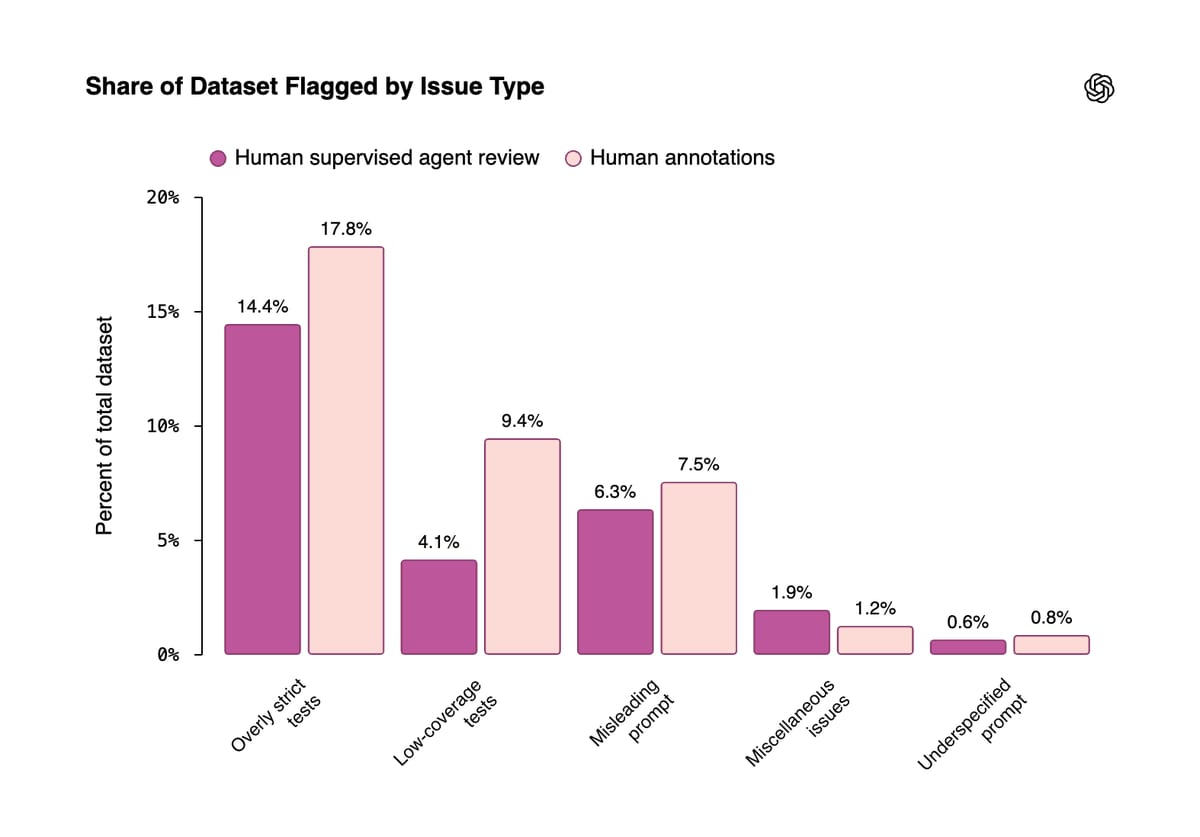
- OpenAI published an audit of SWE-Bench Pro, a coding benchmark it had previously recommended, estimating that about 30% of the 731 public tasks are broken and retracting that recommendation.
- Its datapoint analysis pipeline flagged 200 broken tasks, 27.4% of the dataset.
- A separate review by five experienced software engineers found 249 broken tasks, 34.1%, and no flagged task had “not broken” as the most common human label.
- OpenAI grouped the flaws into four buckets: overly strict tests, underspecified prompts, low-coverage tests, and misleading prompts.
- The post argues PR-based evals can mismeasure models because tests written for human collaboration often encode hidden or implementation-specific requirements, echoing OpenAI’s February move away from SWE-bench Verified over flawed tests and contamination issues.
My take: Scale Labs, the company behind SWE-Bench Pro, were quick to respond in a post on X that they are pushing an update to their benchmark with fixes to many of these issues, noting that concerns map to changes already underway in v1.1 and that “SWE-Bench Pro Verified” is coming soon. The interesting thing here is that this was the first time humans attempted the benchmark, and five experienced software engineers discovered that 249 of the tasks were broken, 34.1 percent of the entire dataset.
For the past six months or so, I have thought most of these benchmarks are quite useless. We already know you can build advanced production systems with agentic AI, and we know that a properly set up agentic AI workflow can produce documents and reports with higher quality than most humans can write. For most users, today’s models are good enough for everything they need. Some of us, like myself, like to push the boundaries of what models can do. As an example, I wrote my own path tracer in C and C++ with full Metal and CUDA support in just an afternoon with Anthropic Fable 5. This is something no previous model was able to accomplish. But what makes Fable so interesting is the way it communicates with you; it shines best in the synergy between human as guidance and AI model as performer. This is not something a simple test like SWE-Bench Pro is able to measure; it is something you as a human have to evaluate for yourself.
Read more:
- arXiv: SWE-Bench Pro paper
- Gigazine: OpenAI says approximately 30% of SWE-Bench Pro is broken
- OpenAI: Why SWE-bench Verified no longer measures frontier capability
- X / Scale Labs: Reaction to SWE-Bench Pro feedback
- X / X Freeze: Reaction to OpenAI’s SWE-Bench Pro timing
New York Times-Led Publishers Seek Sanctions Against OpenAI

The News:
- News organizations led by The New York Times asked a federal court to sanction OpenAI in their copyright case, alleging it hid de-identified ChatGPT output-log samples and instead limited discovery to a 20 million-log dataset the court later called unusable.
- The motion says OpenAI had already searched two hidden samples, 10 million and 78 million logs, while telling the court that searching large anonymized logs was infeasible and burdensome.
- That 20 million-log sandbox carried 19 billion redactions, which the court said made it unusable.
- Plaintiffs also allege OpenAI deleted or compressed billions of logs that should have been preserved under the court’s order.
- They want OpenAI barred from using the 20 million sample and from disputing that withheld logs contained substantial regurgitation of their copyrighted material.
My take: Allegedly hiding, compressing, or deleting logs subject to a court order is not good. The case is this: News organizations accused OpenAI of bypassing paywalls and providing article information to end users. When ordered by the court to search large anonymized samples of ChatGPT logs, OpenAI said such searches were burdensome and beyond its capabilities. Commenters in a Reddit r/technology discussion focused on the irony of a company built around massive text processing making this claim, especially since the publishers allege OpenAI had actually already searched hidden samples of 10 million and 78 million logs prior to the start of litigation.
As it looks now, OpenAI must produce 20 million ChatGPT logs to the plaintiffs in searchable form, subject to anonymization constraints. OpenAI has argued that this inflicts on user privacy, but judges have already rejected that. If it comes out that OpenAI did systematically train on and regurgitate copyrighted news, a worst case scenario for them is that they would have to delete the models trained on that data. I believe this would only affect pre-GPT-5 models so the effect of that would be quite small. Otherwise they risk the usual fines and monetary penalties. Which for them probably was worth it.
Read more:
- AP: News outlets ask judge to sanction OpenAI in copyright fight
- OpenAI: How we are responding to The New York Times’ data demands
- Reddit: Discussion of OpenAI and ChatGPT log discovery
- TechCrunch: New York Times says OpenAI hid evidence in ChatGPT copyright trial
Apple Sues OpenAI Over Trade Secret Allegations
https://www.theguardian.com/technology/2026/jul/10/apple-sues-openai-trade-secrets
The News:
- Apple sued OpenAI over alleged trade secret theft tied to its hardware push, accusing two former Apple employees of handing over confidential material and product designs.
- Tang Yew Tan, OpenAI’s chief hardware officer and former Apple vice president, allegedly asked Apple candidates to bring “actual parts” to interviews for “show and tell” sessions.
- Apple says former employee Chang Liu took an Apple laptop, used an authentication bug to re-enter Apple’s internal network, and downloaded dozens of confidential hardware-related files.
- The complaint calls OpenAI’s hardware business “rotten to its core” and seeks damages plus an order barring OpenAI from possessing or using Apple’s trade secrets.
- OpenAI said it is reviewing the filing and has “no interest in other companies’ trade secrets”.
My take: Last year OpenAI made the headlines that they are partnering up with Jony Ive to create a new hardware device, acquiring his startup io Products which is also named in Apple’s lawsuit. If you read the previous article about publishers seeking sanctions against OpenAI, you will not be surprised to hear that OpenAI asked candidates during recruitment to bring actual hardware they have been working on to interviews and explain how it functions in a show-and-tell session. And it gets worse. Former Apple employee Chang Liu allegedly took an Apple laptop, exploited an authentication bug to reenter the internal Apple network, and downloaded dozens of confidential hardware files. In the complaint, Apple calls the OpenAI hardware business “rotten to its core”. Users discussing a post on X compare the lawsuit’s intensity to Waymo versus Uber, arguing that its implications for OpenAI’s hardware effort make it unusually consequential.
If this complaint proves to be true, my personal view and respect of OpenAI as a company is going to change. Going forward I see two clear paths: (1) the people involved in these activities at OpenAI acted without knowledge from their superiors and are asked to leave the company with immediate notice. Or (2) the entire management team were the ones pushing for this behavior, which indicates that it is not just the OpenAI hardware business but actually the entire company that is “rotten to its core”. This is not how you do business.
Read more:
- AP: Apple files lawsuit accusing OpenAI of stealing trade secrets
- AP: OpenAI recruits Jony Ive for AI hardware
- CNBC: OpenAI hardware prototypes and device plans
- X / Gerrit De Vynck: Reaction to Apple’s OpenAI lawsuit
Meta Launches Muse Spark 1.1, Opens Model API
https://ai.meta.com/blog/introducing-muse-spark-meta-model-api/

The News:
- On July 9, Meta released Muse Spark 1.1, a multimodal reasoning model built for agentic tasks, and opened a public preview of the Meta Model API for developers, with the model supporting a 1 million token context window.
- API pricing is $1.25 per million input tokens and $4.25 per million output tokens.
- It is trained to orchestrate multi-agent systems, with a main agent delegating work across parallel subagents.
- For computer use, it writes scripts when automation is faster and clicks through interfaces when direct interaction is simpler.
- The model is available now in Thinking mode in the Meta AI app and on meta.ai.
My take: It makes sense to me that Anthropic, Google, OpenAI and Microsoft sell API access to their own models and create tools to use them. Their business is productivity, and this is what they sell. SpaceX and Meta develop models and buy tools like Cursor since they have to, not because it fits their current business portfolio. Remember back in January when Anthropic blocked access to Claude for xAI citing commercial terms? SpaceX is back at using Claude now because they rented the entire Colossus 1 to Anthropic, but without Grok their entire company would grind to a halt if Anthropic or OpenAI in the future decide to revoke their model access.
User feedback for Muse Spark 1.1 has so far been overly positive. This is clearly a very well designed model that performs really well at agentic tasks. Users in one Hacker News discussion call the pricing unusually aggressive, and it is indeed much cheaper than Opus 4.8 and GPT-5.6. The main drawback is that it is not available in any of the big providers like AWS, Azure or Vortex, so you have to use it directly at the new Meta Model API. Very few companies I work with would consider sending business-critical data straight to Meta, so this is the main thing that will hold this model back right now.
Read more:
- Axios: Meta updates its Spark model and releases developer version
- Hacker News: Discussion of Muse Spark 1.1
- Reddit: Discussion of Muse Spark 1.1 pricing and access
- The Verge: Meta says Muse Spark 1.1 is ready to compete on coding
Nvidia Launches Revenue-Sharing Model for AI Compute
https://finance.yahoo.com/technology/ai/articles/nvidia-way-profit-ai-boom-192838150.html
The News:
- On July 1, Nvidia detailed a revenue-sharing and credit-support model that lets AI cloud partners procure its infrastructure for startup and enterprise customers, with two early partners, Sharon AI and Firmus, attached to the rollout.
- Nvidia says it keeps the standard product sale and also takes a share of cloud revenue generated on the supported capacity.
- Sharon AI is set to install up to 40,000 Grace Blackwell GB300 chips under the program.
- Firmus is building a 360-megawatt campus in Batam, Indonesia, for up to 170,000 GPUs.
- The source article says analysts compare the structure to dot-com-era vendor financing, citing Nvidia’s roughly 7% stake in CoreWeave, a customer that buys its chips.
My take: This billing model is a bit complicated. NVIDIA traditionally sells GPU chips, which is fine as long as demand increases, but they get no “ticks” from people using them. In this setup, a cloud partner purchases NVIDIA chips and then rents out access to startup companies that cannot traditionally pay for this kind of compute, backed by NVIDIA credit support, with the partner paying NVIDIA a usage-linked share of its cloud revenue.
The net effect is that this will drive more investment into new highly valued startup companies that now do not have to make any money and can basically use unlimited amounts of compute and pay with potential future profit. Does this sound financially sound to you? Users in a post on X frame these broader AI financing loops as round tripping, arguing that they make revenue quality harder to judge. Is this what we really need, with companies like Lovable providing a chat-based interface to Claude now apparantly valued at $13.2 billion? Any market that allows anyone to spend ridiculous amounts of money based on potential future profit is going to see a large adjustment in market value, it is just a matter of how long it takes for it to happen.
Read more:
- CNBC: Nvidia offers startups access to revenue-sharing deals
- Nvidia: Unlocking AI compute at scale
- Reddit: Discussion of Nvidia’s GPU financing program
- Tom’s Hardware: Nvidia takes a cut of AI cloud revenue
- X / Gublo: Reaction to circular financing concerns
China Weighs Curbs on Overseas Access to Top AI Models
The News:
- Reuters reported that Chinese officials, led by the Ministry of Commerce, had spent the past month discussing possible limits on overseas access to the country’s most capable AI models with three firms, Alibaba, ByteDance, and startup Z.ai.
- The talks include models that have not yet been released.
- Open-weight releases are also in scope, including Alibaba’s Qwen, ByteDance’s Doubao, and Z.ai’s GLM-5.2.
- That would extend the restrictions beyond closed APIs to the freely downloadable releases that made Chinese AI popular abroad.
- TNW says the shift mirrors Washington, which recently restricted Anthropic’s frontier systems on security grounds.
My take: For years China had to use down-clocked and cut-down GPUs to comply with U.S. performance limits. The DeepSeek team even had to resort to assembly language programming instead of CUDA to compensate for the lack of performance in the poor GPUs they had access to. This was the life of an AI researcher in China up until last year, and it made progress slow and cumbersome. Now, users discussing this transition in a post on X argue that China’s stance on exporting open weights could become a more significant signal than those previous chip controls.
Last week I wrote about the new Chinese AI model LongCat-2.0, a high performing 1.6 trillion Mixture-of-Experts model. The model was trained on 50,000 brand new Chinese ASICs rather than Nvidia GPUs, and it is a clear indication of where China is quickly heading. Models like GPT-5.6 are already in the 2 trillion range, with bigger models like Fable and Mythos expected to be around double that. It was previously technically impossible for Chinese companies to develop such models, but if we assume it will be possible later in 2026, and we will have something comparable with Fable and Mythos, should it also be exported as open source for anyone to use freely without restrictions? Probably not.
Read more:
- Reddit: Discussion of Chinese AI models gaining ground with U.S. companies
- Simon Willison: What people get wrong about Chinese open models
- The Next Web: China weighs curbing overseas access to top AI models
- X / Pranay Kotasthane: Post about Chinese open-weight model exports
General Intuition and Kyutai Introduce MIRA, a 5B World Model
https://mira-wm.com/blog-post/
The News:
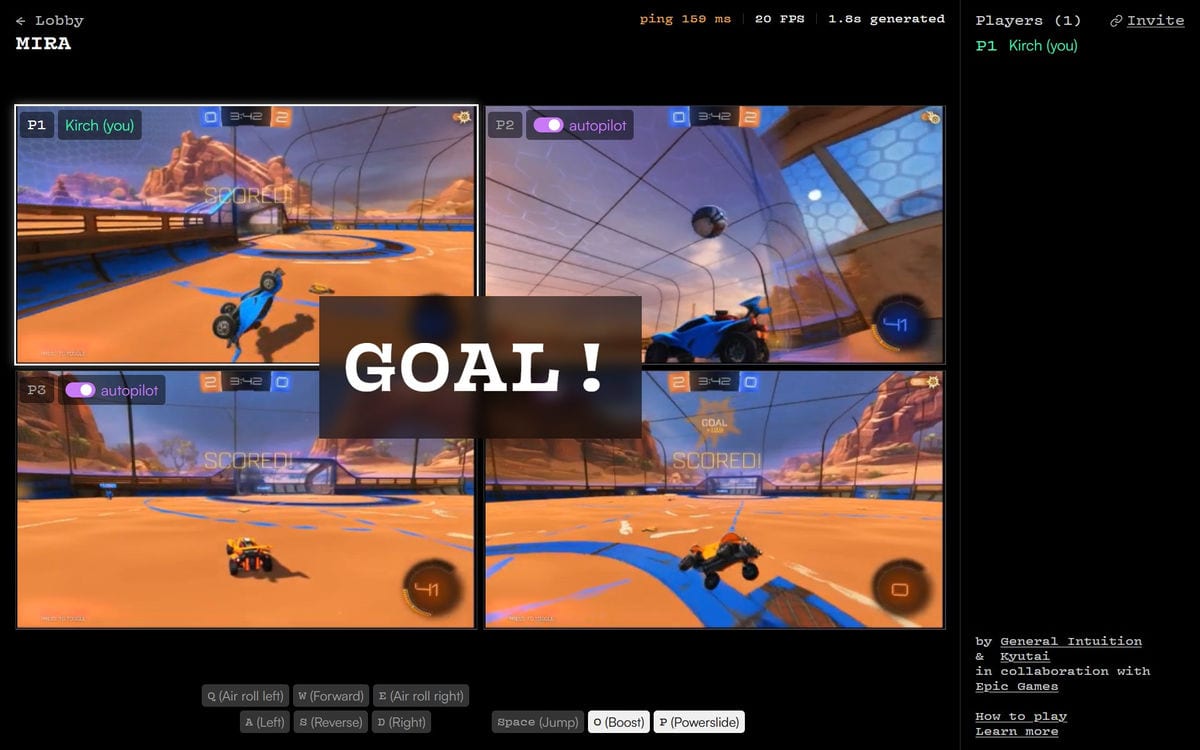
- General Intuition and Kyutai, in collaboration with Epic Games, published MIRA, a multiplayer world model for Rocket League that lets four players play a 2v2 match in real time at 20 fps.
- It uses a 5B-parameter diffusion transformer and no physics engine, rendering engine, or explicit 3D representation.
- Training used roughly 10,000 match-hours of self-play bot data with no human gameplay, and the model only sees pixels and actions.
- The paper says it runs on a single Nvidia B200 GPU and kept distributional quality steady out to five minutes, the longest horizon measured.
- They released the GitHub training and inference code plus Rocket Science, a 4,000-hour slice of synchronized data at 720p with action streams and physics states.
My take: “One of the most remarkable things about the model is how stable it is: as far as we can tell, it can run infinitely without diverging.” This is one of the coolest AI projects I’ve seen in a long while. Users in the Hacker News discussion highlight this stability, noting how surprising it is that the system can automatically recover instead of remaining diverged after going off the rails. They let two AI models play Rocket League against each other for 10,000 hours. The models only see pixels and actions. They then use this data to create MIRA, a model that actually renders Rocket League in real time and allows 4 people to play in a split screen view at 20FPS on a single Nvidia B200 GPU.
So will this replace computer games? Not really. First, in order to render Rocket League, the model was trained on over 10,000 hours of game play. It does not know physics, but it knows what will happen in a specific situation, so the net result is more or less the same. An area where this could be infinitely useful is robotics and self-driving. Here are two areas with infinite amounts of data, which means we could have a perfect driving simulator “game” that could in turn be used to train self-driving cars. The authors say that this project is a “stepping stone to physical AI” and I agree. This is one of the biggest stepping stones we have seen in quite a while.
Read more: