Tech Insights 2026 Week 39
September 21, 2026

Two weeks ago Dario Amodei, CEO of Anthropic, published a blog post titled “We Must Pace the Frontier”, where he proposes a global pacing of AI development in cooperation with China. Sam Altman posted on X that he agrees, and so did Elon Musk.
Last week there was a lot of pushback on this. Mark Zuckerberg argued that each lab already has its own “responsibility and incentive” for pacing itself safely. Donald Trump called AI risks a “hoax”, and China’s foreign ministry spokesperson Guo Jiakun told reporters that “cooperation in taking things slower and more safely in relation to AI, is very, very unlikely”. Jensen Huang in an interview on Friday summed it up as, “We’re going to go as fast as we can”.
In an interview with The Verge, Mustafa Suleyman directed his feedback specifically at Anthropic: “Anthropic has made the choice to say, “You should think about whether you have feelings and whether you deserve human rights.” That is reflected in Anthropic’s training materials. If you want that to stop, if you think that’s the wrong approach and that will lead to safety issues down the road, the two mechanisms are one, the governments of the world can tell Anthropic, “Don’t do this. This is an illegal way of providing training materials to the model.””
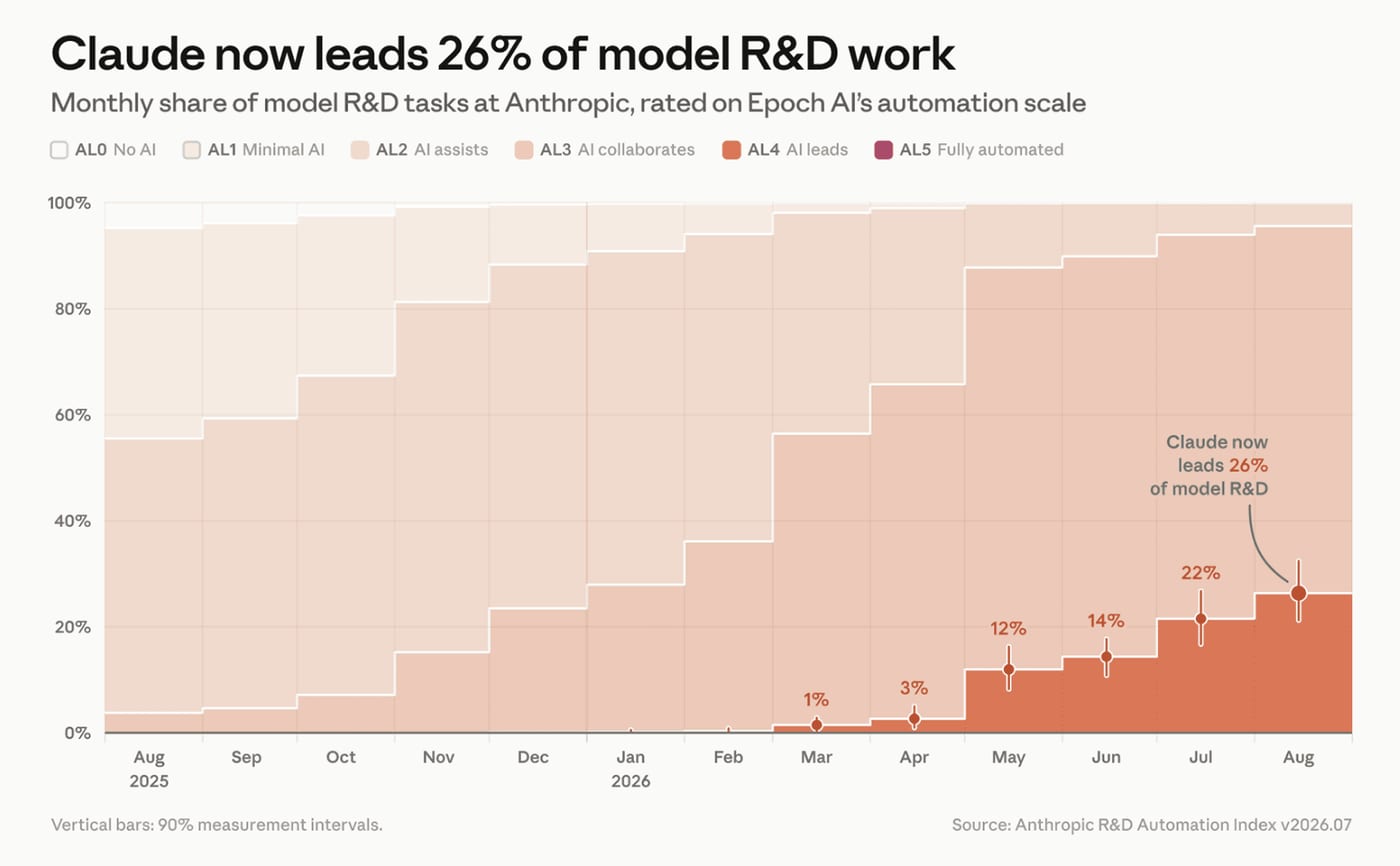
Inside Anthropic, Claude now does 26% of their internal AI R&D work. Not as an assistant, but actually coordinating and leading the work. It was 1% in February. It’s easy to understand why some companies think we should slow down, and it’s also easy to understand why some think we should not. As it is now, the majority thinks we should go “as fast as we can,” so this is how I think it will continue for the foreseeable future. We’ll just have to deal with the risks as we go along.
Thank you for being a Tech Insights subscriber!
Listen to Tech Insights on Spotify: Tech Insights 2026 Week 39 on Spotify
Notable model releases last week:
- Gemini 3.8 Live and 3.8 Live Extended Thinking by Google. Adds asynchronous function calls during streamed audio and configurable background thinking, ranks #1 on Artificial Analysis’ Speech-to-Speech leaderboard, and costs $0.005/min input and $0.018/min output.
- Odyssey-3 by Odyssey. Autoregressive diffusion transformer world model with task-specific action decoders, spanning robots, vehicles, drones, and games; simulation-trained driving reached 77% of real-footage policies’ intervention distance.
- P-Video-2-Pro by Pruna AI. Video generation model based on MiniMax H3, supporting text and first/last-frame conditioning for 5-15 second clips at 480p or 768p.
THIS WEEK’S NEWS:
- TypeSafe AI Releases Jev, a Decision-Only Model With 70-to-500-Millisecond Latency
- Google Turns CC Into a Shared AI Agent for Families
- Google DeepMind Launches the DeepMind Institute to Debate AGI Policy
- Anthropic Redesigns Claude Projects to Run Parallel Cloud Sessions
- Anthropic Uses Claude to Accelerate More Than 30 Open-Source Biology Models by Roughly 4x on Average
- Anthropic Publishes AI Development Metrics, Revealing Claude Leads 26% of Internal AI R&D
- OpenAI Tests Sponsored Agents as Securities.io Reports ChatGPT Ads Reach $1 Billion Run Rate
- OpenAI Launches Astra for Law With 230 Million Document Index
- Specific Labs Publishes Real-SWE Benchmark Testing Agents on Private Enterprise Codebases
- Z.ai Infra Agent Builds GLM-5.3-Flash Inference Stack on 100,000 Chinese Chips
- Carter Leffen Decrypts 1941 Enigma Message MVUEH With GPT-6 Astra
TypeSafe AI Releases Jev, a Decision-Only Model With 70-to-500-Millisecond Latency
https://typesafe.ai/blog/introducing-system-one-models-and-jev
The News:
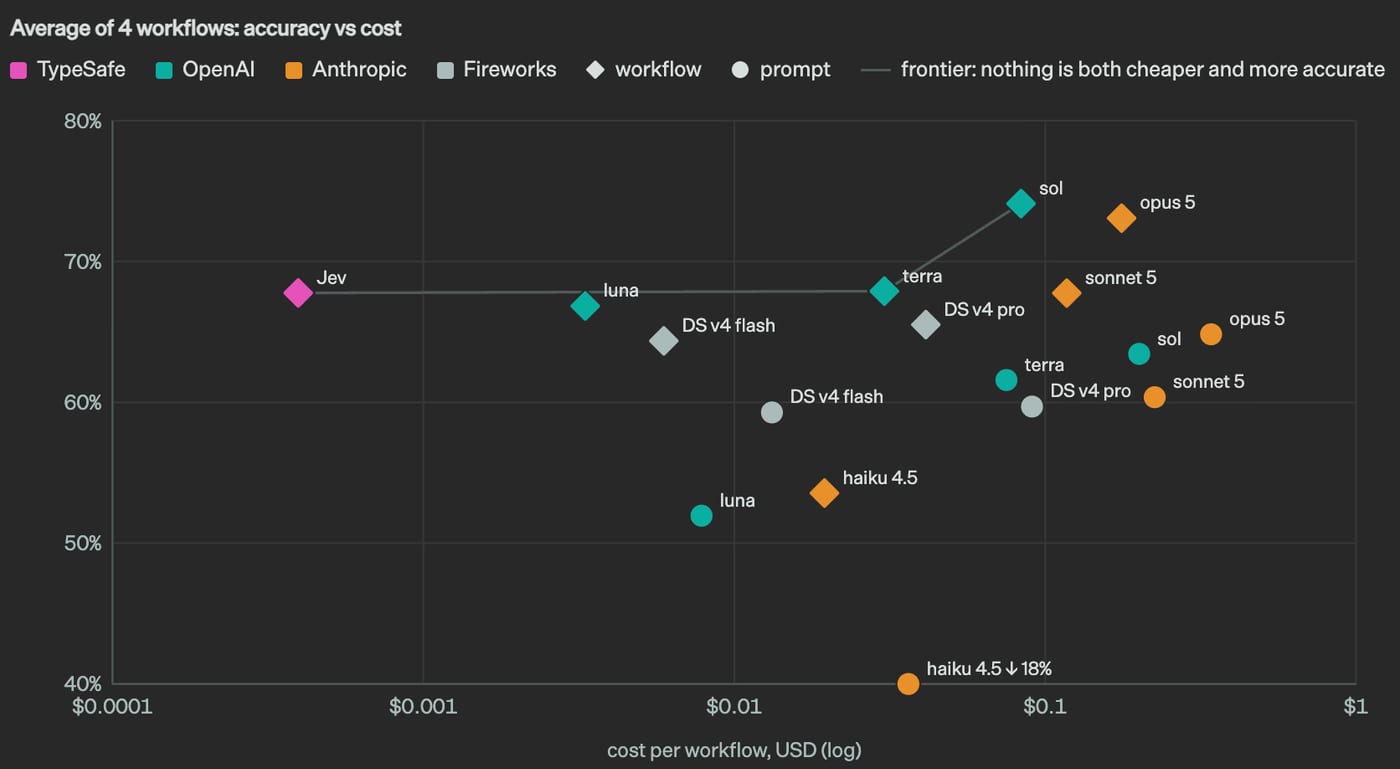
- On September 15, TypeSafe AI launched Jev, a “System One” model that abandons text generation entirely to return typed, probability-scored decisions directly to software in 70 to 500 milliseconds.
- Instead of predicting text sequentially, the model evaluates questions in parallel against a predefined schema to act as an intelligent logic gate.
- Because Jev only outputs these predefined structures, TypeSafe claims the design mathematically eliminates type errors and prevents structural hallucinations.
- Input tokens cost $0.042 per million and output tokens are free, lowering costs for developers building automated workflows where traditional language models are too slow or unpredictable.
My take: When you think about it, it actually makes little sense to use a text-based LLM for quick decisions. For example, when using a computer, the LLM always needs to translate the output text into commands that can control the input. The same goes for a smart AI model router - instead of just routing, it needs to translate the decision into a predictive command. Jev aims to solve this and is introduced as an intelligent logic gate that can be used for a wide variety of tasks like classification, routing, scoring, extraction, and branching. You send it unstructured text or a program state along with predefined questions, and you get back typed choices, scores, or Boolean probabilities. And it does not produce type errors or hallucinate. Jev is not a replacement for LLMs, but a very promising complement to them.
Read more:
- Explainx: How Jev Works
- Hacker News: Discussion of a Local Mini-Jev Implementation
- LangChain: Building a Harness With Jev
- Openchamber: What Public Jev Reports Measured
- Reddit: Discussion of Jev as an Agent Router
Google Turns CC Into a Shared AI Agent for Families
https://blog.google/innovation-and-ai/models-and-research/google-labs/cc-expanding-to-groups/
The News:
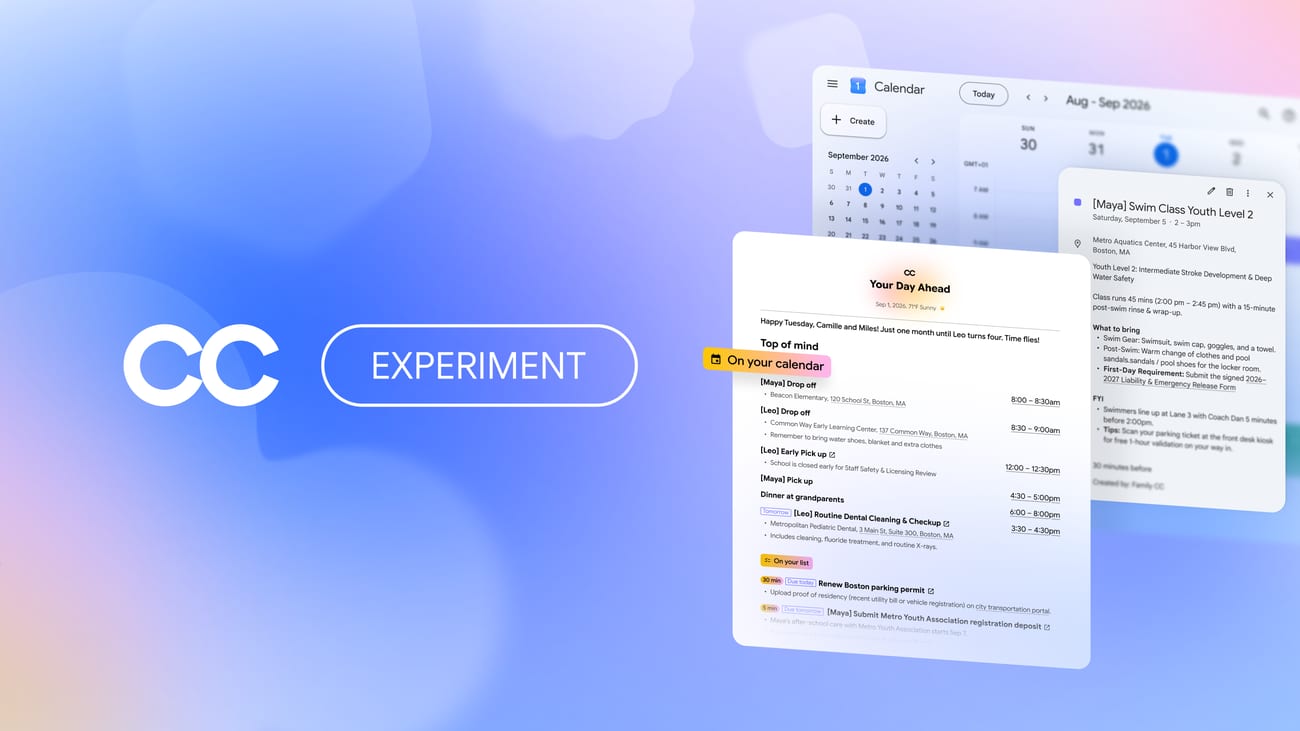
- On September 17, Google Labs expanded its experimental CC personal assistant into a shared household AI agent that manages schedules, tasks, and paperwork for up to six family members.
- Instead of living inside one person’s phone, the agent receives its own verified Google account and only accesses specific emails, Chat messages, or Drive files that users explicitly share with it.
- It pulls this fragmented data into a single synced calendar, generates a daily “Your Day Ahead” email for the group, and handles administrative chores like pre-filling PDF registration forms.
- Behind the scenes, each CC runs on its own isolated cloud computer powered by Google’s Antigravity agentic harness and Gemini models.
- New users can currently join a waitlist, and the service is restricted to users 18 and older in the U.S., meaning parents must manage the coordination for the children whose schedules it sorts.
My take: Google CC is an AI agent that runs on its own isolated cloud computer and acts as a virtual assistant for families. Connect it to your Gmail, Chat, Docs, and Calendar, and the agent will try to keep everything happening in your family updated and in sync. It runs on its own dedicated Google account, and it will send out daily task lists, update shared to-do lists, and organize shared calendars.
I’m not a fan of opening up access to strictly personal information like financial details, emails, tasks, and documents to an LLM that is shared with other people. I understand that you can limit access on a granular level in CC, but to get to a decent level of isolation, you need to spend quite a bit of time configuring and updating these rules. Maybe for some families that don’t already have shared documents, shared calendars, and shared to-do lists configured, and never want to set these up manually, this setup where you have an AI agent manage all these things automatically for you makes perfect sense.
Read more:
- explainx.ai: Google Labs CC family agent analysis
- SiliconANGLE: Google expands CC to families
- TidBITS: Testing Google’s original CC daily briefing agent
- Times of India: CC household workflows and limitations
- X / Xainewsbot: Reaction to CC’s permission model
Google DeepMind Launches the DeepMind Institute to Debate AGI Policy
https://institute.deepmind.com/essays/introducing-the-deepmind-institute/
The News:
- On September 16, Google DeepMind launched the DeepMind Institute, a public publishing platform dedicated to debating the societal and safety implications of artificial general intelligence.
- Demis Hassabis and DeepMind co-founder Shane Legg direct the initiative alongside Google executive James Manyika.
- The institute functions as an essay forum open to external contributors.
- An inaugural essay proposes limiting the “opaque serial depth” of reasoning models to maintain human oversight.
- The launch arrives as Legg, according to DroidFeats, reiterates his prediction of a 50% probability of reaching minimal artificial general intelligence by 2028.
My take: For people who like to write essays, argue, and debate in public, there has probably never been a better time in history than now to make their opinions heard. Last week, Mustafa Suleyman at Microsoft published a 37-page document called the “Humanist AI Code of Conduct,” and here, with the DeepMind Institute, Demis Hassabis and Shane Legg are launching a dedicated publishing platform to discuss the various societal and safety implications of AGI.
Discussions are good, but we are entering an era of recursively self-improving AI. No one on Earth knows where we will be in just two years, or the risks and possibilities that come with this. Most AI research will also continue to be done behind closed doors, much like it is now. Labs like Anthropic and OpenAI do not publish research papers, and I am quite sure they will not be active participants in the Google DeepMind Institute either.
Read more:
- DroidFeats: DeepMind Institute and Legg’s AGI forecast
- Hacker News: Discussion of the DeepMind Institute
- TechCrunch: Google DeepMind widens the AGI debate
Anthropic Redesigns Claude Projects to Run Parallel Cloud Sessions
https://claude.com/blog/projects-redesigned

The News:
- On September 17, Anthropic launched a redesigned version of Claude Projects in beta, transforming the workspace from a static folder into an autonomous coordinator that manages parallel coding sessions.
- Users state a goal, and Claude automatically spins up parallel cloud threads to migrate code, run tests, and open pull requests across multiple repositories.
- Every thread operates as a full Claude Code session, meaning parallel tasks consume a user’s Pro or Max subscription limits faster.
- On paid plans, when a project’s knowledge base approaches its context window limit, the system automatically activates a RAG mode to expand capacity by up to 10x.
- The beta currently restricts workers to cloud execution; local execution alongside local code and behind a user’s network is not yet available.
My take: This is a major update to Claude Projects, and it gives you a good glimpse into the future of software development. Claude Projects has evolved to be your own autonomous project manager that can plan, coordinate and implement tasks based on your input. Where you previously could achieve some parts of this with worktrees and subagents, it was much more complicated and difficult to use, especially for long-running tasks that run for hours.
Access is limited. The new Claude Projects is only available in beta to a few select subscribers and only supports new cloud-only sessions. It will roll out to more users in the coming weeks, and later it will also support local projects. For anyone using goals and long-running tasks in Claude Code, this should be a major QoL improvement to their everyday work once it’s out.
Read more:
- AlphaSignal: Claude Projects and Parallel Coding Sessions
- Claude Help Center: What Are Projects?
- Windows Forum: Claude Projects Usage and Billing Tradeoffs
- X / Pran: Product-Team Reaction to Claude Projects
Anthropic Uses Claude to Accelerate More Than 30 Open-Source Biology Models by Roughly 4x on Average
https://www.anthropic.com/research/claude-uplifts-biomolecular-modeling
The News:
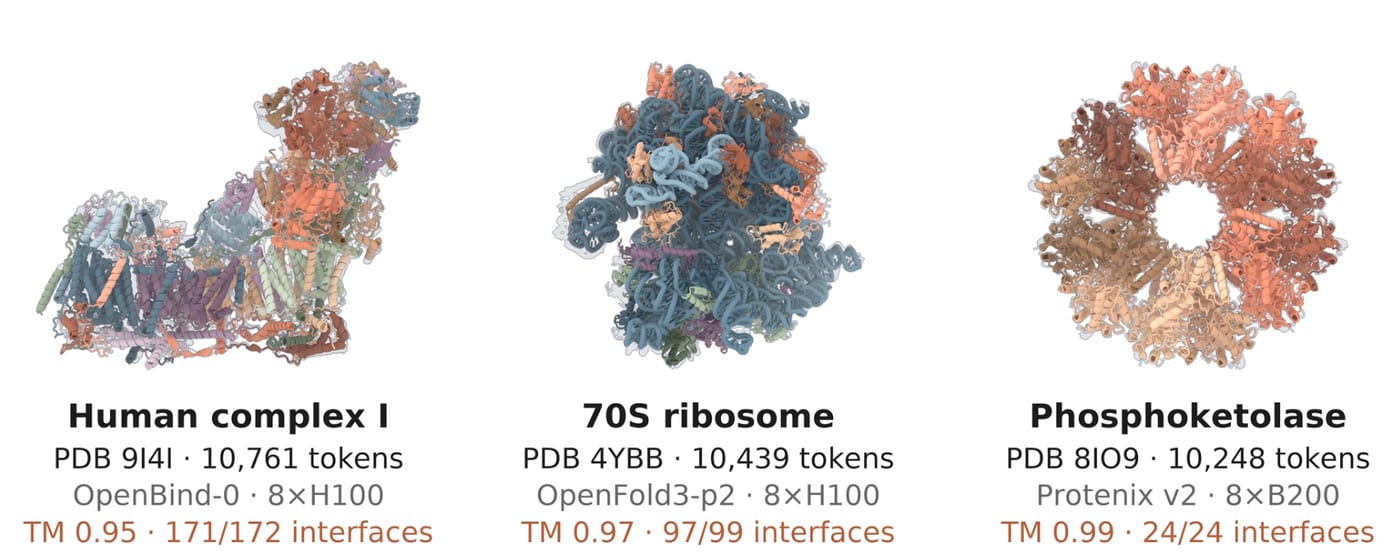
- On September 17, Anthropic released optimization code written by Claude that makes more than 30 open-source biomolecular modeling tools run roughly four times faster on average.
- The update introduces FlashPairformer custom kernels that outperform NVIDIA’s standard cuEquivariance software by up to 2.9x on triangle attention operations.
- A low-memory mode allows the tools to accurately model molecular complexes larger than 10,000 tokens, such as bacterial ribosomes, using just one NVIDIA GPU node.
- For autonomous protein design, the optimized models matched Anthropic’s previous benchmark results using about 100 times fewer GPU hours, reducing total compute and token costs to approximately $150.
My take: A 4x speedup across 30 open-source biomolecular modeling tools is an amazing achievement. But the way it was done is the real story. Anthropic had two staff members with zero kernel engineering expertise supervise Claude in rewriting low-level GPU kernels. And the code they produced outperforms NVIDIA’s own standard software for triangle attention operations.
Read more:
- Adaptyv Bio: Wet-lab benchmark of Claude’s protein designs
- Anthropic: Biomolecular modeling technical report
- GitHub: Uplifting biomolecular modeling code
- Science: Debate over AI and biological-weapons risk
- X / Deniz Kavi: Reaction to Claude’s kernel optimizations
Anthropic Publishes AI Development Metrics, Revealing Claude Leads 26% of Internal AI R&D
https://www.anthropic.com/institute/measuring-pace-of-ai-development
The News:
- Anthropic published three metrics to track the pace of frontier AI development, reporting that Claude now leads 26% of the company’s own AI research and development work.
- This 26% figure represents AI R&D work where the model completes most of the task end-to-end from a high-level prompt under human supervision, up from under 1% in February, while over 90% of R&D work now involves AI collaboration.
- Anthropic also tracks oversight of the approximately 30,000 AI agents running simultaneously on its most-used internal platform, noting that the online monitor blocked 0.002% of over a billion agent decisions in August.
- A third metric tracks compute allocation, showing that during an examined week, about 6% of the computing power Anthropic spends on AI R&D goes toward safety research.
- The public disclosure follows CEO Dario Amodei’s call for a coordinated industry slowdown and is designed to serve as a reporting starting point for other frontier labs.
My take: “The system goes on-line on August 4. Skynet begins to learn at a geometric rate.” The idea of AI improving itself exponentially is the core of most science fiction movies, and Anthropic’s new metrics show it’s quickly becoming reality. Six months ago, the amount of work that was “led” by Claude was just 1%. Today, it’s 26%. And overall, more than 90% of their R&D today involves AI collaboration.
The reason this is possible is the new, larger models like Fable and Astra, with new harnesses like the Claude Projects discussed above. I don’t think current models are good enough to fully replace humans in AI research loops, but next-gen models built on Vera Rubin might be. We won’t be seeing those models until 2028, though, so it’s still a bit into the future when models might actually start to learn at geometric rates all by themselves.
Read more:
- Anthropic: How AI Is Transforming Work at Anthropic
- Gigazine: Anthropic Reports Approximately 30,000 Concurrent Internal Agents
- Oxford / Louis Yiven Zhu: Silent Revision in Frontier AI Safety Frameworks
- X / Guillermo Flor: Reaction to Anthropic’s Public Metrics
OpenAI Tests Sponsored Agents as Securities.io Reports ChatGPT Ads Reach $1 Billion Run Rate
https://openai.com/index/reimagining-advertising-with-ai/
The News:
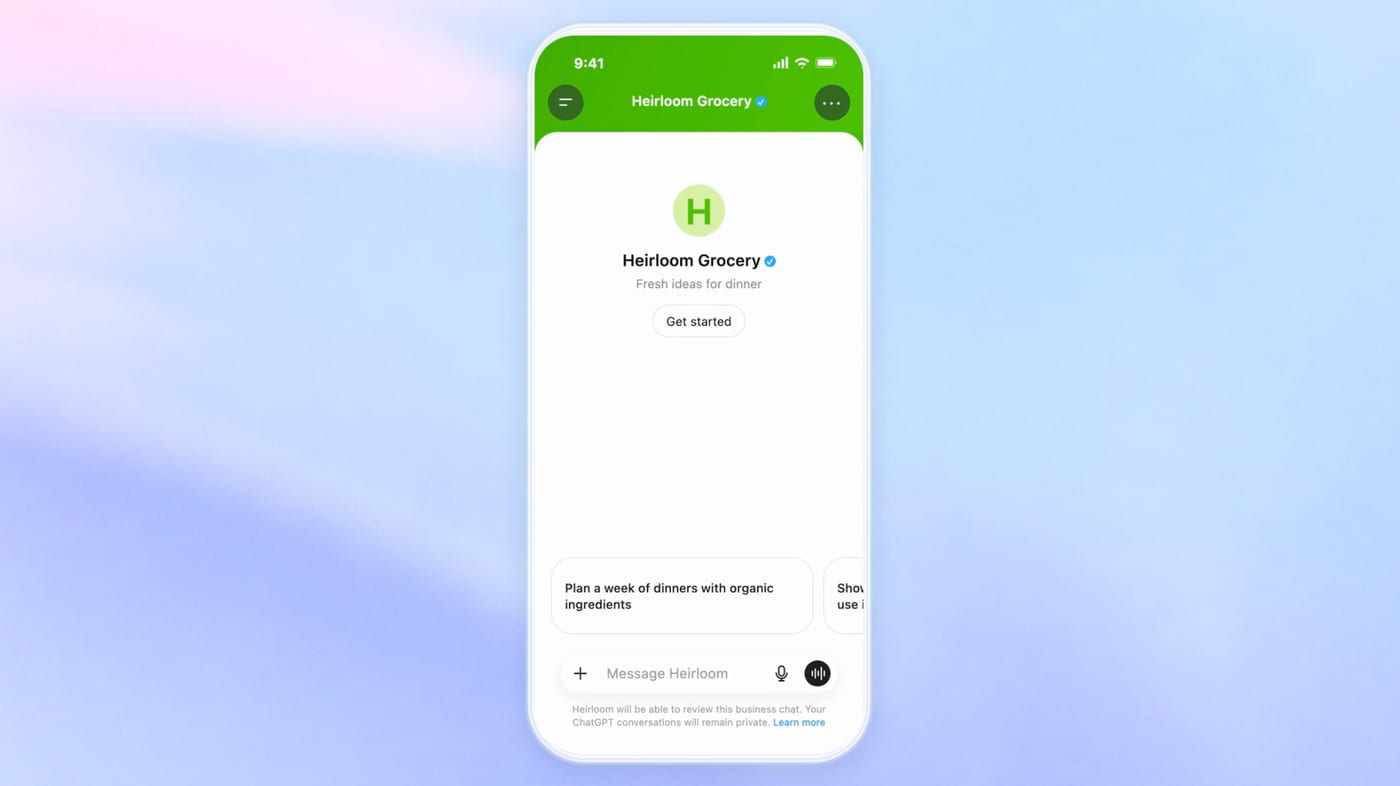
- OpenAI began testing Sponsored Agents, a new ad format that lets users chat directly with a business’s AI representative after clicking an ad in ChatGPT, as Securities.io reports OpenAI said ChatGPT Ads had reached a $1 billion annualized revenue run rate.
- According to Emergent, the format uses a pay-per-engagement pricing model starting at a $5,000 monthly minimum and is currently limited to a US alpha test for select advertisers.
- OpenAI also released its first CRM and ecommerce integrations with HubSpot and Shopify; Shopify products are integrated through Shopify Catalog, and both integrations let businesses track performance.
- New natural-language tools in ChatGPT with the Ads Manager plugin allow marketers to build campaigns and analyze performance by writing prompts, while an opt-in Ads Manager feature automatically translates ad copy.
- OpenAI’s Ad Tools Terms make advertisers responsible for ad materials, campaign settings, and approved generated creatives.
My take: This ad model changes everything. Where clicking a traditional ad takes you to a traditional landing page, clicking an ad within ChatGPT now connects you to a business AI representative, where you can ask specific questions that help with your specific needs. For most purposes, I think this is the better experience. It means the situation where you research a product like a lawnmower, buy it, and then keep seeing lawnmower ads for three months will no longer happen. Instead, you will get an ad asking if you want to discuss with an AI agent how to get your lawn to grow better. To the user, it will feel like chatting in the regular app, but they are actually communicating with the business agent.
Read more:
- Hacker News: Discussion of Sponsored Agents
- OpenAI Help: Sponsored Agents in ChatGPT Ads
- OpenAI: Ad Tools Terms
- Reuters: OpenAI tests advertiser-sponsored agents
- Securities.io: Sponsored Agents and ChatGPT Ads integrations
OpenAI Launches Astra for Law With 230 Million Document Index
https://openai.com/index/astra-for-law/
The News:
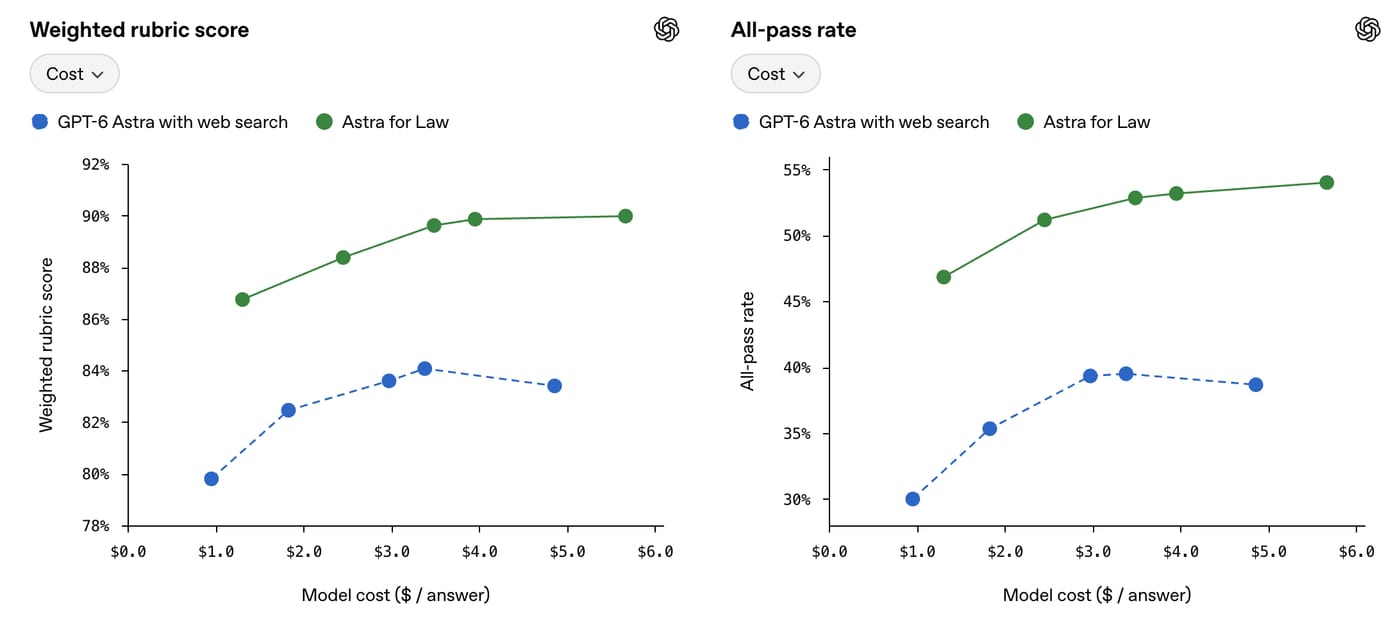
- On September 17, OpenAI released Astra for Law, a specialized configuration of its GPT-6 Astra model paired with a search index of over 230 million U.S. legal documents.
- The system passed 54.0% of overall correctness checks on Vals AI’s Legal Research Bench, compared to 38.7% for standard GPT-6 Astra using web search alone.
- The search index covers 99.9% of published U.S. precedential case law through a partnership with the Free Law Project.
- The launch adds 26 partner-built plugins to connect ChatGPT to incumbent legal tools like Relativity, Clio, and iManage.
- Access is currently limited to selected law firms through a Trusted Access Program that excludes data from human review, with API availability planned for a later date.
My take: These are the kinds of models that legal firms are the most afraid of when they don’t have access to them in their own companies. OpenAI paired GPT6-Astra with over 230 million documents covering 99.9% of published U.S. precedential law cases, giving the companies with access to it extreme leverage over everyone else when it comes to winning legal cases in court. I can only imagine how many people in these large companies spend their days searching these precedential documents as their full-time job, which can soon be fully replaced by an AI model doing it with both higher precision and hundreds of times faster.
Read more:
- AlphaSignal: Astra for Law and the BigLaw buying equation
- Hacker News: Discussion of Astra for Law
- LegesGPT: Astra for Law access and limitations
- The Next Web: Astra for Law’s case law index and benchmark
- X / Hakim Siddiki: Reaction to workflow and citation QA
Specific Labs Publishes Real-SWE Benchmark Testing Agents on Private Enterprise Codebases
https://withspecific.com/benchmarks/real-swe
The News:
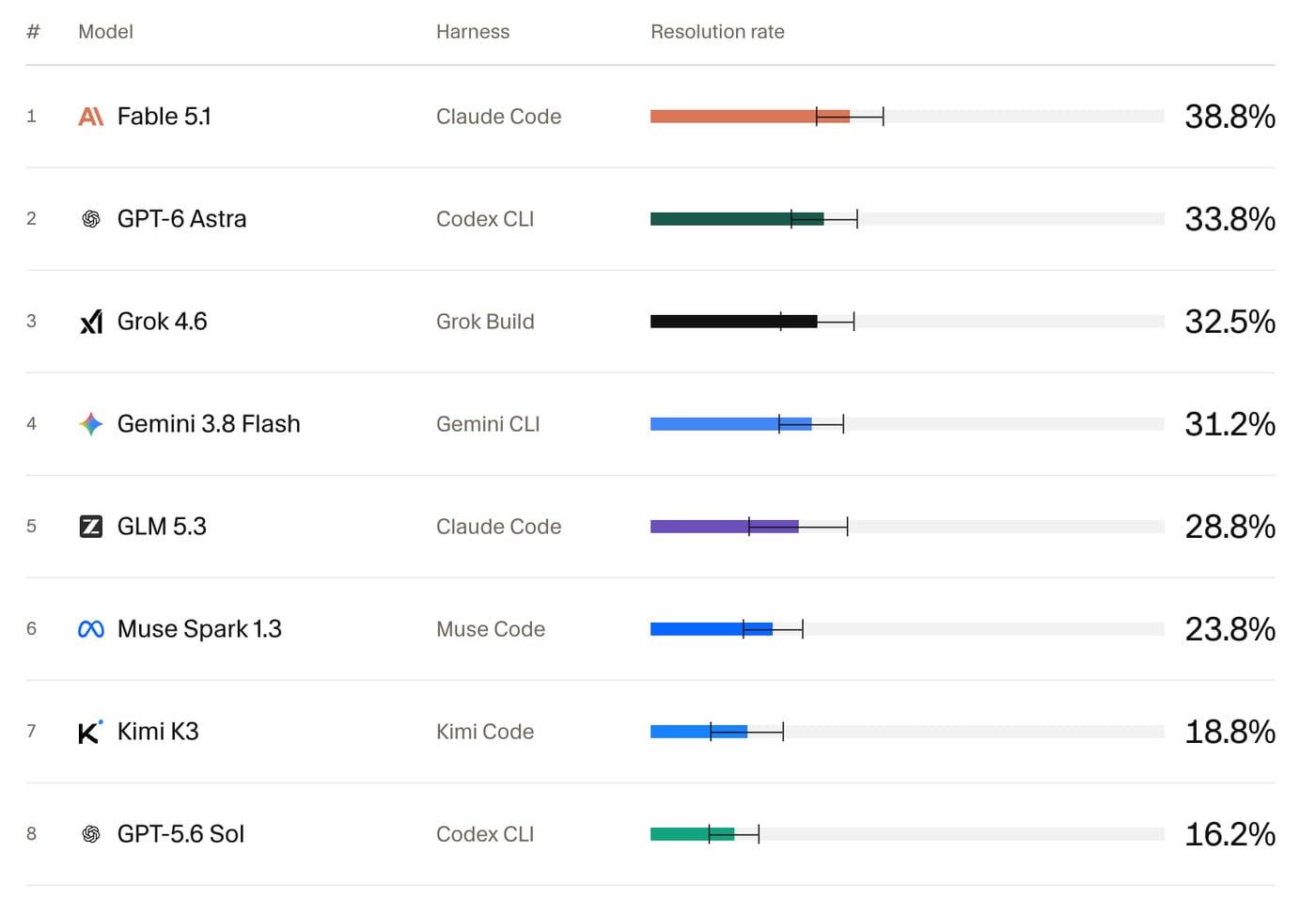
- Specific Labs published Real-SWE, a benchmark evaluating AI coding agents on private production codebases where the highest-scoring setup resolved only 38.8% of its tasks.
- The benchmark licenses private code from operating businesses that Specific Labs says is unlikely to have appeared in model training.
- The evaluation scored eight model-and-harness combinations across 640 rollouts on tasks spanning business logic, databases, and third-party services; for the repository-backed sample tasks, reference solutions edited a median of 11 files.
- Fable 5.1 running in Claude Code led the leaderboard with a 38.8% resolution rate, followed by GPT-6 Astra in Codex CLI at 33.8% and Grok 4.6 in Grok Build at 32.5%.
- Six of the ten tasks had resolution rates below 15%, with missed requirements acting as the most common failure mode overall.
My take: “Can a coding agent actually do the work of a software engineer in the real world?” This is the question Real-SWE wants to answer, and right now, the answer is still clearly NO. There are two things I found interesting in the results posted. First are the poor results by GPT-5.6 Sol in Codex CLI. I think this is why so many people prefer to work with Claude Code, but some people, like myself, prefer to work in Codex. Codex and GPT-5.6 require you to be very strict with your prompts, and if you are, you will get much more deterministic output compared to Claude Code with something like Opus 5. For some people, that works well; for people who don’t like to prompt, it’s a quite poor fit.
The second part I found interesting is that you cannot blindly trust AI models to solve tasks, even with loop-based or goal-oriented setups. You need to keep steering them. For maximum quality and the most effective token usage, you need to limit your use of goals and loops. Run one task at a time, evaluate, check that it’s going in the right direction, then continue with the next. I will change my recommendation once Real-SWE results get above 80%.
Read more:
- GroundTruth: Real-SWE tests agents on private company codebases
- Hacker News: Discussion of Real-SWE
- METR: Many SWE-bench-passing PRs would not be merged
- SWE-Marathon: Evaluating agents on long-horizon engineering tasks
Z.ai Infra Agent Builds GLM-5.3-Flash Inference Stack on 100,000 Chinese Chips
https://z.ai/blog/glm-built-its-inference-infrastructure
The News:
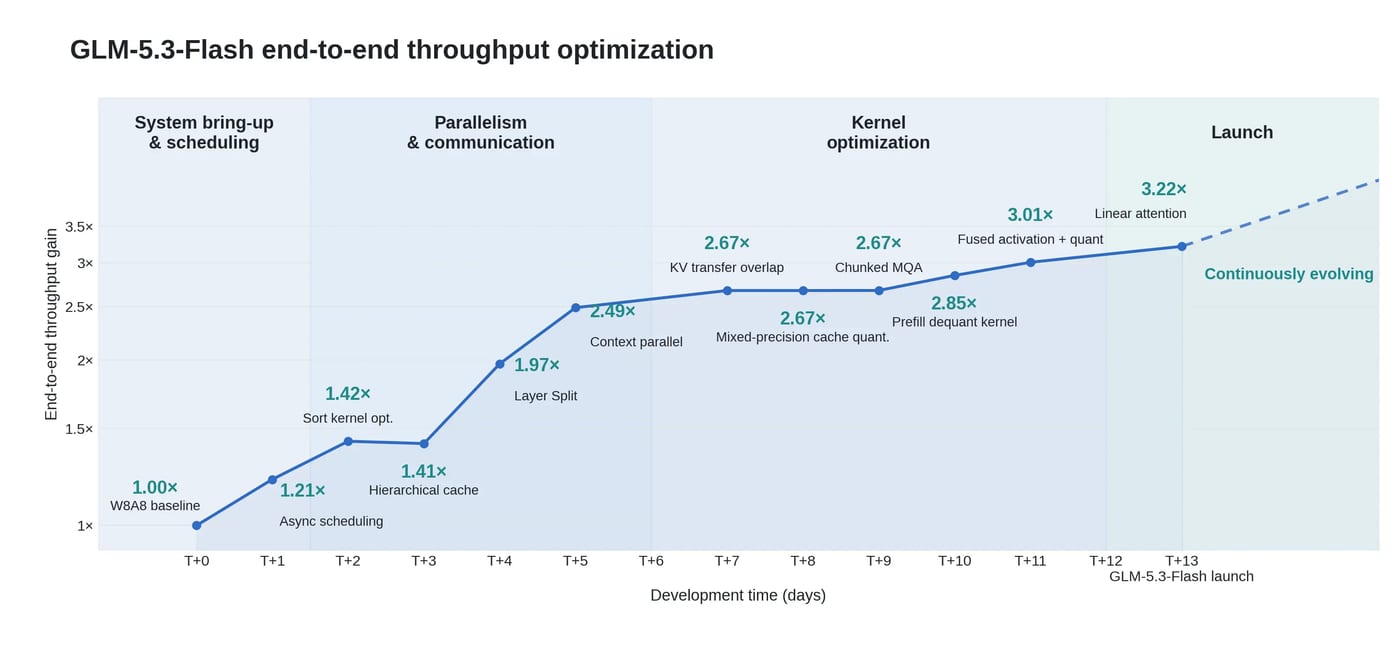
- On September 17, Z.ai announced that an infrastructure agent powered by its GLM-5.3 model built a complete production-grade inference service from scratch for GLM-5.3-Flash on a cluster of over 100,000 Chinese-made AI accelerators.
- The agent advanced the system from initial hardware adaptation to production readiness in under two weeks, ultimately tripling end-to-end throughput.
- Engineers managed the agent using local correctness tests, execution traces, and microbenchmarks rather than relying solely on end-to-end load tests.
- Hardware utilization and per-token costs reached efficiency levels comparable to mainstream NVIDIA GPUs.
- Within a week of its anonymous test launch on OpenCode and OpenRouter, the infrastructure processed over 62 trillion tokens.
My take: Recursive Self-Improvement (RSI) is getting closer by the month now, and this is a great example of it. In just under two weeks, an agent powered by GLM-5.3 was able to build a complete production inference service on a cluster of over 100,000 GPUs, which effectively tripled their end-to-end throughput. We are quickly approaching the point where AI models can autonomously build any piece of software imaginable.
Read more:
- arXiv: Recursive self-improvement in AI
- Cloud Security Alliance: Security implications of recursive self-improvement
- GIGAZINE: GLM-5.3-Flash inference on Chinese AI infrastructure
- Hacker News: Discussion of GLM building its inference infrastructure
Carter Leffen Decrypts 1941 Enigma Message MVUEH With GPT-6 Astra
https://mvueh-enigma-solved.carterl.chatgpt.site/
The News:
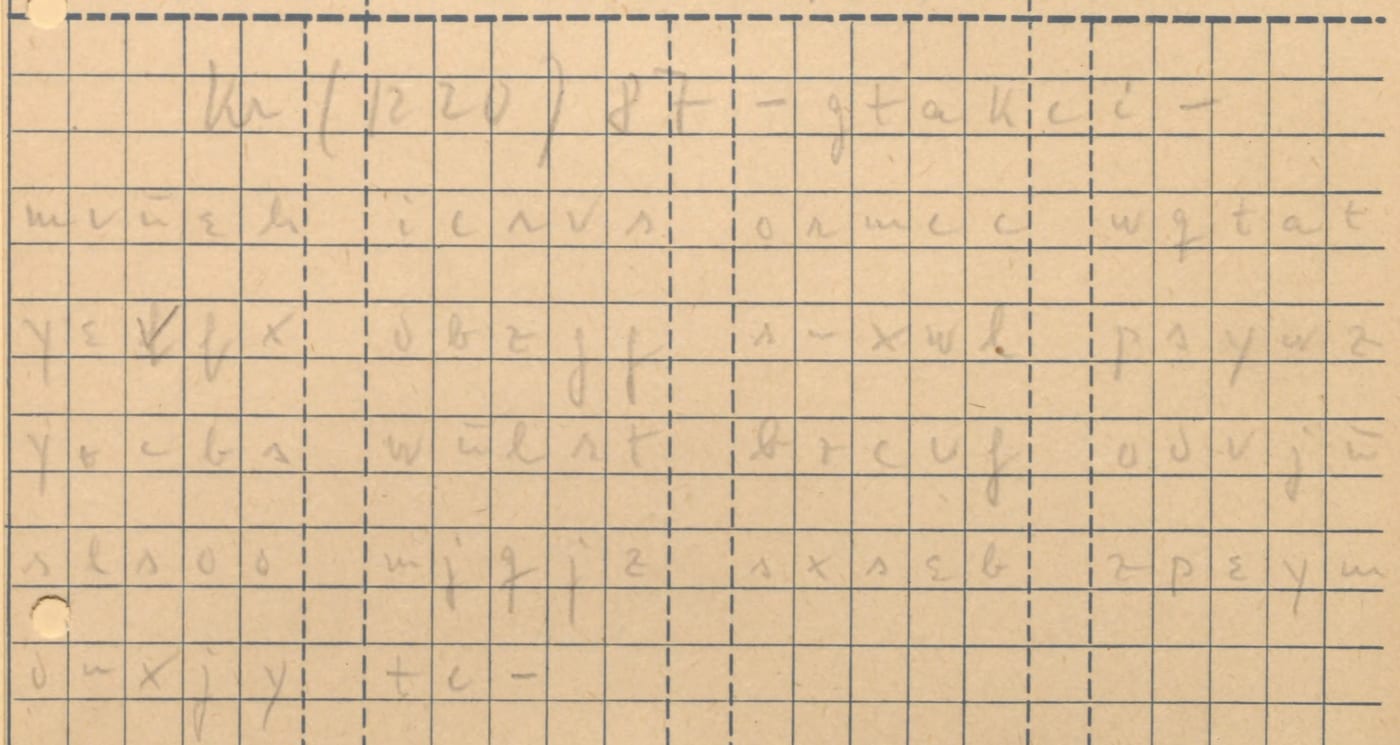
- Over September 14 and 15, Bloomberg developer Carter Leffen used OpenAI’s GPT-6 Astra and parallel AI agents to decrypt MVUEH, an 82-character German Army Enigma message from July 1941.
- Across the two-day investigation, the researcher and agents searched historical archives, built an Enigma simulator, wrote cryptanalysis code, and checked 14.8 million physical keys.
- The breakthrough came from a 14-letter guessed phrase based on the town name “Rosenow”, which the team drew from a related solved message and treated as a possible plaintext phrase.
- The recovered text translates to a mundane field dispatch asking for a route of march and an immediate radio reply.
- All search data, attack code, and a working 3D Enigma simulator are now available for independent verification.
My take: Over two days, Bloomberg developer Carter Leffen used OpenAI’s GPT-6 Astra to crack a still-unresolved 82-character German Army Enigma message from 1941. We have just reached the point where an AI model can seamlessly switch between acting as a historical researcher, a cryptanalyst, and a C++ programmer in the same project.
Read more: