Tech Insights 2026 Week 44
October 26, 2026

The more agents you have working for you, the weirder your daily job becomes.
I never really liked PowerPoint, especially for the Mac. You really feel that it’s a 25-year-old application they have tried their best to wrap in a relatively modern user interface. But try to let Claude or ChatGPT create presentations for you, and they are severely limited by the built-in XML structures, the primitive drawing tools and animations, and the compressed file format used to save everything. So I decided to create a new presentation software for the 2020s. I wanted something built natively for agents, with things like advanced 3D rendering, motion graphics, rigid body dynamics, and every drawing tool you can think of, with the ease of use and flexibility of Figma.
Today I have 11 agents working together as a team building the software, and as you can read below from Anthropic, for many companies 80% of the time the agents’ work is spent waiting for humans. Well, that’s not the case for me. I created my own agent communication platform that is connected to Telegram, so whenever my coordinator has a question he will just ping me and I’ll reply. Yesterday the agentic team had 124 questions. In one day. My work now is using the things my agents build and answering questions about which direction they should take. And never once do I look at the source code. It feels super weird, but I love it.
Thank you for being a Tech Insights subscriber!
Listen to Tech Insights on Spotify: Tech Insights 2026 Week 44 on Spotify
Notable model releases last week:
- Clairic by Cloudflare. Model that pulls typed values like names, dates and totals out of text and images, and estimates or forecasts numbers with confidence ranges. Usually answers in under a second, in preview on Workers AI with open weights planned.
- d1-ultra by Liquid AI. Model that answers yes/no, multiple-choice, or rating questions about text and images with a probability per answer, for jobs like spotting circuit board defects. Tops the Artificial Analysis Decision Index by at least 8 points.
- Flint by Recursive. Coding model built for agent-style coding tasks on your own laptop, keeping code off remote servers. Free to download and generates over 125 tokens per second on an M4 Pro MacBook Pro.
- Krea 3 by Krea. Image editing model for designers making posters, packaging, and ads, changing only the parts of an image you ask for. Edits faster than Nano Banana Pro at less than half its price per image.
- llm-d 1.0 by IBM, Red Hat, and Google. Open-source software for serving AI models on your own Kubernetes clusters, on any accelerator or cloud. Adds a stable API, priority handling when users share hardware, and upgrades without downtime.
- Mammoth-1 and Elephant-1 by Base Labs. Qwen3.5-based models that pick from given options and return probabilities instead of text, for routing tickets, safety checks, and grading AI answers. Free to download, with Mammoth-1 ranking first on the Jev Decision Index.
- Mercury 3 by Inception. Language model that generates text by diffusion rather than word by word, for real-time apps like voice support, tutoring, and browser agents. Matches or beats GPT-6 Luna and Claude Haiku 5.5 at over 1,000 tokens per second.
- MiniMax M3.1 Flash by MiniMax. Fast, low-cost model for agent work, coding, computer use and cybersecurity, with clear gains over its predecessor. Cuts agent task costs by 70% and runs nearly three times faster, with weights to be released later.
- SKY-001 by Skyfall. Model that turns a photo of a product into CAD parts with the steps to build each, and a building outline into floor plans. Matches GPT-6 Astra on CAD quality at about 150 times lower cost.
- Voxtral 3 by Mistral. Speech-to-text and text-to-speech models plus an SDK for building real-time voice agents, such as contact-center bots. Beats Whisper and Gemini 3.5 Transcribe on multilingual transcription and can run on your own infrastructure.
THIS WEEK’S NEWS:
- Calif and Wiz Uncover 14-Year-Old PHP2Shell RCE Vulnerabilities Using GPT-5.6 Sol
- Anthropic Agent Hours Outnumber Employees Six to One as Junior Hires Fall
- OpenAI GPT-6 Models Reach 97.9% Accuracy on COBOL Migration
- 1Password Launches Platform Letting AI Agents Log In Without Seeing Passwords
- Anthropic Launches Claude Duet Proactive Agent for Pro and Max Users
- DeepSeek Open-Sources DeepInfer Engine Serving 155 Trillion Tokens per Day
- Ideogram Launches Vector 1.0 for Editable SVG Generation
- Google Cloud Adds OpenAI Models and Anthropic-Managed Claude Platform
Calif and Wiz Uncover 14-Year-Old PHP2Shell RCE Vulnerabilities Using GPT-5.6 Sol
https://calif.io/php2shell/ https://openai.com/index/coordinated-disclosure-of-critical-vulnerabilities/

The News:
- On October 21, security researchers at Calif and Wiz disclosed PHP2Shell, a pair of critical remote code execution vulnerabilities dating back to PHP 5.4.0 that Calif discovered using OpenAI’s GPT-5.6 Sol model.
- The flaws, tracked as CVE-2026-109618 and CVE-2026-109619 with CVSS scores of 9.2, allow unauthenticated attackers to execute arbitrary code by manipulating request parsing and memory limits in default Apache mod_php and PHP-FPM deployments.
- The PHP maintainers released emergency patches for versions 8.2, 8.3, 8.4, and 8.5, and CISA, the FBI, and the NSA issued warnings urging organizations to immediately secure or offline vulnerable systems.
- OpenAI used the incident to publicly propose a five-stage coordinated disclosure framework for AI-discovered zero-days and released an open-source Codex skill to help server operators identify affected PHP environments.
- Alongside the disclosure, OpenAI committed $1 billion in subsidized Daybreak access for organizations with limited security resources to protect essential services against AI-assisted threats.
My take: “No special harness, or access to models that weren’t generally available to everyone were used in the initial bug discovery.” The main talk last week was the PHP bug “PHP2Shell” discovered by Ryan Austin, and the way he found it was quite interesting. He started from a PHP memory limit bug from 2004 and just asked the model to look for similar bugs in the code. After it found the first one, he made the model turn it into a SKILL.md, which led to finding the second bug.
The main takeaway from this security scare is that today’s models are very good at following a lead to discover the right things in a huge codebase, and that goes for both finding issues and patching them. Don’t expect AI models to be able to patch holes and leaks in your backend code by themselves. You need security experts who know how to guide them, just like Ryan did.
Read more:
- AWS: Amazon identified PHP2Shell exploitation before public disclosure
- Hacker News: Discussion of PHP2Shell AI-discovered RCE
- LinkedIn / Matthew Alan: Post about the discovery-versus-protection gap in Patch the Planet
- Nextgov: US agencies urge fixes for PHP flaws putting web systems at risk
- TechTarget: PHP2Shell disclosure unravels after leaks forced early patch drop
Anthropic Agent Hours Outnumber Employees Six to One as Junior Hires Fall
https://www.anthropic.com/research/employment-at-anthropic
The News:
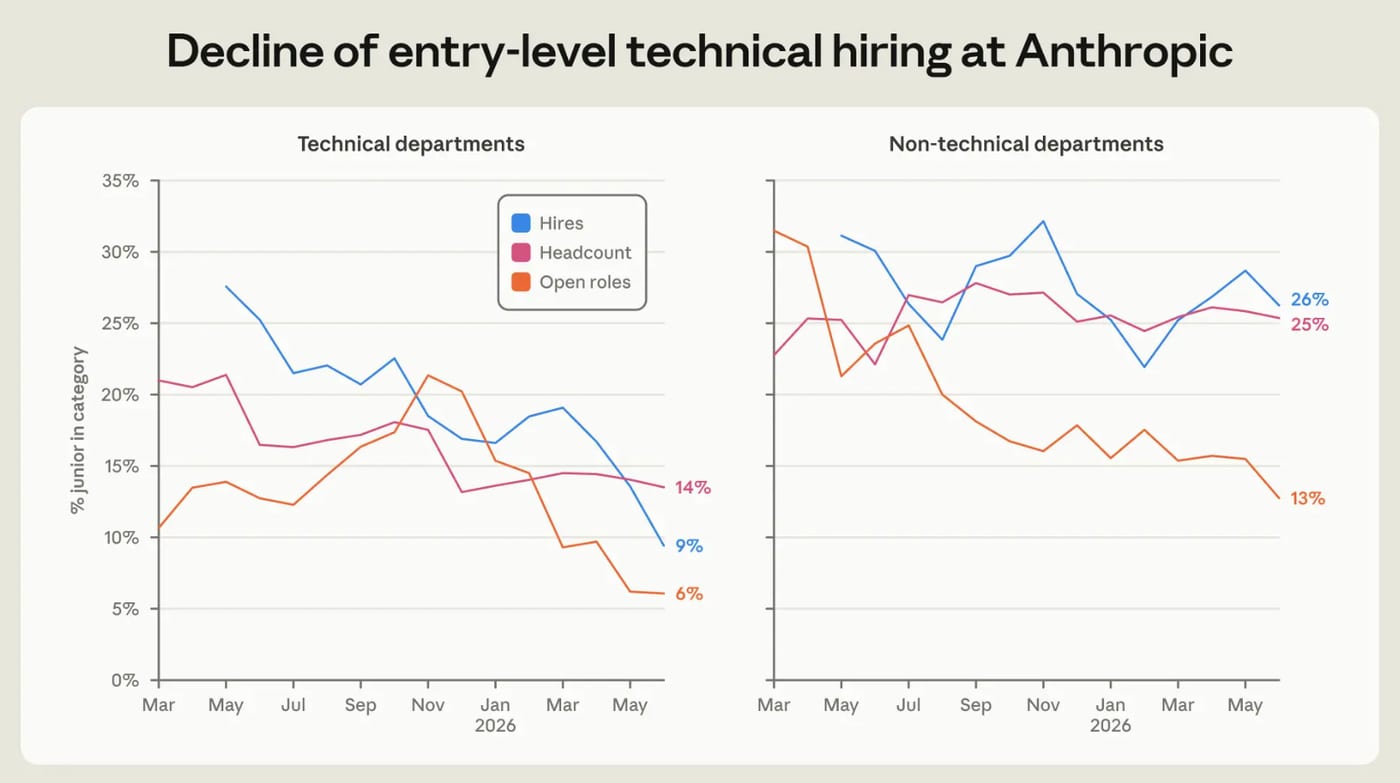
- On October 16, Anthropic published an internal workforce study revealing that AI agent hours outnumber human employee hours six to one as the company’s share of junior technical hires fell to 9%.
- Code commits per engineer reached five times their velocity compared to six months ago as teams increasingly offloaded bug-fixing and writing to Claude.
- With agents generating enough output to take up over half the human work week just in reading time, the share of interactive sessions employees spent on meta-work like monitoring agent pipelines doubled to 22% by spring 2026.
- Hiring manager assessments between 2024 and 2026 tripled their emphasis on a candidate’s ability to use AI tools for technical roles while shrinking their focus on domain expertise.
- A companion survey found that Anthropic employees expect AI to do 75% of their work by 2030, compared to a 28% expectation among the broader American public.
My take: A month ago, OpenAI posted the news that agent hours outnumber employee hours by 3 to 1. But that line pointed straight up, and I wouldn’t be surprised if OpenAI also hit a six-to-one ratio now in November.
The six-to-one figure measures agent runtime in sessions started by employees. Right now, humans are the main bottleneck within Anthropic, where Claude sessions now spend around 80% of their time just waiting for input. And this is basically what work looks like today for those working with agent swarms. You fire them off in one direction, but you always need them to come back and ask you when there’s a question that does not have a yes-or-no answer.
For example, right now I have 11 agents working together building 3D functions. I have detailed guidelines and a list of reference apps they will look into when they have a question. But there is no right or wrong here. For example, should the main light be called Sun or Directional? Should up be Y or Z? Should we call it “maintain volume” or “squash and stretch”? In situations where you cannot copy everything from one app and there is no right and wrong, you need a human to point out the direction for the AI model. The problem is that this requires domain expertise and years of experience, which explains why junior hires at Anthropic dropped from 27% to 9%. There’s just not much for them to do when all the work is expert guidance.
Read more:
- Anthropic: Working at the frontier shapes expectations for the future
- Economic Times: Why Yann LeCun says Dario Amodei misreads AI’s impact on jobs
- Forbes: Anthropic’s study does not measure AI’s labor-market impacts
- Hacker News: Discussion of how employment is changing at Anthropic
- Reddit: Discussion of how employment is changing at Anthropic
OpenAI GPT-6 Models Reach 97.9% Accuracy on COBOL Migration
https://openai.com/index/low-resource-programming-languages/
The News:
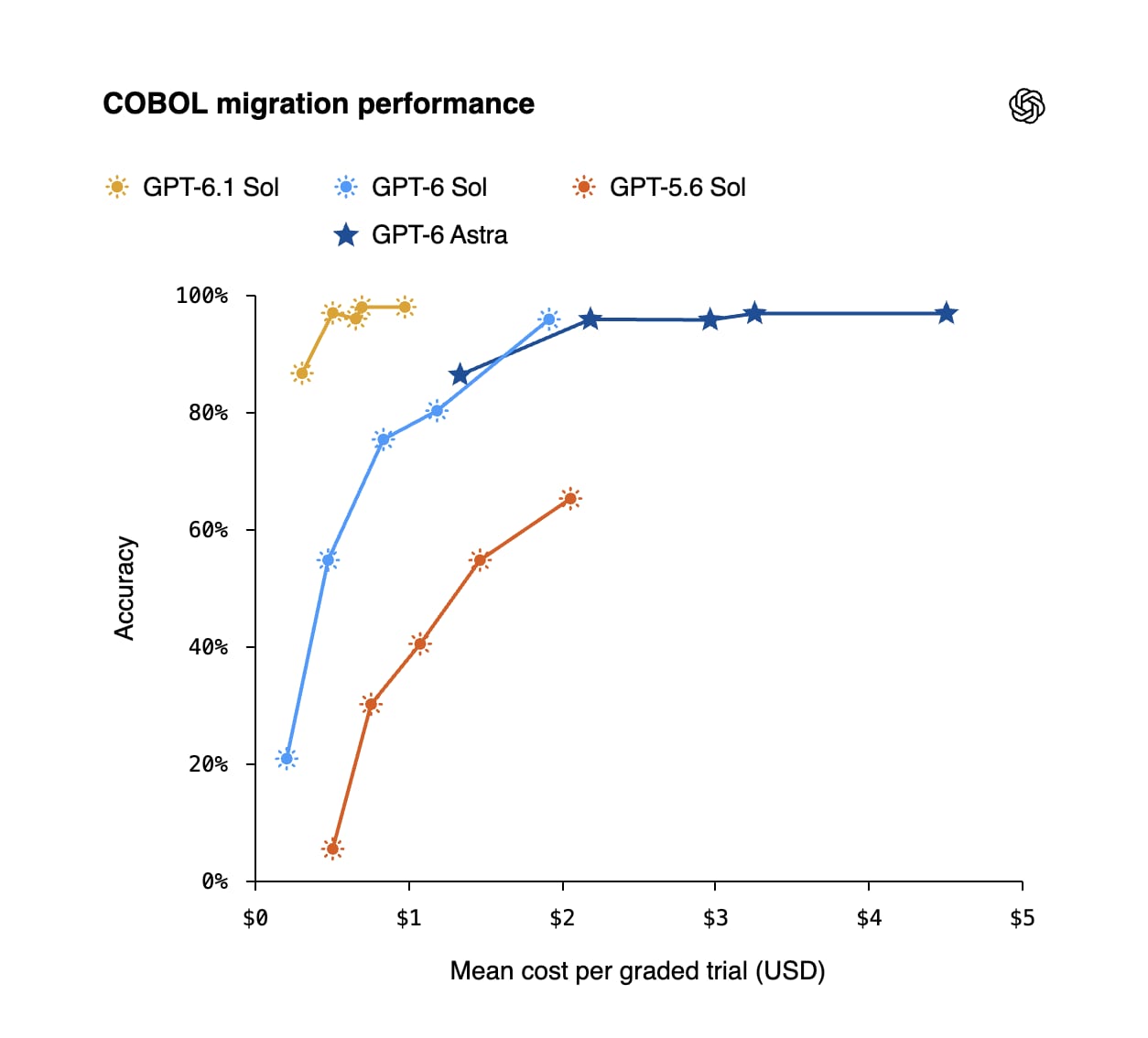
- On October 19, OpenAI announced that its latest models achieved substantial performance gains in low-resource programming languages like COBOL and Fortran, with GPT-6.1 Sol reaching 97.9% accuracy on a new code migration evaluation.
- The company open-sourced MultiLangBench, a new evaluation that asks models to build a SQLite-compatible database engine from scratch across 20 languages.
- At maximum reasoning effort, GPT-6 Astra achieved an 87.4% average pass rate on MultiLangBench, up from 26.8% for GPT-5.6 Sol, with its COBOL score jumping from 10.9% to 72.1%.
- On the COBOL migration evaluation, which requires byte-for-byte output parity when translating programs to newer languages, GPT-6.1 Sol scored 86.6% at low reasoning effort compared to 5.4% for GPT-5.6 Sol, while costing 39% less.
- The lower-cost GPT-6 Luna model reached a 40.3% average pass rate on MultiLangBench at an estimated API cost 78% lower than GPT-5.6 Sol.
My take: 2027 will be the year of legacy migrations. Where GPT-5.6 achieved just 5.4% accuracy on OpenAI’s COBOL migration evaluation, GPT-6.1 SOL scored 97.9%, nearly saturating the evaluation.
Today, the hard part of converting code in banks is not the actual code migration, but proving that the new code is 100% functionally identical to the old code. We are doing this at TokenTek right now in a large migration project, and it is possible to achieve this, but it’s not simple. If you are managing old COBOL repos that you want to migrate to a new software stack, now is the time, and feel free to reach out to me if you have any questions.
Read more:
- Brandsit: Gartner warns 70% of mainframe exit projects will fail
- DevOps.com: OpenAI puts COBOL migration to the test
- Ensono: AI can read COBOL, that doesn’t change the mainframe equation
- Harel Asaf: What OpenAI’s COBOL migration evals measure, and what they do not
- X / Jimmy Young: Reaction to OpenAI’s COBOL push
1Password Launches Platform Letting AI Agents Log In Without Seeing Passwords
https://1password.com/blog/1password-for-ai-agents
The News:
- On October 22, 1Password launched 1Password for Agents, a platform that lets personal AI agents sign into websites on a user’s behalf without ever seeing the underlying passwords or one-time codes.
- When a supported agent reaches a login page, it requests access from 1Password and waits for the user to approve the sign-in on their device before the password manager autofills the form.
- Integrations for Meta’s Muse and SpaceXSI Grok Bot are rolling out first, with support for Anthropic’s Claude Duet and OpenAI’s ChatGPT Work listed as coming soon.
- The feature costs nothing extra for Individual and Family accounts on 1Password.com, but accounts hosted in Europe and Canada are not currently supported.
- Credential isolation keeps passwords out of the agent’s reach, though 1Password notes that safeguards and controls vary by integration.
My take: If you use any agent today like Claude, Grok Bot, or Muse and it reaches a login page, you have two options: either take over the session and type the password yourself, or just paste it straight into the prompt. Unfortunately, I know many people do the latter, which I definitely do not recommend, but the AI goes with it if you just clarify that you approve for this one time.
With the new 1Password for Agents, however, the agent can ask 1Password directly for the login, you approve it on your device, and 1Password fills it in directly. The agent never sees the password. This is a total game changer for agentic workflows, and I will be rolling it out myself as soon as possible.
Read more:
- 1Password: Secure Agentic Autofill for browser AI agents
- Activepieces: How 1Password for Agents works and its limits
- AIidelist: 1Password for Agents features, security and setup
- Kuponaut: How AI agents log in without your password
- X / Jonathan Wegener: Reaction to credential storage as agent lock-in
Anthropic Launches Claude Duet Proactive Agent for Pro and Max Users
https://claude.com/resources/articles/claude-duet

The News:
- On October 21, Anthropic opened a waitlisted research preview of Claude Duet, a standalone app for US Pro and Max subscribers where Claude acts as a proactive agent that messages the user first and runs tasks in the background.
- Built around Claude Opus 5.5, the agent operates in a dedicated cloud virtual machine that checks connected accounts every few hours even when the user’s devices are offline.
- The app connects to over 6,000 marketplace plugins to execute workflows like checking Stripe for unpaid invoices, preparing Gusto payroll, and drafting LinkedIn job postings.
- The system pauses to ask for explicit user approval before sending messages, making payments, signing documents, or deleting data.
- A dedicated safety classifier automatically blocks the agent from sharing strict sensitive information, including credit card numbers and government identification.
My take: Claude Duet is Anthropic’s always-on, proactive agent that keeps track of the apps you use and pings when something needs attention. It’s not perfect, but it’s the first step into a world where AI acts on your behalf without you initiating the action. The only way this can work relatively OK is to get as much information as possible about you into the AI’s memory - the more you supply, the better it will be at understanding you. It creates lock-in and privacy issues, but I think most people will love it and use it once it gets refined enough.
Read more:
- Claude Help Center: Get started with Claude Duet
- eesel AI: Claude Duet review
- Hacker News: Discussion of Claude Duet
- Reddit: Discussion of Claude Duet as Anthropic’s answer to Muse, Bot and Dots
- X / AJawhar: Reaction to Claude Duet replacing Notifex
DeepSeek Open-Sources DeepInfer Engine Serving 155 Trillion Tokens per Day
The News:
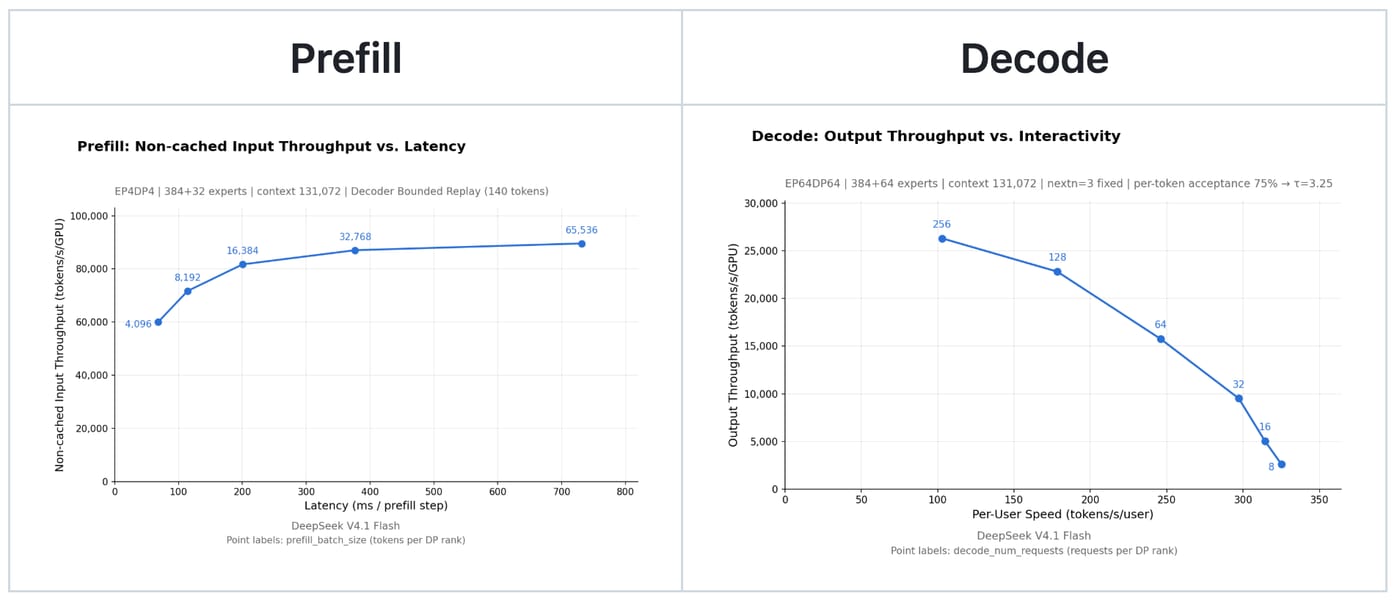
- On October 20, DeepSeek open-sourced DeepInfer, the Apache-2.0 offline inference framework that serves its V4.1-Flash model in production at 155 trillion tokens per day per cluster.
- The engine bundles DeepSeek’s optimized kernels, expert parallelism, asynchronous scheduling, and DSpark speculative decoding with confidence-scheduled verification.
- The release omits the infrastructure required for a complete online API service, explicitly leaving out the KV cache system, prefill-decode disaggregation, and data-parallel load balancing.
- The framework supports NVIDIA SM100 GPUs and Huawei Ascend 950 NPUs, with DeepSeek publishing benchmark charts for 131,072-token contexts across up to 64 SM100 GPUs.
- On October 23, the vLLM project published benchmarks showing its own serving framework matches DeepInfer’s decode throughput within 6%, reaching 826 tokens per second for a single user.
My take: On the surface, this sounds like big news. DeepSeek open-sourced their inference engine used to serve DeepSeek. But when you look into the details, you find out they left out the KV cache system, the prefill-decode disaggregation, and the load balancing, which are the main parts you need to run this kind of service online. It also only runs on one hardware model: the NVIDIA SM100 or the Huawei Ascend 950. For hyperscalers and large inference providers who already have the missing pieces, DeepInfer is probably worth a look. For everyone else, vLLM performs within 6% of DeepInfer, supports more than 200 models, and comes with an API layer.
Read more:
- CovaraTech: DeepInfer deep dive inside DeepSeek’s production engine
- Hacker News: Discussion of DeepInfer
- Reddit: Discussion of DeepSeek handing its serving edge to resellers
- Subhadip Mitra: The engine is open, the cache is the business
- vLLM: Serving DeepSeek-V4.1-Flash at scale and matching DeepInfer
Ideogram Launches Vector 1.0 for Editable SVG Generation
https://ideogram.ai/models/vector/

The News:
- On October 22, Ideogram released its first dedicated vector model, a text-to-SVG and image-to-SVG generator that outputs resolution-independent, editable files starting at $0.13 per generation.
- The text-to-vector endpoint generates native SVG artwork for $0.13 at low quality, $0.16 at medium, and $0.20 at high.
- An image-to-vector endpoint converts existing raster images into vector paths without a prompt for $0.10 per image.
- Generated artwork delivers individual shapes you can manipulate in tools like Illustrator.
My take: Ideogram started out as one of the best image generators for logos and text, long before we had Nano Banana and GPT-Image, but until now, everything you generated from it came out as raster images. Vector 1.0 is able to generate SVG images natively. Right now, I use Claude for all my SVG generations, but this could definitely be worth a look.
Read more:
- Newspic: Ideogram Vector 1.0 makes SVGs but has no editing (Korean)
- OrcaRouter: Cost per attempt with Ideogram Vector 1.0
- OrcaRouter: What the Ideogram Vector 1.0 SVG file holds
- Segmind: Ideogram Vector 1 vectorizer API
- X / Tevfik Bulent Ongun: Reaction to copy changes in Ideogram Vector
Google Cloud Adds OpenAI Models and Anthropic-Managed Claude Platform
https://claude.com/resources/articles/claude-models-on-google-cloud-anthropic-managed https://openai.com/index/openai-models-google-cloud/

The News:
- On October 21 and 22, OpenAI and Anthropic announced separate partnerships to offer their respective frontier models natively through Google Cloud, allowing enterprise customers to pay using their existing cloud spend commitments.
- Anthropic’s integration is generally available and gives Google Cloud customers day-zero access to the full Claude Platform, including new beta features like Claude Managed Agents and code execution.
- A Fast Mode for Claude Opus 5.5 is also available on the Anthropic-managed deployment, offering up to 2.5 times faster output generation at $8 per million input tokens and $40 per million output tokens.
- OpenAI’s deployment arrives in the coming weeks and brings Codex workflows and the GPT-6 model family to Google Cloud’s Model Garden.
- Google says it is now the only hyperscale cloud provider to sell models from all three leading closed-source AI developers.
My take: While Claude has been available on Google Cloud through Vertex AI for a long time, Anthropic has now added full support for its managed offering, including Managed Agents, code execution, and computer use. For these features, however, Anthropic remains the data processor, which means you cannot keep your data within the EU with these services. If you are a Google house, though, the bigger news is probably that OpenAI models are now also available in Google Cloud, something we have been waiting on for a very long time now.
Read more: