Tech Insights 2026 Week 45
November 2, 2026

Is Anthropic a junk company?
Last week, Anthropic filed its papers to go public, and the shares are planned to start trading on the Nasdaq in mid-November, raising up to $100 billion in capital. The filing also offered a look into Anthropic’s finances: revenue for the first half of 2026 was $16.3 billion, up from $1.2 billion the year before. They also have over $130 billion in cash and investments. The filing shows a loss of $80.7 billion, which sounds like a lot, but almost all of that is an accounting effect from loans that investors can swap for shares.
If you followed the news however, the main word that stuck out from last week was “junk.” According to the Financial Times, Blackstone, one of Anthropic’s largest lenders, just told its investors that the big credit rating agencies will likely give Anthropic a “junk rating” after the listing. The main reason for this is that Anthropic signed contracts for nearly $500 billion of computing power running into the 2030s, while customers have only committed to around $11 billion in future revenue. Until its income proves it can pay those bills, the agencies will keep its credit rating low.
Every week I meet new companies in different industries, and most of them are just in their early stages of AI transformation. The true power of agentic AI systems comes when you no longer need to depend on humans for reviews and tests; this is when productivity truly skyrockets. But it requires different team structures and new organizational structures, and it has to be proven internally before anyone is willing to change things. It takes time, and right now, most companies are at the “prove it before we move it” stage.
That said, once most companies move past that stage and start seeing the real benefits of agentic AI, that is when I believe Anthropic’s revenues will start to skyrocket. The fact that they made $16.3 billion is amazing, but those figures will be nothing compared to what they will make once most companies start using AI for real.
Thank you for being a Tech Insights subscriber!
Listen to Tech Insights on Spotify: Tech Insights 2026 Week 45 on Spotify
Notable model releases last week:
- Drama 3 by Fish Audio. Text-to-speech model you direct like an actor, describing emotion and pacing in plain words and adding sighs or pauses exactly where you want them. Generates whole multi-speaker scenes in one pass, also through the API.
- Gemini 4 Carbon by Google. Successor to Gemini 4 Argon for long-running coding and agent tasks and for finding and patching software vulnerabilities. Ranks first on the Artificial Analysis Intelligence Index, but only selected cyber defenders get access for now.
- GPT-6.1 Terra by OpenAI. Fast, low-cost model for everyday work such as drafting proposals, reading technical drawings, and filling out forms on a computer. Costs half as much as GPT-5.6 Terra while more than doubling its Terminal-Bench coding score.
- Kimi K3.1 Pro by Kimi. Update to Kimi K3 that is much better at agentic coding, 3D modeling and financial research, with a 1M-token context. Nearly matches Claude Opus 5.5 on Terminal-Bench, with weights free to download by November 4.
- LFM3 by Liquid AI. Family of small models (about 2B parameters) for text, vision, and audio, built to run on phones and laptops and be fine-tuned for specialized tasks and local agents. Free to download, with the text model beating the much larger Qwen3.5-9B on browser and business-app agent tasks.
- Nemotron 3.5 Transcribe by NVIDIA. Speech-to-text model that transcribes recordings in 40 languages, labels speakers, translates, and answers questions about the audio. Free to download and tops open models on the Hugging Face Open ASR Leaderboard for English.
- Pika H3 Flex by Pika. Video generation model with synchronized sound, built on MiniMax H3, for creators who refine clips using images, video, and audio as references. Free to download and ranks first among open-weights models on DesignArena’s text-to-video leaderboard.
- Unlimited OCR 2 by Baidu. Small 3B-parameter model that turns scanned or photographed document pages into text. Free to download and reads documents of any length, even a whole book, in one request with nearly constant memory use.
THIS WEEK’S NEWS:
- Anthropic Files for Nasdaq IPO Revealing $16.3 Billion First-Half Revenue
- Epoch AI Uses Open-Weight GLM 5.3 to Build $1,000 Firefox Exploits
- Google DeepMind Previews Genie 4 World Model With Native Audio
- Figma Trains First-Party Design Editing Model as Its Agent Gets 20% Faster
- Mistral Releases 1-Trillion-Parameter Large 4 Weights Under Modified License
- Artificial Analysis Launches Intelligence Index v5 With 60% Private Datasets
- Cognition Releases FrontierCode 2.0 Benchmark as Claude Opus 5.5 Scores 45.5%
- GitHub Releases Copilot Fusion Orchestrator at Half the Cost of Opus 5.5 Max
- Microsoft Opens Copilot Agent Harness to Developers Through Foundry
Anthropic Files for Nasdaq IPO Revealing $16.3 Billion First-Half Revenue
https://www.anthropic.com/news/s1-sec
The News:
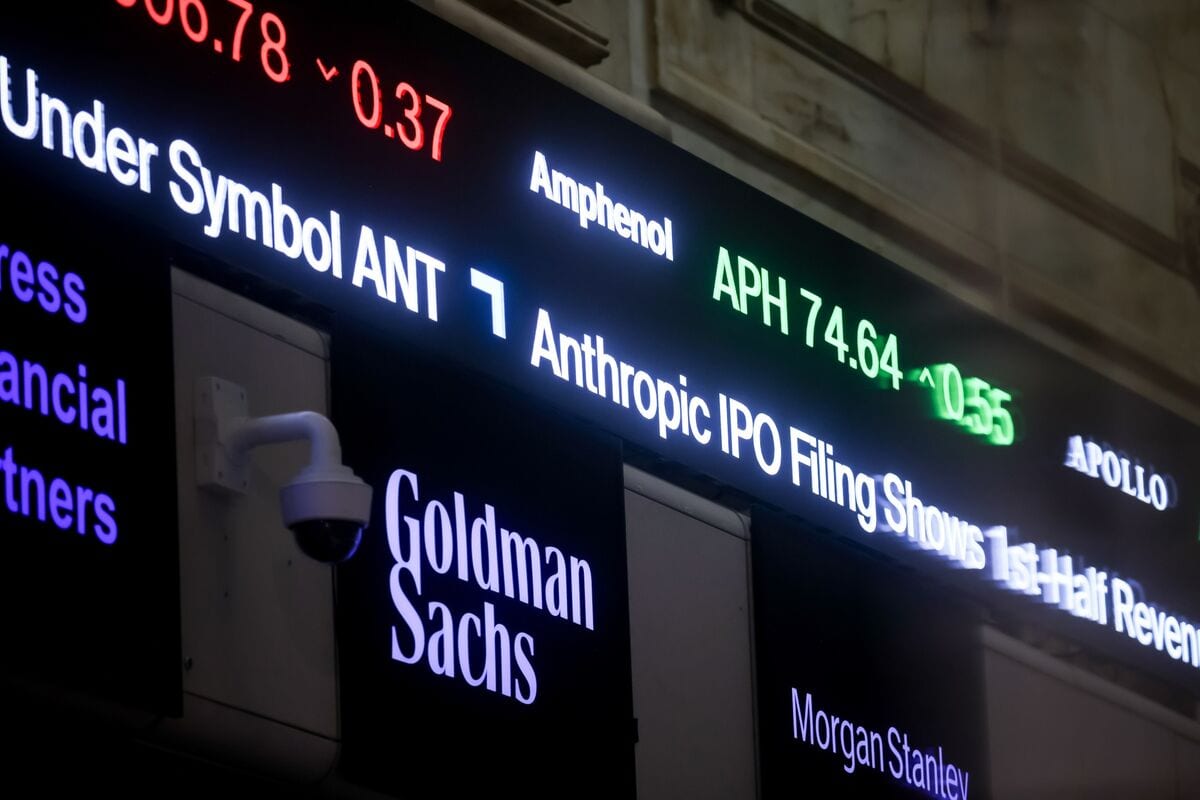
- On October 26, Anthropic filed its S-1 prospectus for a Nasdaq initial public offering under the ticker “ANT”, reporting $16.3 billion in revenue for the first half of the year.
- The filing documents an $80.7 billion net loss over the same six-month period.
- The company committed between $542 billion and $567 billion for future compute and infrastructure, including a $417 billion deal signed on December 31, 2025.
- A Long-Term Benefit Trust will hold Class T shares to elect a board majority, while the seven co-founders share a single Class F stock that carries 50.1% of the vote on shareholder decisions.
- Fortune reports the offering targets a valuation between $1.5 trillion and $2 trillion.
My take: In the first half of 2026, Anthropic made $16.3 in revenue but lost $80.7 due to compute investments. They also committed to spending more than half a trillion dollars on more compute and infrastructure in the coming years. Anthropic is building for a future where most organizations use agentic AI as their core infrastructure, whereas most companies today are using AI as a clever writing assistant. If you believe every white-collar company will fundamentally change their organization and way of working within the next 3-10 years, the investments planned by Anthropic make perfect sense. If you, on the other hand, believe most companies will continue using AI as a smart assistant in their current organizational structure, these investments probably make no sense at all.
Read more:
- Fortune: Anthropic plans to spend up to $567 billion on compute
- Fortune: Anthropic’s dual-class share structure explained
- Hacker News: Discussion of the trust looming over Anthropic’s IPO
- Semafor: Anthropic’s IPO needs believers to bridge it to the payoff
- The Next Web: Anthropic files for Nasdaq IPO as half-year revenue hits $16.3bn
Epoch AI Uses Open-Weight GLM 5.3 to Build $1,000 Firefox Exploits
https://epoch.ai/publications/open-weight-models-patch-gap

The News:
- On October 29, Epoch AI published research showing that Z.ai’s open-weight GLM 5.3 model autonomously turned published-but-unshipped security fixes into working one-click Firefox exploits for roughly $1,000 per attack.
- Given only publicly available information at the time of each release, the model autonomously built its fastest successful attack in 12 hours.
- The model chained the patch-gap exploits with an unpublished sandbox vulnerability to read local files, prompting Mozilla to patch the flaw in its October 27 Firefox 159.0 release.
- Attempts to replicate the attack on Google Chrome using the same setup failed, despite researchers spending about $100,000 in API costs on the effort.
- Epoch calls the results evidence of the diffusion of advanced cyber capabilities, and expects more software to become vulnerable to patch-gap attacks as more capable open-weight models are released.
My take: This is yet another finding that challenges open source as a concept. The first challenge most repos experienced earlier this year was the “pull request storm,” where users who wanted a specific feature just asked their AI agents to implement it and post it as a pull request. This caused many large repos to disable contributions completely, simply because the quality of contributions dropped so much. Examples include large repos like Ghostty and tldraw.
Now, this second challenge for open source is complicated. What Epoch AI did was spend about $100,000 in API costs to create an agentic environment that was able to pull the latest bug fixes to the Firefox codebase and turn them into workable exploits. Once their agentic environment was up and working, the cost came to roughly $1,000 per workable one-click exploit.
Firefox has now shifted to bi-weekly updates, but with AI moving as fast as it does today, this still leaves a large window open where exploits can be actively used against targeted users. If you are using Chrome or Firefox today, make sure you have enabled automatic updates and restart your browser the moment it asks you to - do not leave the update notice hanging.
Read more:
- Anthropic: Measuring LLMs’ impact on N-day exploits
- Hacker News: Discussion of GLM-5.3 going open-weight
- Interconnects: Was I wrong about open models and cyber risks?
- Mozilla: Defending the patch gap against automated attackers
Google DeepMind Previews Genie 4 World Model With Native Audio
https://deepmind.google/blog/genie-4-a-new-generation-of-world-simulation/

The News:
- On October 27, Google DeepMind announced Genie 4, a real-time world model that generates interactive environments with simultaneous native audio and dialogue.
- The system runs Gemini Omni to anchor visual appearance and uses Gemini 3.8 Flash as a continuous supervisory agent to maintain logical coherence during a session.
- Users can explore the generated environments using keyboard controls and alter the scene mid-session using plain-language text prompts.
- Genie 4 is currently a research preview for trusted testers, with a planned rollout to Google AI Ultra subscribers on the $200 per month tier and to early-access API partners.
- All video and audio outputs include SynthID digital watermarks, and Google describes coherence over “short sessions” without giving a session length.
My take: If you have a few minutes to spare, check out their web page. It’s really amazing. When Genie 3 launched a year ago, it had a one-minute memory and physics errors like people walking backwards. With Genie 4, Google runs Gemini 3.8 Flash as a “supervisory agent” that checks that the scene stays logically coherent, while Gemini Omni keeps the visuals looking right.
The demos look super impressive, but Google is clear that the world only stays coherent over “short sessions,” without providing any specific numbers. My guess is that the video examples posted on their web page were the “lucky” ones where they managed to get somewhat coherent videos over a slightly longer stretch. Still, there are many use cases for this, like adding cinematic effects to movies at a very low cost.
Read more:
- Hacker News: Discussion of Genie 4
- Reddit: Discussion of whether Genie 4 is the seed for FDVR
- TechTimes: DeepMind Genie 4 adds native audio and Gemini-powered reasoning
- The Agent Daily: Genie 4 claims checked
- X / Tencent Hunyuan: Hy-Nomas vs Genie 4 comparison
Figma Trains First-Party Design Editing Model as Its Agent Gets 20% Faster
https://www.figma.com/blog/training-a-figma-fluent-editing-model/
The News:
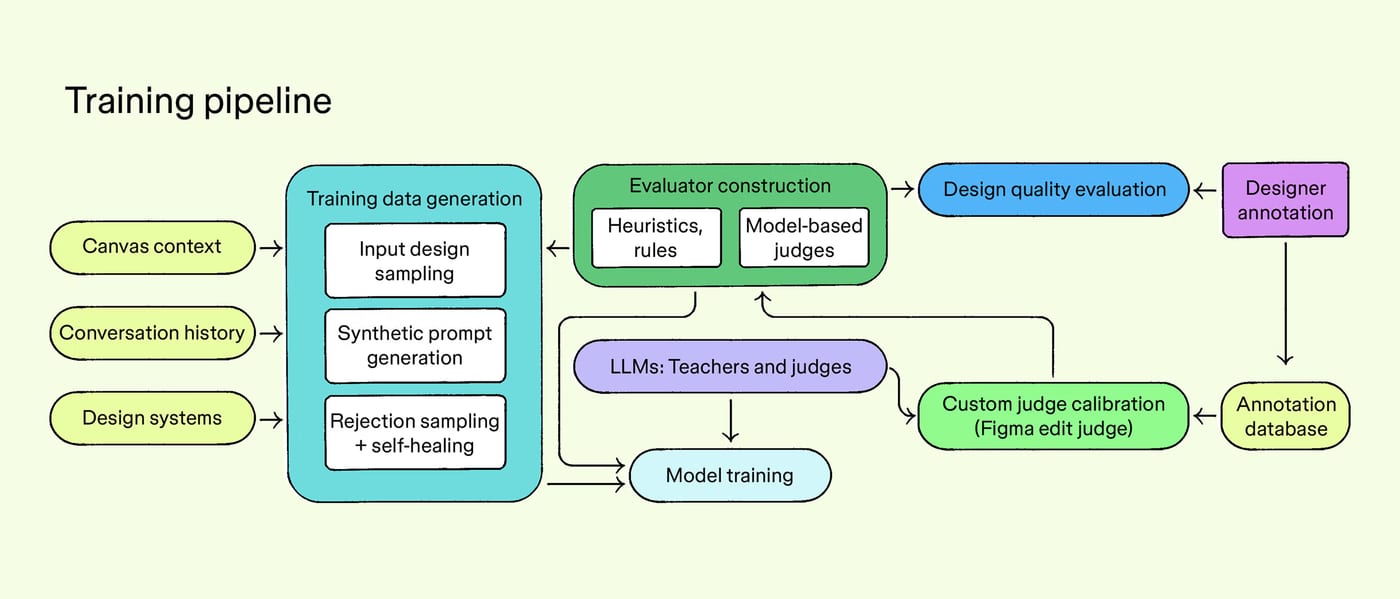
- On October 29, Figma detailed the training architecture behind its first-party design editing model, part of the generally available Figma agent, which completes typical user tasks about 20% faster than during its beta.
- The company added reinforcement learning alongside supervised fine-tuning in its latest training pipeline, post-training base models like Qwen 3.8 27B to natively manipulate Figma file formats.
- On Figma’s internal editing evals, the unreleased Qwen-based model scored 77.8%, ahead of third-party model Sol 6.1 at 76.9%.
- The Figma agent routes precise design iterations to this first-party model while handing off image generation and new design explorations to leading third-party models.
- In head-to-head testing with expert designers, the updated agent matches or beats Figma’s previous production agent 62% of the time and reduces user undos by 60%.
My take: Most AI models have problems laying out objects in Figma, PowerPoint and Keynote because their file formats are not built for agents - they’re built on legacy. Figma is now 10 years old, the PowerPoint XML format has been around since 2007, and Apple Keynote since 2003. So companies are putting a lot of effort into working around this, like in this case by fine-tuning models like Qwen so they know how to navigate around in the files, so they do not lay out things on top of each other and misalign objects. It’s the same with PowerPoint; companies are addressing it with extensive rulesets describing how models should work, which has the net result that most AI-generated presentations from a certain model look the same.
I think it’s time for new applications to be built that are agentic from the start. I have previously mentioned my own presentation tool I am writing that is designed from the start for AI agents, and it does not need any fine-tuned agents to create beautiful presentations. If you are curious about what types of presentations an AI can create in a 100% AI-native environment, check out markdownpoint.com. I hope to be able to release it soon.
Read more:
- Dev.to: Testing Figma AI across 20 design workflows
- Figma: Building Figma AI and model training controls
- Figma: Work with the Figma agent in design files
- Figmalion: TJ Pitre on Claude Design and real design systems
- Reddit: Discussion of Figma agent token consumption
Mistral Releases 1-Trillion-Parameter Large 4 Weights Under Modified License
https://mistral.ai/news/mistral-large-4-oss/
The News:
- On October 29, Mistral released the weights for Mistral Large 4, its 1-trillion-parameter multimodal model, under a custom license that requires separate commercial agreements for Model-as-a-Service providers.
- The Mixture-of-Experts architecture features 52 billion active parameters and supports a 1-million-token context window.
- On the Artificial Analysis Coding Agent Index, Mistral Large 4 scored 48%, matching the open-weight GLM-5.3 while using 47% fewer tokens per task.
- Developers running the model through the official API pay $0.70 per million input tokens, $0.07 per million cached input tokens, and $2.10 per million output tokens.
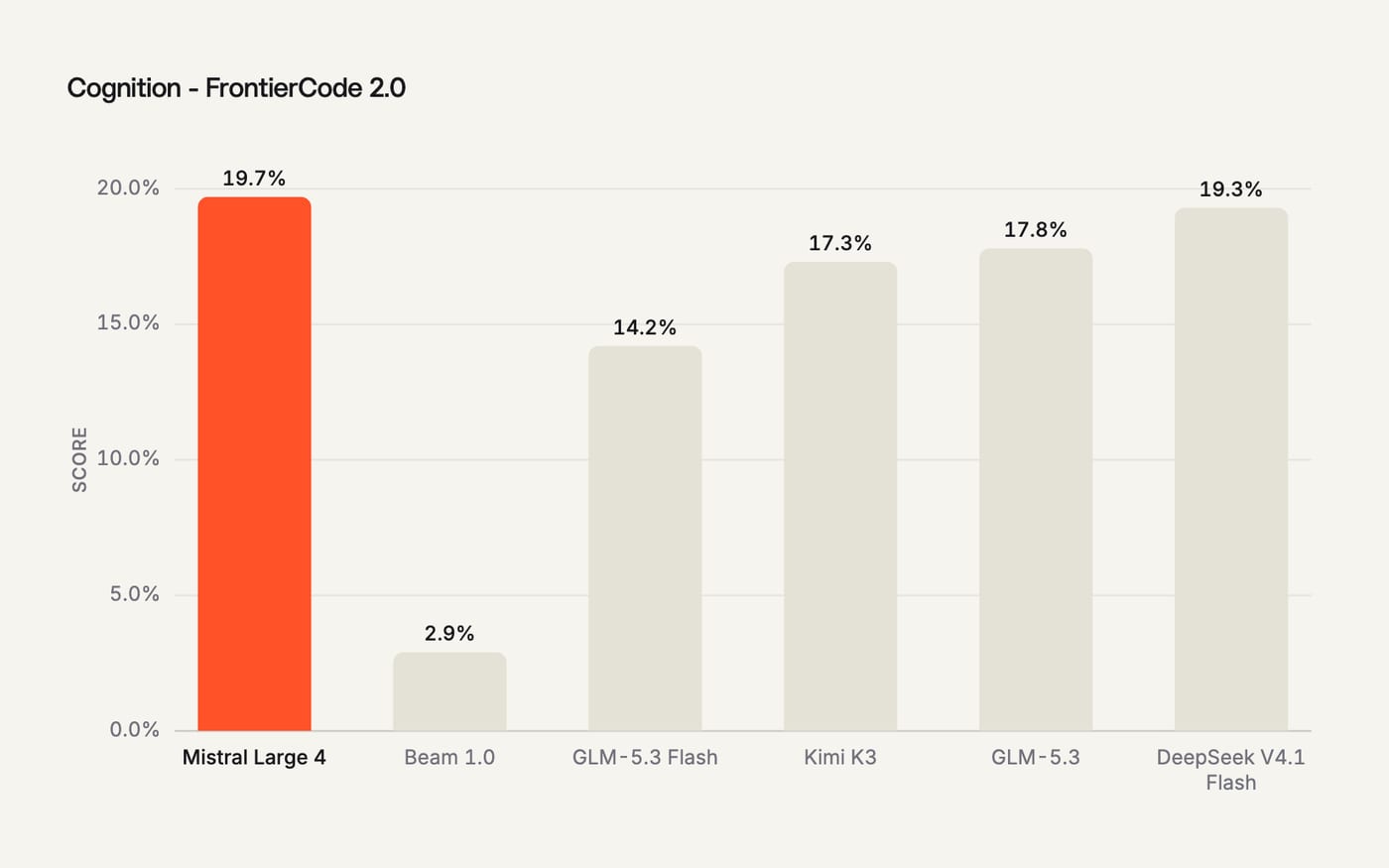
My take: If you are one of the lucky companies with a server of eight B200 GPUs, you can now download and run the latest “Le Chonk” model by Mistral fully locally. I know several companies that need to use local models for compliance reasons and actively avoid Chinese open models, and this model would fit the bill perfectly. In the image above, Mistral Large 4 looks like quite a capable model, beating both Kimi K3 and GLM-5.3 at 19.7% in the FrontierCode 2.0 benchmark by Cursor. However, if you look at the big picture, it’s actually one of the worst-performing models available for coding - just look at the graph below.
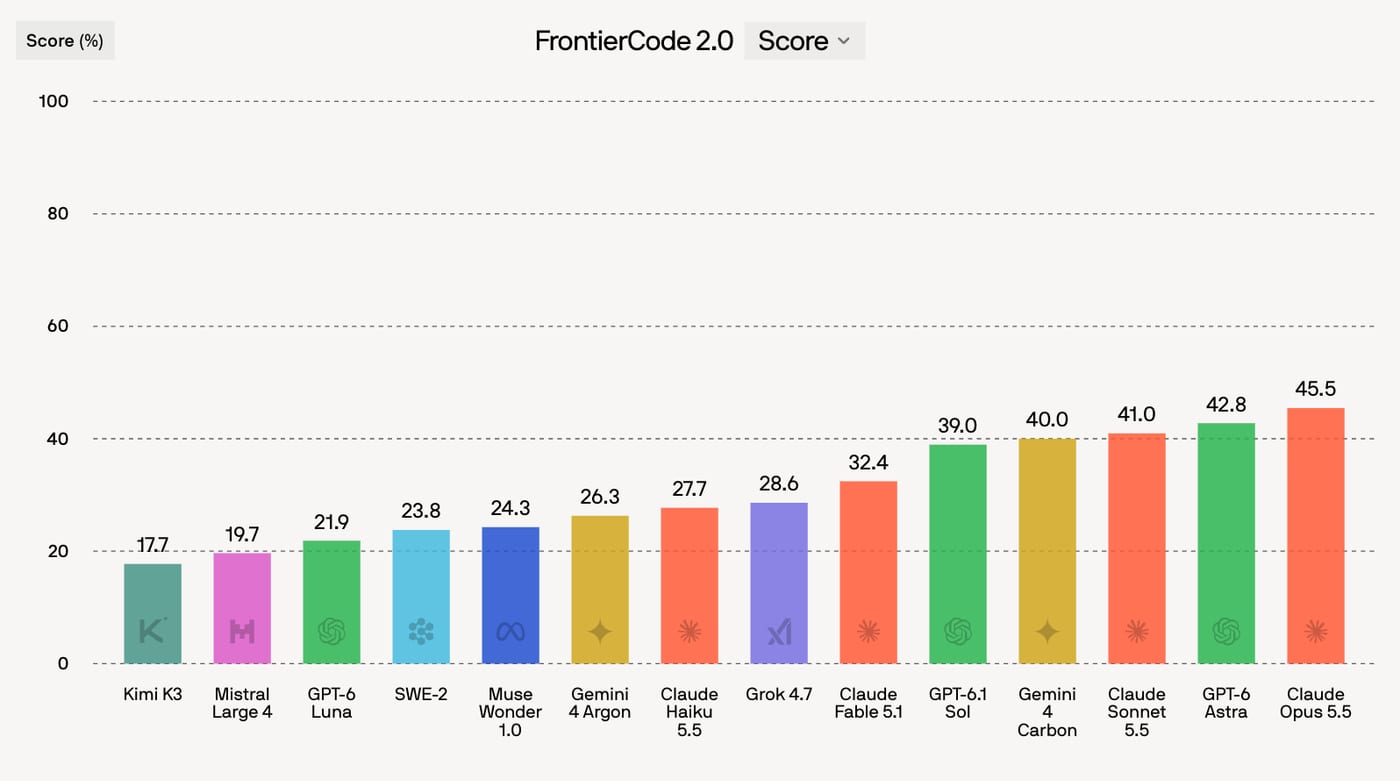
If you need a cheap model, my recommendation today would be GPT-Luna or GPT-Terra; they are both much better performers than Mistral Large 4 and cost almost nothing. The only reason you might want to look into this model is if you have the hardware to run it and you cannot run frontier models for compliance reasons.
Read more:
- Hacker News: Discussion of Mistral Large 4 open weights
- Reddit: R/LocalLLaMA on Le Chonk going open weight
- Socialvik: Mistral Large 4 open weights, 1,061 GB and a licence catch
- VentureBeat: Mistral Large 4 arrives as the top open model outside China
- X / Ensō: Mistral Large 4 vs Opus 5.5 on the same prompt
Artificial Analysis Launches Intelligence Index v5 With 60% Private Datasets
https://artificialanalysis.ai/articles/artificial-analysis-intelligence-index-v5
The News:
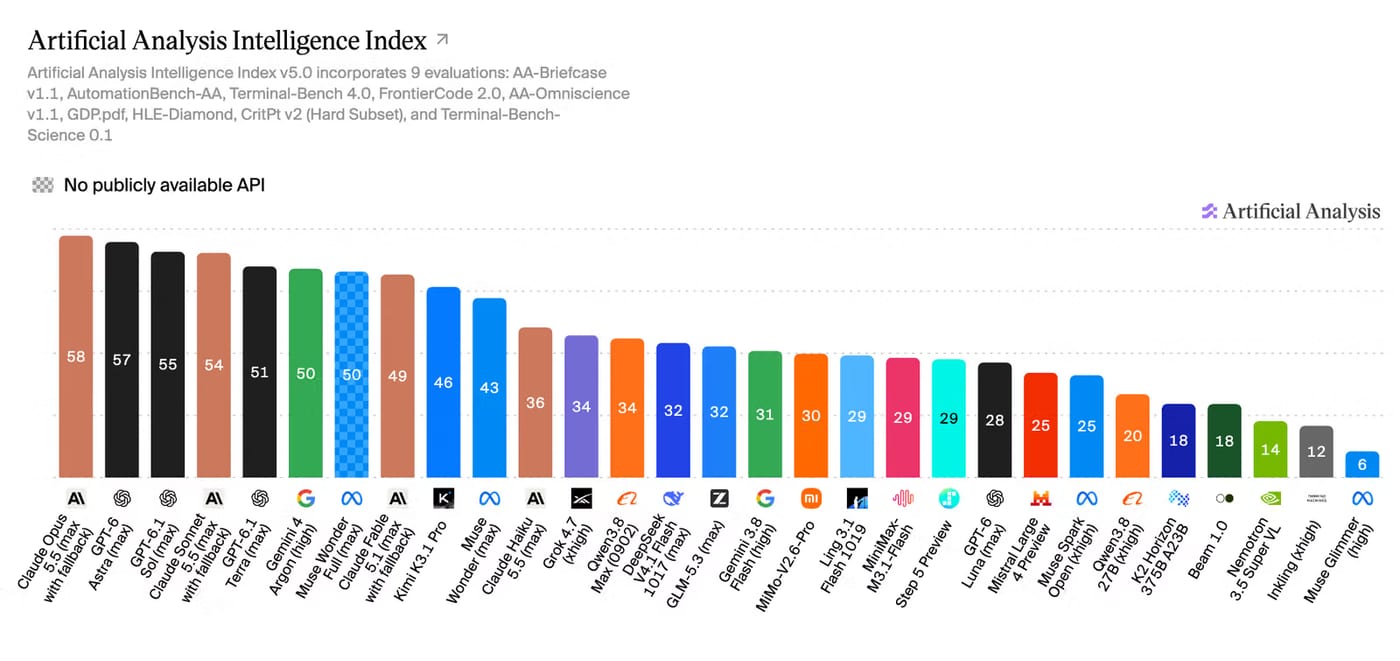
- On October 27, Artificial Analysis released Intelligence Index v5, updating its composite model evaluation to run 60% of its tasks on private datasets to prevent test contamination.
- Claude Opus 5.5 (max) led the launch leaderboard at 58, ahead of GPT-6 Astra (max) at 57, before Google’s Gemini 4 Carbon later took the #1 spot.
- The capability gap between proprietary and open-weights models widened from three points in v4.3 to 12 points in v5, with the unreleased Kimi K3.1 Pro scoring 46 and the top released-weights model, DeepSeek V4.1 Flash 1017 (max), scoring 32.
- The v5 index introduces Cognition’s private FrontierCode 2.0 and Terminal-Bench-Science, while swapping Humanity’s Last Exam for HLE-Diamond, a refined 1,000-question version split evenly between reasoning and knowledge.
- Median output tokens per task rose from 35,000 to 59,000 across measured models, with GPT-6.1 Sol (max) scoring within four points of Claude Opus 5.5 (max) for about an eighth of the price per task.
My take: Most AI benchmarks today are public, which means model vendors let their models train specifically on them. Meta is a good example of this; all their models score exceptionally well on most benchmarks but fail in everyday tasks compared to other similarly rated models. What makes the Intelligence Index v5 notable is that 60% of the test is based on private tests or held-out answers. The downside is that all tests need to be done through their own custom harness, and no one outside can verify how a model was scored.
Read more:
- Artificial Analysis: Changelog
- Artificial Analysis: Intelligence Index methodology
- Hacker News: Discussion of Intelligence Index v5
- X / DeepWater: Mistral Large 4 scores vs AA harness
- X / TheMonti: Reaction to Gemini 4 Carbon taking #1
Cognition Releases FrontierCode 2.0 Benchmark as Claude Opus 5.5 Scores 45.5%
https://cognition.com/blog/frontier-code-2.0
The News:
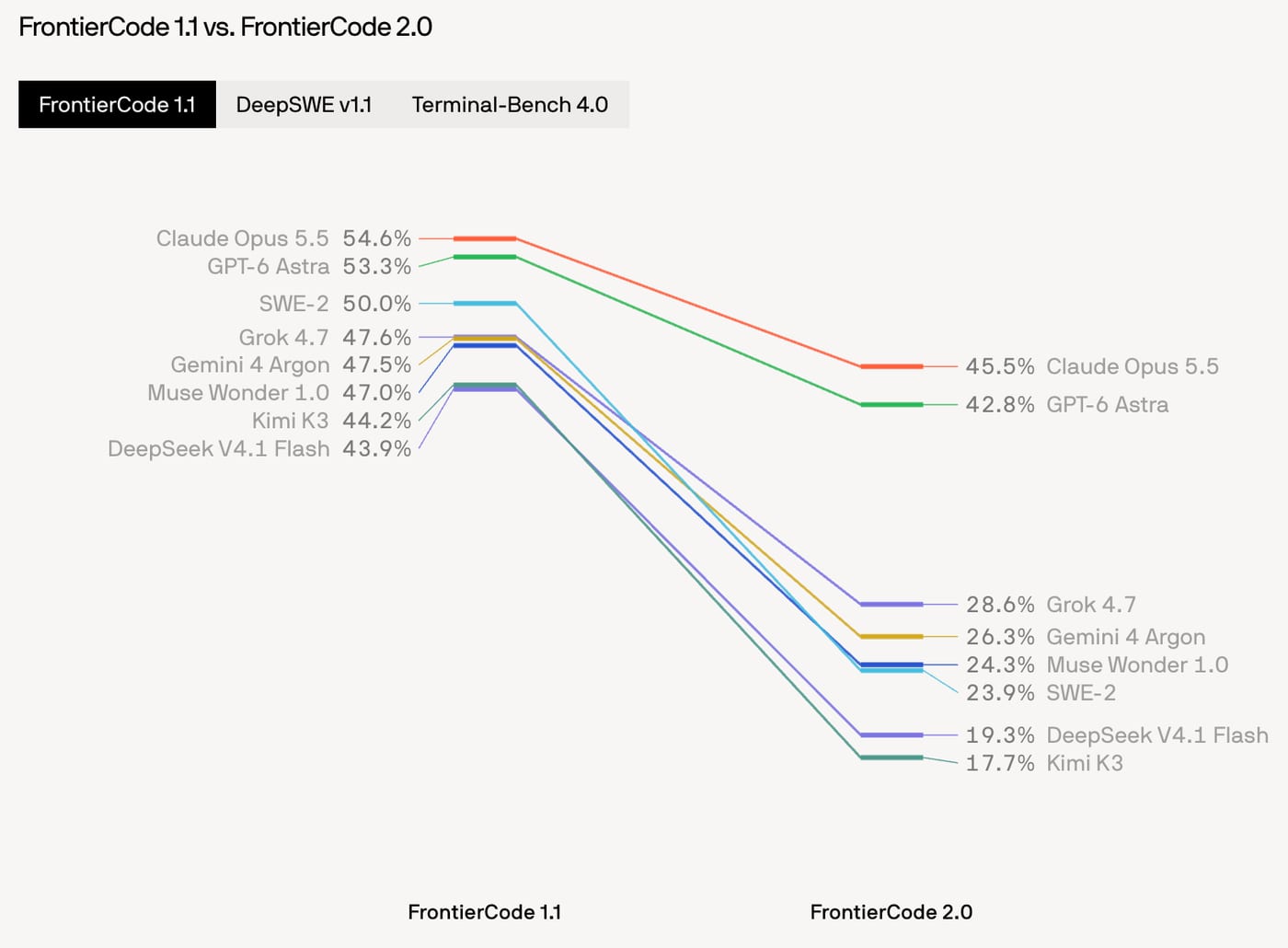
- On October 27, Cognition released FrontierCode 2.0, a 132-task update to its software engineering benchmark that applies stricter correctness criteria and caps the top-scoring model, Claude Opus 5.5, at 45.5%.
- Compared to version 1.1, the reference solutions modify 67% more files and 89% more lines of code in codebases that are 25% larger.
- The grading rubric triples the number of blocking checks for thoroughness, which now fail 26.0% of the time at low reasoning effort.
- Claude Opus 5.5 anchors the high end of the cost-performance frontier, while Cognition singles out OpenAI’s GPT-6.1 Sol for particularly strong performance relative to its cost.
- Artificial Analysis integrated the evaluation into its Intelligence Index v5 at a 15% weight, utilizing the private nature of the tasks as a defense against model training contamination.
My take: How do you prompt Claude when coding? This is the question Cognition asked itself when it built the FrontierCode 2.0 benchmark. Previous benchmarks give the model a very detailed spec of exactly what it is expected to build. FrontierCode 2.0 instead uses short, informal prompts and fails when the model misses something it should have worked out on its own. As an example, the prompt points to a bug in one place, but the bug also exists in other places - does the agent fix all places? These “thoroughness” checks are also why most models fail this test. Claude Opus 5.5 only reaches 45.5%, and Cognition’s own SWE-2 dropped from 50% to 23.9%.
FrontierCode 2.0 again highlights why you must always work in loops with agents. Due to the way agents work when scanning a codebase, copying bits and pieces into context memory, you must always repeat every task multiple times with different input parameters. If you only prompt your AI and ask it to build things and fix things, even if it works for you on your computer, there’s a high risk it will not work in another environment under different conditions.
Read more:
- Artificial Analysis: FrontierCode 2.0 benchmark results
- FourWeekMBA: Opus 5.5 tops Cognition’s test, GPT-6.1 Sol costs 12x less
- Hacker News: Discussion of FrontierCode 2.0
- Heise: Artificial Analysis Index v5 adds more secret AI benchmarks
- June Kim: Auditing FrontierCode
GitHub Releases Copilot Fusion Orchestrator at Half the Cost of Opus 5.5 Max
https://github.blog/changelog/2026-10-28-route-and-orchestrate-models-with-github-copilot-fusion/
The News:
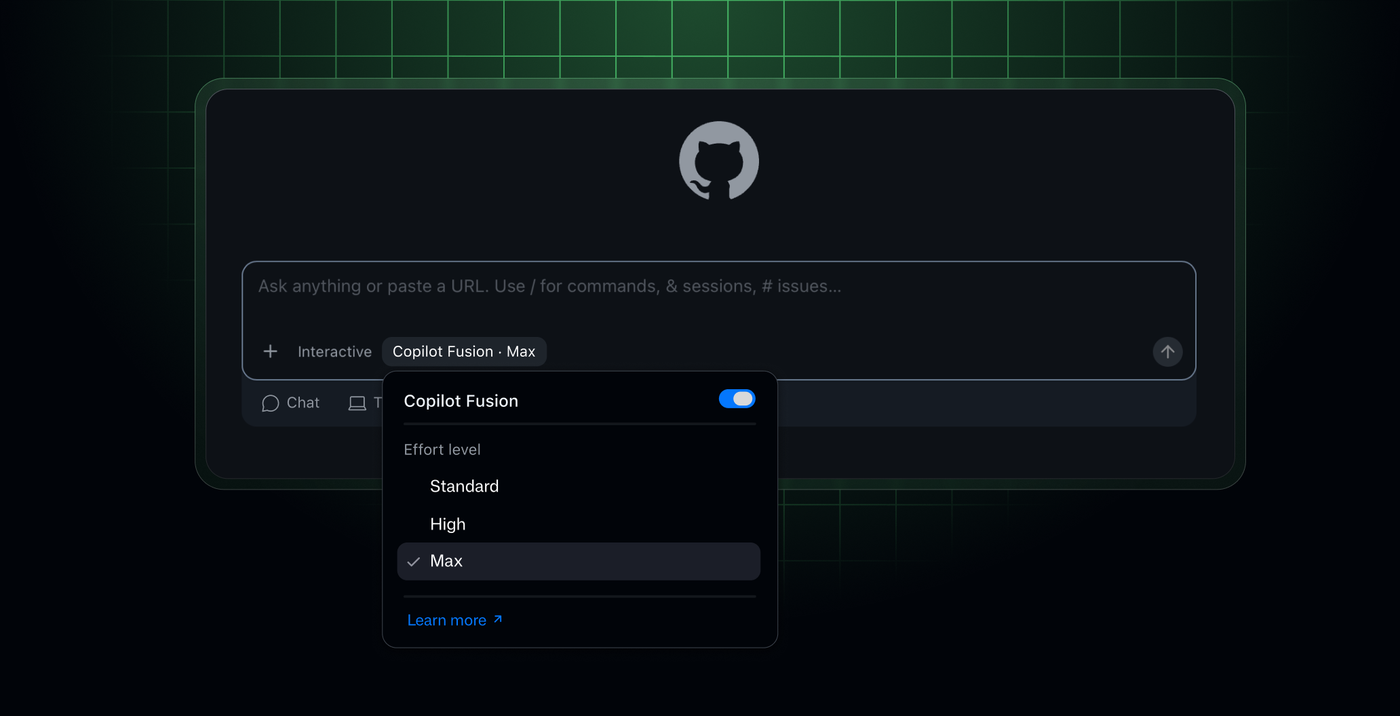
- On October 28, GitHub made Copilot Fusion generally available, introducing a runtime orchestrator that routes coding tasks across multiple models to score 60 on the Artificial Analysis Coding Agent Index at roughly half the API cost of Claude Code running Opus 5.5 Max.
- Users select a Standard, High, or Max effort level, and the system coordinates models through single-pass, cascade, or draft-and-critique workflows.
- Fusion Max completed tasks about 40% faster and used half as many tokens as the Opus 5.5 Max baseline during the Artificial Analysis evaluation.
- The system bills for each underlying model at its standard rate, though GitHub is offering a limited-time 30% discount on model costs for paid Copilot plans.
- Copilot Fusion only routes to models that enterprise administrators explicitly enable in their organization policies.
My take: What was previously the Auto model selection in Copilot is now called Copilot Fusion. Compared to the Auto mode, Fusion can now route a prompt to multiple models, letting a cheaper model draft and a stronger model check or redo the work. GitHub says Fusion Max scored 60 against 62 for Claude Code with Opus 5.5 Max in the Artificial Analysis Coding Agent Index, at half the API cost per task.
My own experience with the Auto mode in Copilot was not good. While I can see why GitHub Fusion works well for highly specific tasks like the ones in the Artificial Analysis Coding Agent Index, I can also see how it could work very poorly with prompts that are less specific. Before switching over to Fusion, I recommend spending some time benchmarking it against Opus 5.5 with at least a dozen tasks on your existing codebase, and then letting a model like GPT-6.1-Astra rate the work done by both approaches.
Read more:
- Artificial Analysis: Copilot Fusion orchestrates Anthropic and OpenAI models
- GitHub Docs: About GitHub Copilot Fusion
- Reddit: Discussion of Copilot Fusion caching and model switching
- VentureBeat: Copilot Fusion mixes models for near-Opus 5.5 performance at half the cost
- X / Outlier Feed: Reaction to Copilot Fusion benchmark costs
Microsoft Opens Copilot Agent Harness to Developers Through Foundry

The News:
- On October 28, Microsoft released the Microsoft Copilot harness through Microsoft Foundry, giving developers access to the multi-model agent orchestration layer that powers its own Copilot products across 20 frontier models.
- In internal evaluations, the Copilot harness improved task pass rates over the Standard harness by 10.8 percentage points with an OpenAI model and 22.1 percentage points with an Anthropic model.
- When tool calls failed, agents running the Copilot harness kept trying to solve the problem in 84% to 91% of cases, compared with fewer than 7% on the Standard harness.
- The runtime is ported to Rust to reduce session overhead and supports agent plugins, skills, and the open MCP standard.
- Developers can download the SDK or run the managed execution environment in the cloud, with support for bring-your-own-key configurations alongside the built-in models.
My take: What started as the “GitHub Copilot SDK” harness for GitHub Copilot CLI and GitHub Copilot in VS Code has now been renamed to the “Microsoft Copilot SDK” and is used across all Copilot products within Microsoft. Microsoft is also making it available through Foundry so developers can use it for online agents. If you develop AI agents and need a production-proven harness with an easy way to switch between models, it’s probably worth checking out.
Read more:
- Gartner: First Take on Microsoft’s new harness for Copilot Studio
- Microsoft Copilot Blog: The GitHub Copilot harness is now the Microsoft Copilot harness
- Microsoft Learn: Use the Microsoft Copilot harness with prompt agents in Foundry
- Reddit: Discussion of possible Copilot harness improvements
- The New Stack: Microsoft’s Copilot harness and the switching problem