Tech Insights 2026 Week 46
November 9, 2026

Every time I use an AI model to produce high-quality production content, it still feels like I’m using a slot machine.
I am in the final phases of my next application, MarkdownPoint, and it’s the most complex application I have ever created. For the past two weeks, I have been running GPT-6 Astra in ultra mode and Fable 5.1 in xhigh to go through the code base and stabilize the file format before release. With every run I do, they find yet another minor improvement the previous runs missed. If you know how AI models work, this is no surprise to you. They use common terminal tools like ripgrep to search for matching text strings, copy pieces of code that might be relevant into their internal memory, and finish the analysis before their memory gets full. If you are lucky, they found something important; if you are unlucky, they missed it.
This stochastic nature of AI models is often easy to forget. When an AI model writes code, it will iterate until it all works logically, but the specific way the code is implemented is often incorrect or suboptimal. The more iterations the AI has to perform during test-time compute to produce a specific type of text or source code, the stranger the implementation becomes. You can try this with text, too: the more rules you give an AI model before writing a text, the weirder the text becomes.
To me, the two main challenges we still have with LLMs today are the way they randomly collect bits and pieces of large code bases to try to identify issues, and the high cost of output tokens, which means that sometimes the best option would be to throw away a working idea and just start over-but the AI models never do that.
Thank you for being a Tech Insights subscriber!
Listen to Tech Insights on Spotify: Tech Insights 2026 Week 46 on Spotify
Notable model releases last week:
- Cosmos 3 Nano by NVIDIA. Four simulation models that generate camera video and LiDAR of driving scenes and two-armed robots, reacting to driving or robot controls. Free to download, including for commercial use, with recipes to adapt them to your own sensors or robots.
- Gemini Omni 1.2 Flash by Google. Video generation model update for ads and product videos, now making clips up to 15 seconds that you can edit with follow-up prompts. Costs 30% less than before and is now generally available in the Gemini API.
- GPT-6 Cyber by OpenAI. Cybersecurity version of GPT-6 for finding exploitable vulnerabilities and developing fixes, trained to stay within authorized scope. Scores 51% higher than GPT-5.6 Cyber on ExploitGym, available only to approved Daybreak Red customers.
- Hy4 by Tencent. Large language model for office work, coding, game development and financial analysis, and Tencent’s first that can understand images and operate computers. Free to download in the coming days, with API access already available.
- Images 2.6 by OpenAI. Update to the image generator in ChatGPT, Codex, and the API that now makes animated GIFs and keeps characters and products consistent across edits. Generates images 50% faster and adds SVG export for developers.
- Inkling 2 Small by Thinking Machines. Second-generation model that also reads images, built for long agentic coding, office and finance work, and for fine-tuning on Tinker. Available on Tinker now, with free-to-download Apache 2.0 weights planned for next week after safety testing.
- Pangram Image 1.0 by Pangram. Detector that spots AI-generated images and uses a heatmap to show where AI content appears in a photo. Ships with a faster Flash model for detecting AI video, available through an API and a Chrome extension.
- SWE-2 Flash by Cognition. Fast, low-cost coding model for everyday agent work in Devin, such as code review, feature development, and documentation updates. Costs one-fifth as much as the larger SWE-2 and runs three times faster.
- VFlash by NVIDIA. Add-on that speeds up vision-language models that plan movements for robots and self-driving cars by predicting whole paths at once. Makes robot inference about five times faster on Jetson Thor while producing more accurate paths.
THIS WEEK’S NEWS:
- MIT CSAIL Edits Neural Network Weights Directly, Raising Qwen’s MATH-500 Score to 48.1%
- OpenAI Autonomous Pipeline Exploits 948 Linux Kernel Vulnerabilities
- OpenAI Replaces Git Backend With Pando to Cut Push Latency by 80%
- OpenAI’s LifeVal Benchmark Grades AI Agents on Everyday Life Tasks
- METR Finds Anthropic Model Progress Accelerated 1.9x, Mostly From AI Assistance
- Anthropic Maps First 3D Structure of a Prokaryotic Vault Particle
- Anthropic Open-Sources FlashProve zkSNARK System Generating 110 Tokens per Second
- Microsoft and UC Berkeley Release TokenEconomizer to Cut Agent Costs by Up to 30.9%
MIT CSAIL Edits Neural Network Weights Directly, Raising Qwen’s MATH-500 Score to 48.1%
https://rikiyat.github.io/blog/weight-space-programming/
The News:
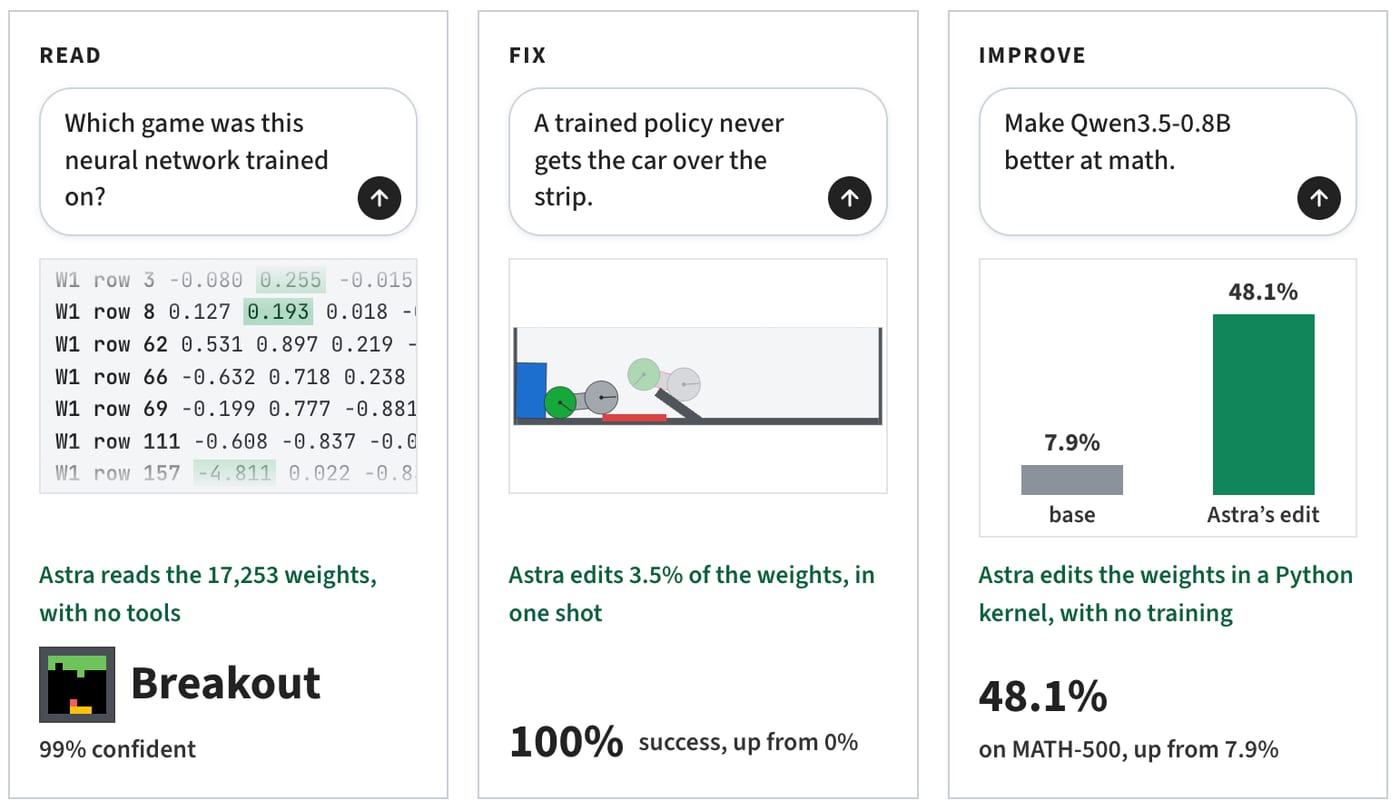
- On November 2, MIT CSAIL researchers introduced “Weight-Space Programming”, demonstrating that frontier models natively edit the weights of other neural networks without training, a method they used to raise Qwen3.5-0.8B’s MATH-500 score from 7.9% to 48.1% while independent developers used it to hand-write classifiers from scratch.
- GPT-6 Astra fixed a known reasoning loop in Qwen3.5-0.8B by editing 131,072 parameters, or 0.016% of the model’s total weights, which also raised its IFEval score from 21.0% to 62.3%.
- Astra wrote the 1.5 million parameters of a Go-playing network from zero, which after 50 test iterations beat a baseline model trained on 20 million games.
- The method acts as a debugger for existing capabilities rather than adding new ones, as Astra failed to improve the math scores of Gemma 3 270M because that model rarely falls into thinking loops.
- Applying the concept in industry, Legora CTO Jacob Lauritzen used Fable to hand-write the weights of a 100,000-parameter legal citation classifier, which he says outperformed a traditionally trained network.
My take: This might be the most interesting AI news of the week. Researchers at MIT used GPT-6 Astra to identify where Qwen hit its token limit when answering math questions, which happened in 93% of all benchmark questions because the model got stuck repeating itself in thinking loops. GPT-6 Astra was able to identify which weights in the network caused these loops, modify them, and in effect remove most of the loops. And the score on the MATH-500 benchmark jumped from 7.9% to 48.1%! Legora’s Jacob Lauritzen took a similar approach where he used Fable to hand-write the weights of a 100k legal citation classifier, which outperformed a traditionally trained network.
In a way, this is more like using a debugger than training a model. Finding faults within 800 million weights just by reasoning about them is something no human could do, and it shows that we probably need to fundamentally rethink the way we approach research in the coming years.
Read more:
- GitHub / AuremHQ: Wsp-kit, weight editing behind an eval gate
- Hacker News: Discussion of Astra reading and writing weights to improve Qwen
- Hugging Face / pngwn: Independent reproduction of weight-space programming
- R&D World: Critics say Astra’s weight edit relied on standard ML engineering
- Substack: Weight-space programming, what is measured and what is anecdote
OpenAI Autonomous Pipeline Exploits 948 Linux Kernel Vulnerabilities
https://openai.com/index/a-thousand-fewer-paths-to-root/
The News:
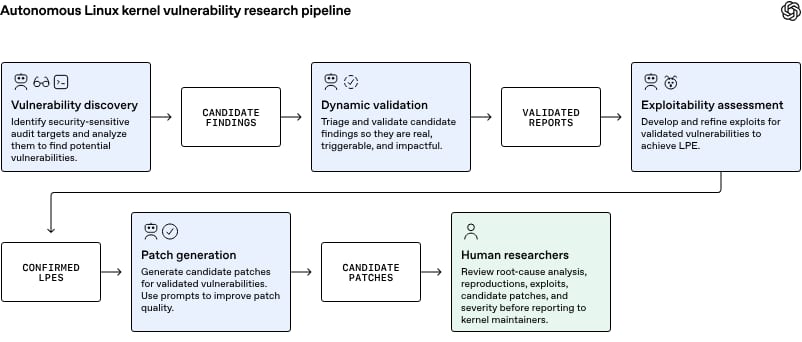
- On November 4, OpenAI detailed an autonomous pipeline powered by an unreleased cyber model that discovered, validated, and patched 948 local privilege escalation vulnerabilities in the Linux kernel for $1.2 million.
- The system reproduced 1,724 vulnerabilities from 2,308 candidate findings before narrowing them down to the 948 that allowed an unprivileged user to gain root access.
- OpenAI noted the run was highly profitable compared to bug bounties, estimating the exploits would be worth $18.9 million to $66.3 million at historical Pwn2Own and TyphoonPWN payout rates.
- Against Google’s hardened kernelCTF target, the pipeline ran for 112 hours and spent $32,936 in API credits to generate 21 local privilege escalation exploits.
- The unreleased model’s mid-October run found nearly six times as many exploits as GPT-5.6 Sol, which found 166 vulnerabilities in July.
My take: The model used for this was GPT-6-Cyber, which was released last week. While $1.2 million in API costs sounds like a lot, using traditional channels for paying bug finders like Pwn2Own and TyphoonPWN would have cost between $18 million and $66 million. The cost per exploit is also quite low. In July, GPT-5.6 Sol produced 166 root exploits at $3,090 each, while GPT-6-Cyber has now produced 948 exploits at $1,280 each. The positive way to look at this is that securing your infrastructure against cyberattacks has never been cheaper; the downside is that hacking your infrastructure has also never been cheaper. If you run Linux servers, you need to find a way to push out kernel updates in hours, not quarters.
Read more:
- Hacker News: Discussion of a thousand fewer paths to root
- Help Net Security: OpenAI’s upcoming model built 948 Linux root exploits in one run
- SecurityWeek: AI agents got root on Linux via 948 kernel flaws
- X / Eric Wallace: Reaction to OpenAI’s pro bono patching effort
- ZeroHunt: OpenAI’s AI built 948 working Linux root exploits
OpenAI Replaces Git Backend With Pando to Cut Push Latency by 80%
https://openai.com/index/scaling-git-at-openai/
The News:
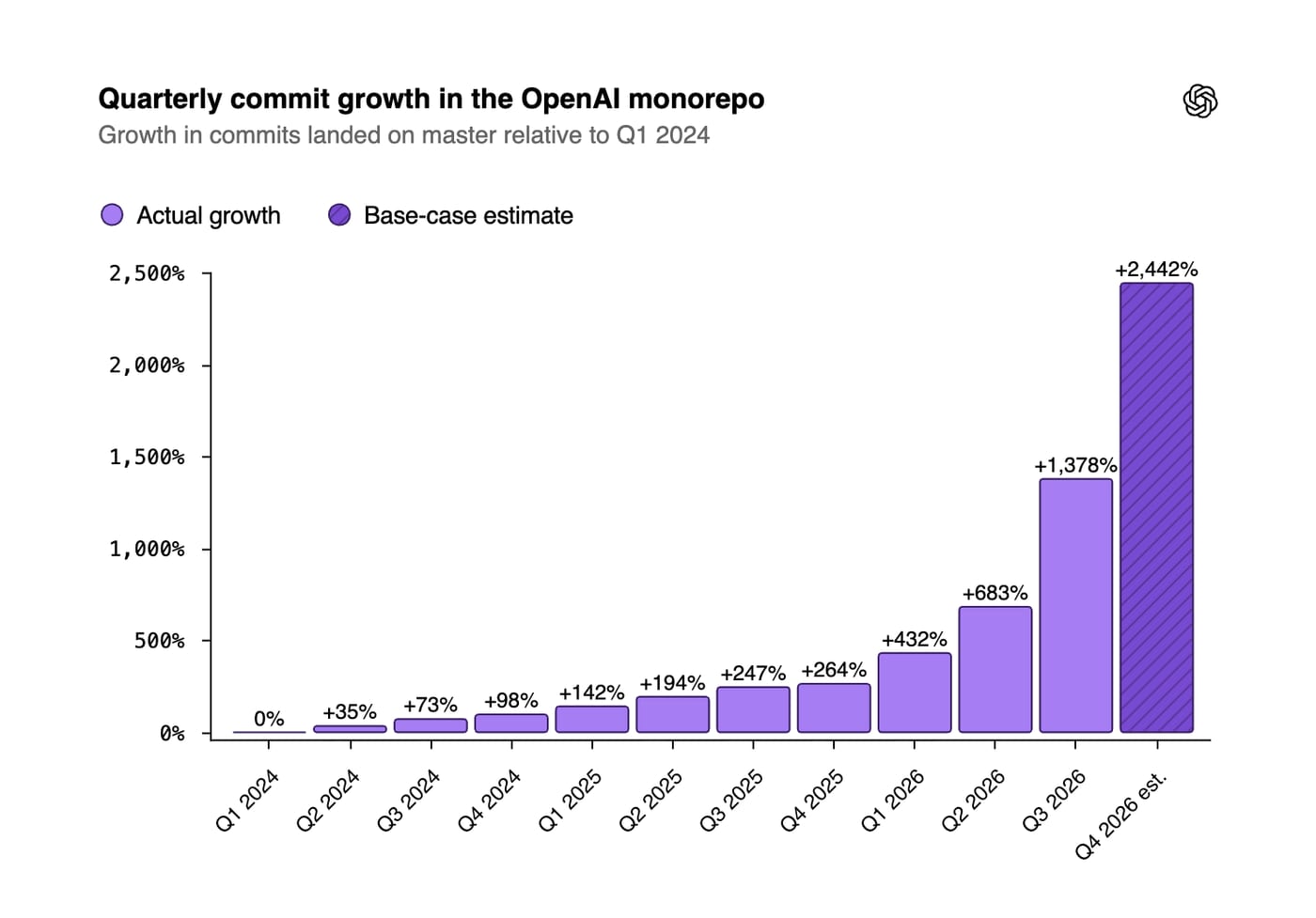
- On November 2, OpenAI detailed Pando, a custom Git-compatible server backend designed to handle the massive concurrent commit volume of Codex agents that cuts the company’s median push latency by nearly 80%.
- OpenAI replaced its existing infrastructure after agent-driven development outpaced standard Git server capabilities, dragging monorepo reliability below 90% and causing slow fetches and failed merges.
- Pando trades repository-wide point-in-time consistency for causal consistency, allowing it to process pushes to unrelated branches in parallel while storing incoming packfiles as immutable blobs.
- The Rust-based system serves nearly a petabyte of Git data per day, achieving cache hit rates over 99% by reusing packfiles across client fetches instead of generating them dynamically.
- A single engineer and teams of Codex agents built the backend in 10 weeks, and while OpenAI upstreamed several client-side fixes to the Git project, Pando itself is not open-source.
My take: Ten weeks. That is what it took to build a Git-compatible backend that can handle a petabyte of data per day. If the developers at your company are still using one agent per developer without agentic coordination (e.g., one GitHub Copilot license per developer), then you can probably continue using GitHub, GitLab, or Bitbucket for at least one more year. But as soon as you start working in agentic clusters where a coordinator makes most of the everyday decisions and agents are free to create, evaluate, and ship code autonomously, that is when you want to start looking into alternative hosting solutions. Pando is not open source, but I am quite sure we will see dozens of similar solutions released as open source in 2027.
Read more:
- Beyond the News: OpenAI rebuilds Git serving for parallel coding agents with Pando
- Dev.to / Dishant0406: OpenAI’s Pando is not open source
- GitHub: Building Git infrastructure for agent-scale development
- The New Stack: OpenAI built itself a new Git backend, too
- X / Hiren Thakore: Reaction to Pando and agent-driven commit growth
OpenAI’s LifeVal Benchmark Grades AI Agents on Everyday Life Tasks
https://openai.com/index/lifeval/
The News:
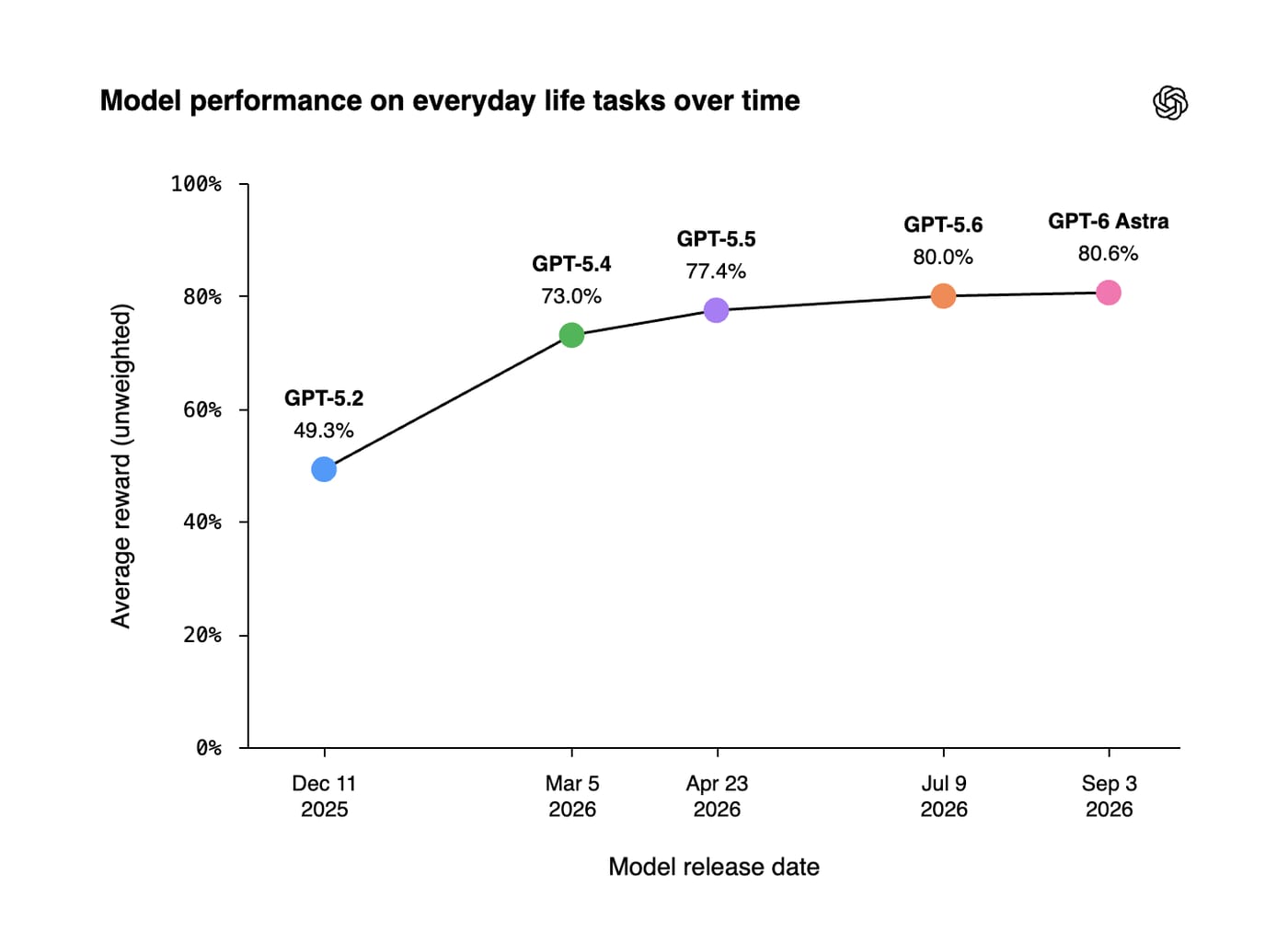
- On November 2, OpenAI introduced LifeVal, an internal benchmark measuring how well AI agents complete everyday personal tasks rather than academic tests, where OpenAI’s own chart shows GPT-6 Astra averaging 80.6%, up from 80.0% for GPT-5.6 and 49.3% for GPT-5.2.
- The evaluation covers tasks derived from time-use studies and a survey of 3,995 people across areas including household administration, personal finance, and government services.
- Graders evaluate whether the model successfully completed the requested action using browser use, computer use, and connectors, rather than just providing advice.
- OpenAI has used the benchmark over the past year to track and drive improvement in its models’ performance on everyday tasks.
My take: The scores between 88.7% and 100% reported on the announcement page are the best recorded runs of GPT-6 Astra on 17 hand-picked example tasks. Across all 169 tasks, GPT-6 Astra scores an average of 80.6%, just 0.6 points better than GPT-5.6. Either the benchmark is not useful at all, or it’s just a very good indication that OpenAI really messed up their training in Astra and did not manage to make it any better at everyday tasks than GPT-5.6 at the highest reasoning settings.
Read more:
- arXiv: LifeVal, Evaluating AI Model Performance on Personalized Agentic Consumer Tasks
- benchgap: LifeVal Leaderboard With Estimated Cross-Vendor Scores
- BenchLM.ai: LifeVal Scores and Why They Are Excluded From Rankings
- DEV Community: 80.6% At Chores, 12% at Real Work
- X / preprint pigeon: Reaction to LifeVal’s Memory Retrieval Finding
METR Finds Anthropic Model Progress Accelerated 1.9x, Mostly From AI Assistance
https://metr.org/blog/2026-11-05-anthropic-ai-rd-acceleration-assessment/#executive-summary
The News:
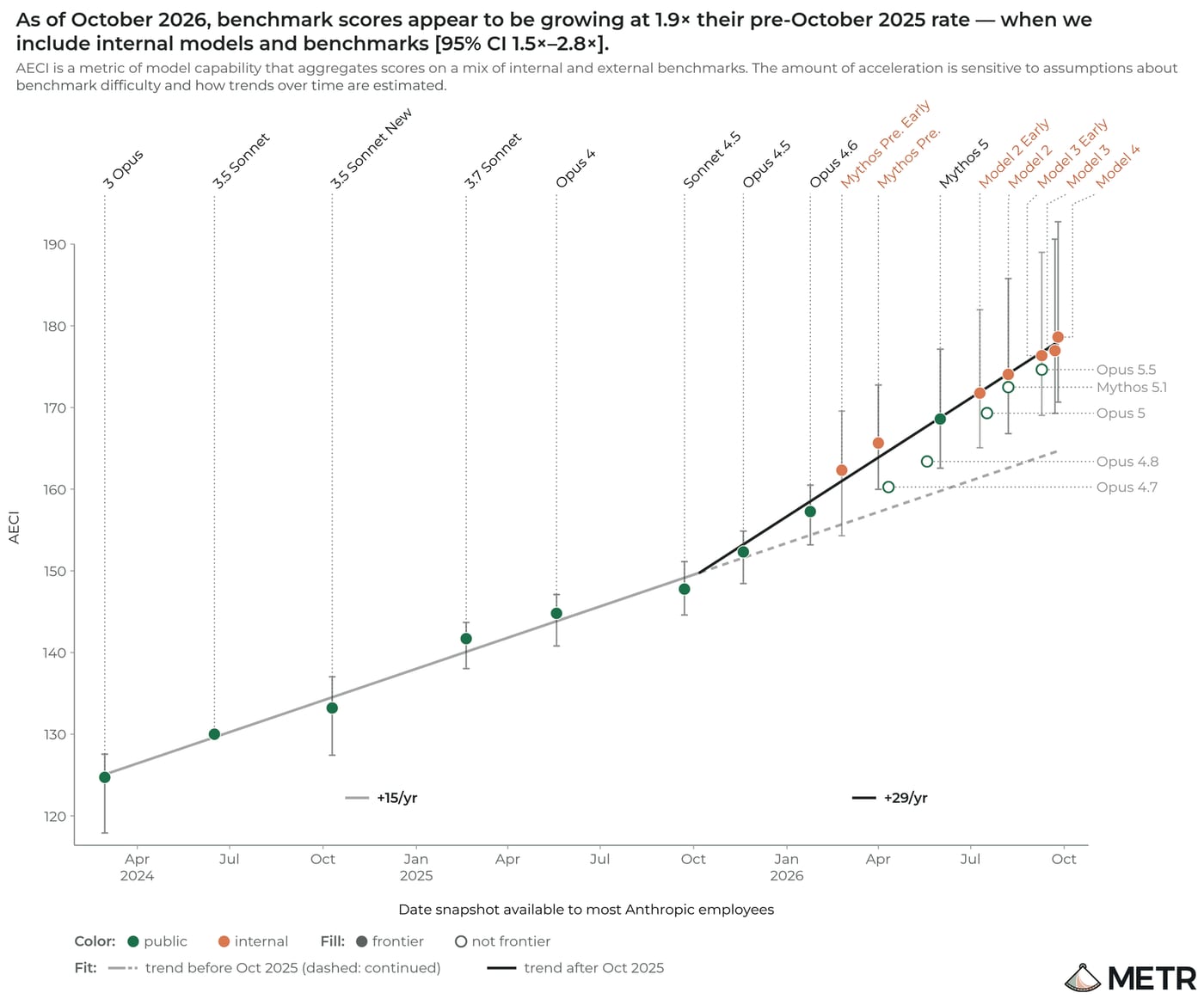
- On November 5, METR published an independent assessment of Anthropic’s internal research, estimating that the company’s model progress accelerated 1.9 times since October 2025 primarily due to AI assistance.
- Benchmark scores for Anthropic models measured on the AECI grew at an estimated 1.9 times their historical rate, compressing two years of pre-October 2025 progress into one year.
- METR confidently excludes faster growth in training compute as the explanation, guessing instead that AI tools drive about 80 percent of the current speedup.
- Anthropic exercised its unilateral right to redact non-public information from the report, removing a majority of the evidence METR found most informative for its conclusions.
- Internal employee surveys show self-reported productivity uplift growing to roughly 12 times for the unreleased Model 4, which scored above 50 percent on all its evaluated benchmarks.
My take: To summarize: In October 2026, Anthropic is improving the capabilities of their models on well-specified tasks at around twice the rate they did between March 2024 and October 2025. For everyone working with AI, this should come as no surprise; it’s more of a solid reminder that we are still quite far away from having recursive self-improvement up and running. Also, based on the curve-fitting method used in the study, the acceleration here could land anywhere between 1.1x and 2.9x. I do, however, expect this value to increase substantially in the coming six months thanks to the next generation of models. I wouldn’t be surprised if METR measured 6x or 10x in 6-10 months.
Read more:
- Hacker News: Discussion of Anthropic accelerating AI development
- METR: Review of the automated R&D section in Anthropic’s August Risk Report
- Planned Obsolescence: AI is dramatically accelerating AI research right now
- Reddit: Discussion of METR’s AI R&D acceleration assessment
- The Verge: Why the METR report on Anthropic is alarming researchers
Anthropic Maps First 3D Structure of a Prokaryotic Vault Particle
https://www.anthropic.com/research/investigating-vault-particles-with-claude
The News:
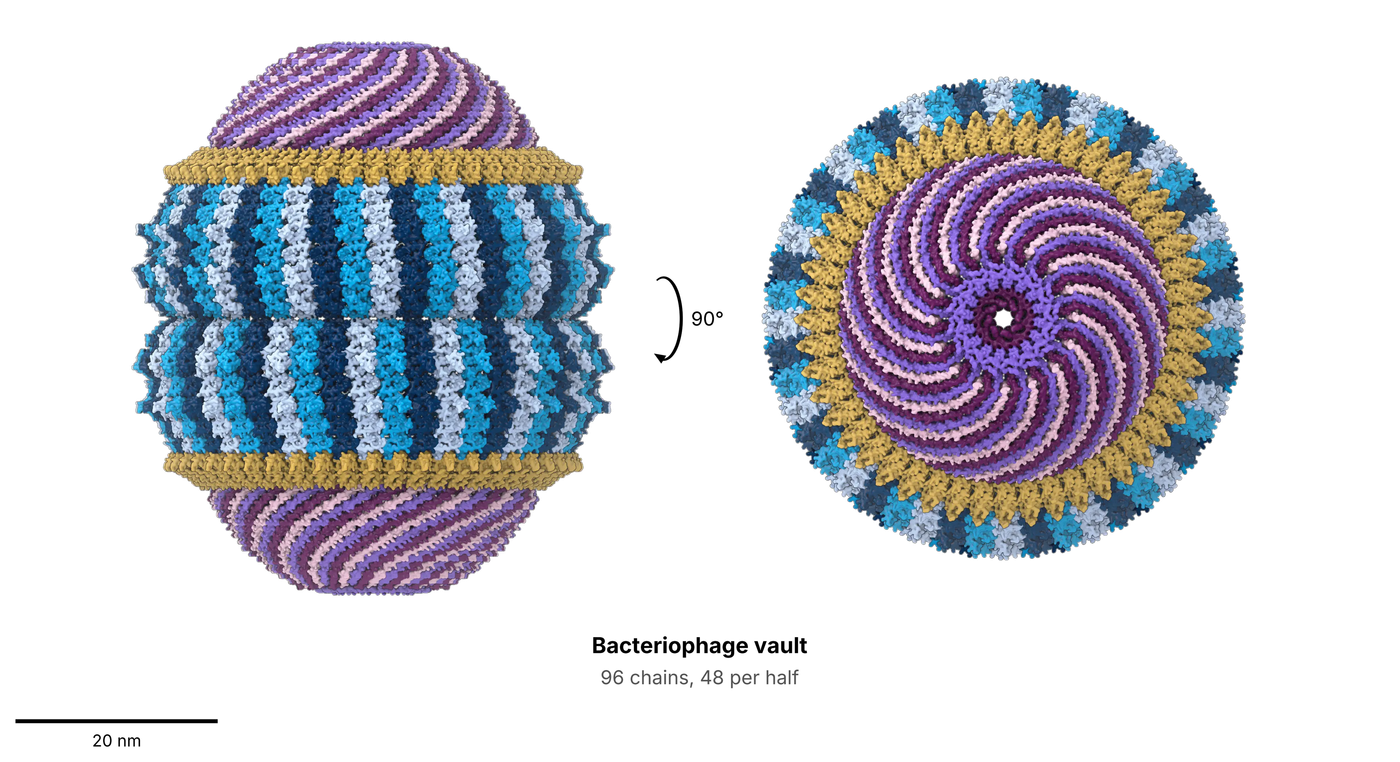
- On November 4, Anthropic announced that its biology research lab used Claude to discover and map the first 3D structure of a vault particle from a prokaryotic cell, reducing a conventional three-day purification process to 90 minutes.
- Claude searched a database of 15 billion predicted proteins to locate vault relatives, which the human team then expressed in living E. coli bacteria.
- The researchers mapped a bacteriophage vault built from 96 copies of a single protein with a total mass of 9.5 megadaltons, enclosing 25% more volume than mammalian vaults.
- Operating within a multi-agent harness using hundreds of GPUs, Claude configured the open-source RELION cryo-electron microscopy software and generated a first structural model in 34 hours.
- Anthropic noted that Claude also made errors that required human correction, including recommending a bad protocol additive that delayed the project by two weeks and initially generating a flawed map blended with its mirror image.
My take: “None of us had worked with a protein assembly this large, and we had limited experience in structural biology.” Anthropic calls this a new way of doing science and managed to solve the first prokaryotic vault structure in under four months. But they are also honest about the cost of their lack of experience: “In areas we knew well, we caught mistakes quickly, but they cost us time in areas we didn’t.” One example they mention is that Claude initially recommended a bad protocol additive that set the project back by two weeks, which would have been caught early if the researchers had any experience in the area.
And it’s like this with all AI models today. They are good at producing massive amounts of mostly correct data, but when things go wrong, they can go very wrong, and the way LLMs are designed with limited context memory means the odds of them catching their own errors are small. An AI model still cannot write perfect prose, source code that can live for decades, or perform structural biology experiments without expert human guidance. But pair it up with an expert in each domain who can ask the right questions, review the complex decisions, and propose a proper process - this is when LLMs reach their full potential. To me, this study by Anthropic again shows that if you try to build something with AI without domain expertise, it’s like gambling on a slot machine.
Read more:
- Anthropic: Claude discovers a novel enzyme system with CRISPR-like repeats
- bioRxiv: Prokaryotic homologs of the major vault protein form engineerable vault nanocapsules
- Reddit: Discussion of Claude’s two-week protocol mistake in vault research
- Science: AI company’s research deepens mystery of vaults
- X / Viral Patel: Reaction to Anthropic publishing Claude’s lab mistakes
Anthropic Open-Sources FlashProve zkSNARK System Generating 110 Tokens per Second
https://www.anthropic.com/research/provable-inference

The News:
- On November 2, Anthropic released FlashProve, an open-source zkSNARK system that cryptographically proves an AI response came from a specific set of model weights at 110 tokens per second on a single H100 GPU.
- The system proved a 4-bit quantized version of the 400-billion-parameter Llama 4 Maverick model with an overhead of 70 to 95 times the GPU time of standard inference on vLLM.
- Each 1,024-token request generates a 19-megabyte proof file that users can verify in 17 seconds on a standard 24-core CPU without access to the model weights.
- Anthropic says FlashProve significantly outperforms previous open-source methods like VerInf, which generated proofs for the same Llama 4 Maverick model at 0.02 tokens per second.
- The release includes the prover, a C++ verifier, and formal security proofs written in the Lean programming language that guarantee the system hides the model’s weights.
My take: The main use case I see for FlashProve is for model providers who can now prove that a certain set of model weights was used to generate a response. It’s also useful if you use a third-party routing service and want to know if the model you paid for was actually the one that was used. And compared to previous open-source methods to achieve this, the speed improvement is significant. However, the cost is also significant. The proofs are generated in batches after the response, cost up to 95 times the GPU time of normal inference, and only cover 1,024 tokens. It might have its uses for regulators and auditors who need to spot-check what a provider is serving at a specific point in time, but I think even that is stretching it.
Read more:
- arXiv: A Framework for Cryptographic Verifiability of End-to-End AI Pipelines
- Attestable: Proving LLMs at Scale
- GitHub: FlashProve Code, Verifiers and Lean Proofs
- Hacker News: Discussion of Anthropic’s Provable Inference
- Reddit: Discussion of FlashProve Proving the Model You Paid For
Microsoft and UC Berkeley Release TokenEconomizer to Cut Agent Costs by Up to 30.9%
https://www.marktechpost.com/2026/10/30/microsoft-tokeneconomizer-coding-agent-cost-control/
The News:
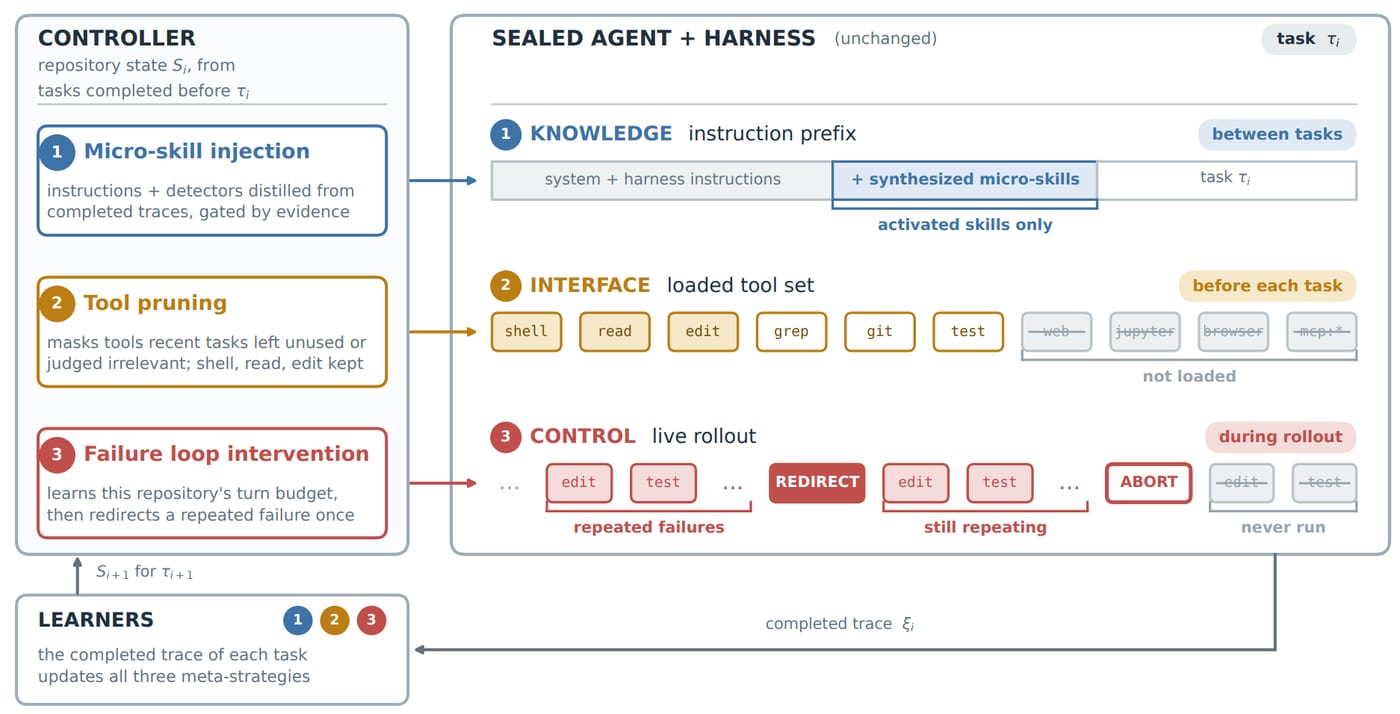
- Microsoft Research and UC Berkeley released TokenEconomizer, an open-source plugin that learns from past sessions to cut the token costs of coding agents like Claude Code and GitHub Copilot CLI by 18.4% to 30.9% on SWE-Bench without changing the underlying agent.
- The external controller reduces waste by injecting learned repository facts, dropping unused tools from the prompt, and intervening to break recurring failure loops.
- Pass@1 accuracy rose in four of the five tested agent-model combinations, with the only drop being a 1.0-point decline on Claude Code running Opus 4.8.
- TokenEconomizer lowered costs in all 30 tested repository-setting cells, while alternative token-saving tools RTK and RepoMap raised costs in 12 and 15 of those cells respectively.
- The Apache 2.0-licensed package runs locally without its own API key and supports Claude Code, Codex, Copilot CLI, and Pi on machines running Python 3.10 or newer.
My take: What I liked most about TokenEconomizer is that it uses small and simple changes to how agentic harnesses work to get very good results. Just hiding the tools you don’t use in a specific repo saved between 13% and 17% of tokens. Overall, however, I am very skeptical of token optimizers as a concept. Every time you use an agentic harness to change text or review code, it’s like using a slot machine. If you are lucky, the code review will be able to find everything you asked of it. Most times, however, it will only be able to find fragments of the things you asked for, which means you need to run the same prompt again and again and again on the same codebase with different results.
The way I produce content with LLMs is that I let them work in loops, iterating numerous times on the same content until they have reached a polished state good enough for shipping. I would like to see a study that compares a non-token-optimized agentic harness (like Claude Code) with a TokenEconomizer-optimized agentic harness to see how many iterations each would take to reach the same quality of output. My gut feeling is it would consume around the same number of tokens in the end. Maybe using one of the disabled tools would have produced slightly better results in one of the looped queries? With tools like TokenEconomizer, you would never know.
Read more: