Tech Insights 2026 Week 47
November 16, 2026

If an AI delivers 96% correct results, how long does it take for it to reach 99.9%?
Last week, Google launched “Gemini Robotics 2.5”, which now has a 96% success rate in picking automotive parts in a factory. At 96%, one pick in 25 fails and someone has to step in and fix it manually, while the 99.9% bar common in factory automation allows just one miss in 1,000, which means 40 times fewer errors. It might sound like we are now very close to humanoid robots replacing workers in factories, but those last few percentages could take years to close.
Compare it to LLM writing skills. Today, there is not a single LLM that can write text that reads like a human wrote it. Even the best model in the world at writing, like GPT-6.1 Sol, scores just 95.3 on the AI Writing Benchmark. While models have become significantly better at writing text that is logically correct, it’s still very easy to spot if a text has been written by an AI or not. The more rules you give the LLM, the more it has to think and the worse the text becomes.
If we manage to solve AI-produced content within the next 1-2 years - and by that I mean that an AI can produce texts and images that are impossible to distinguish from human-written texts and captured photos - that would be my cue that we are also close to solving humanoid robots. But until an LLM can write texts with the same quality as a human, I will not expect them to perform as well as a human in a factory either.
Thank you for being a Tech Insights subscriber!
Listen to Tech Insights on Spotify: Tech Insights 2026 Week 47 on Spotify
Notable model releases last week:
- Claude Fable 5.2 by Anthropic. Upgrade to Anthropic’s top tier for the hardest coding, science, and research work, a step above Opus 5.5. Cheaper than Fable 5.1, with a Mythos 5.2 version for vetted cybersecurity and life-science teams.
- Gemini 4 Hydrogen by Google. Fast, low-cost Gemini 4 model for everyday coding and agent tasks, the successor to Gemini 3.8 Flash. More than triples its predecessor’s Terminal-Bench score and is available to all users in the Gemini app and Search.
- MiniMax H3-Image by MiniMax. Image generation and editing model that creates realistic 4K images in about 10 seconds from text prompts and reference images. Free to download, and also available through MiniMax’s API and Hailuo AI.
- Muse Ember by Meta. Small, low-cost model for the repetitive steps agents run all day, such as tool calls, coding subtasks, routing and document extraction. Matches Claude Haiku 5.5’s best Artificial Analysis score at about a third of the cost.
- Praxis-1 by Runway. Model that controls robots, learning from video and adapting to new robots such as humanoids or industrial arms with light fine-tuning. Now free to download for commercial use, and the top world action model on NVIDIA’s RoboLab-120 leaderboard.
THIS WEEK’S NEWS:
- Google Releases Gemini 4 Carbon With 60 on Artificial Analysis Intelligence Index
- Google DeepMind Formally Verifies Signal’s Machine Code in Four Weeks
- Google DeepMind Releases Gemini Robotics 2.5 With 96% Success at Mercedes-Benz
- Google Launches Gemini Decisions API at $0.10 per Million Input Tokens
- OpenRouter Benchmarks Agent Context Costs, Finding MCP Uses 42 Times More Tokens Than CLI
- Anthropic’s Claude Fable 5.2 Prompting Guide Shows How Old Prompts Raise Costs
- Anthropic Details How Offline Dreaming Fixes Agent Memory
- Anthropic Launches Claude Meetings in Beta on Team and Enterprise
- Anthropic Adds Claude Sheets, Whiteboards, and Data to All Paid Plans
- OpenAI Launches Businesses in ChatGPT for 1.2 Billion Weekly Users
- xAI Releases Grok Bot 1.0 With Shared Teammates for Slack and Teams
Google Releases Gemini 4 Carbon With 60 on Artificial Analysis Intelligence Index
The News:
- On November 10, Google made Gemini 4 Carbon, its heavy reasoning model for long-horizon agentic workflows and cybersecurity, widely available to developers at an introductory price of $2 per million input tokens.
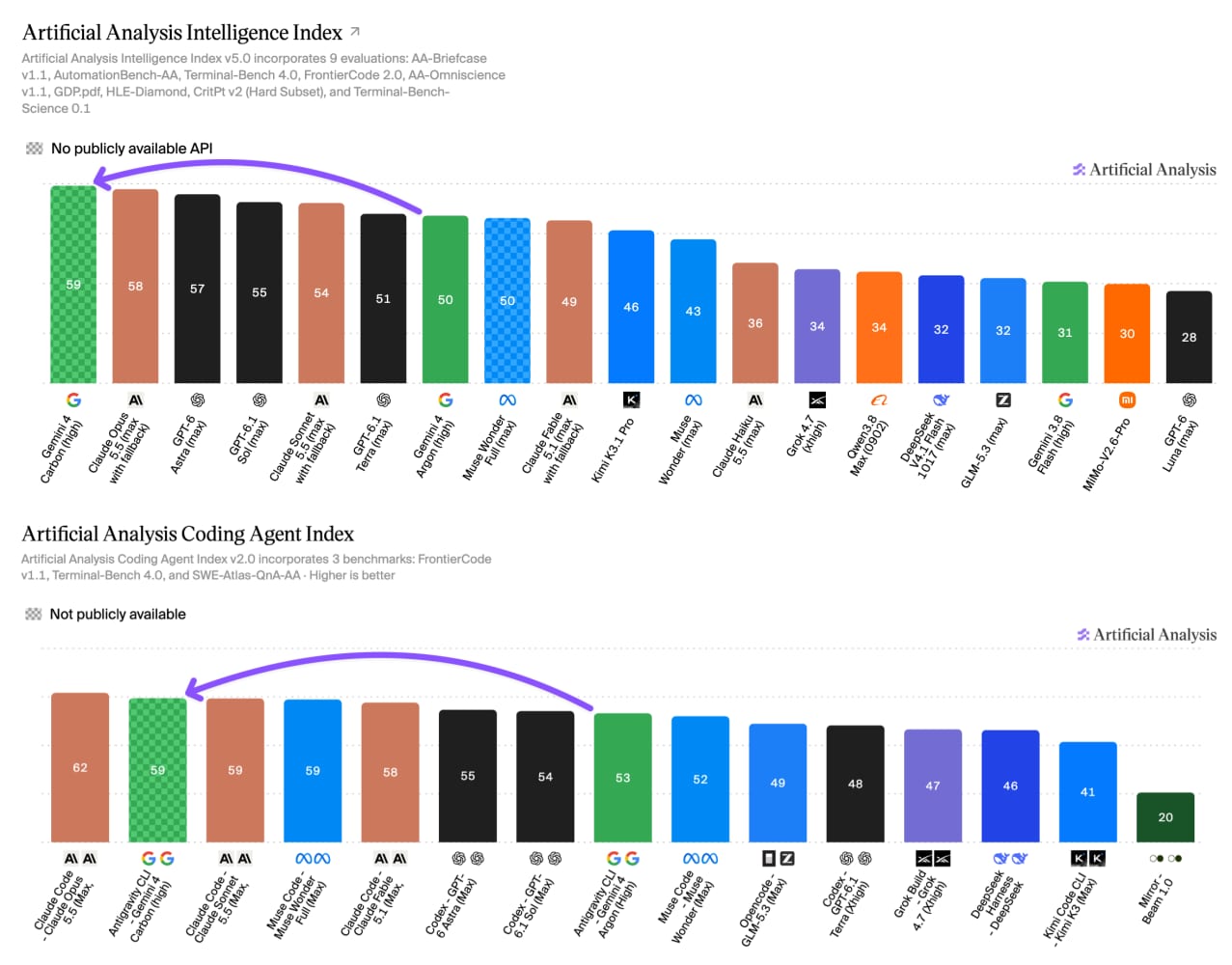
- The model scores 60 on the Artificial Analysis Intelligence Index v5.0, behind Anthropic’s Claude Fable 5.2 at 65 but ahead of Claude Opus 5.5 at 59 and OpenAI’s GPT-6 Astra at 57.
- On the new Multimodal Knowledge Agent benchmark developed with Artificial Analysis, Carbon ranked second overall while costing six times less per task than the top-performing model.
- The introductory API pricing of $2 per million input tokens and $10 per million output tokens doubles to standard rates on December 1.
- On the Gray Swan security benchmark, Carbon achieved a 0% prompt injection attack success rate and lowered the automated cyberattack query success rate to 2.17% from Gemini 4 Argon’s 9.86%.
My take: Gemini 4 Carbon is this year’s top model from Google, and according to them, it uses “more tokens than Argon to explore thoroughly, reason deeply, and run extended verification loops”. Google is offering it for an “introductory price” of $10 per 1 million output tokens, which will increase to $20 on December 1 (the same price as Opus 5.5). So when Google says that it ranks #1 “at more than 2X lower cost per task compared to the next best external model”, it’s only for the introductory pricing; starting December 1, it will cost the same as all other similarly performing models.
So, what should you use Gemini 4 Carbon for? I honestly don’t know. I use Gemini 3.1 Pro for polishing written texts, and I tried switching over my workflows to Gemini 4 Carbon last week, but the results were so bad I had to revert it. Gemini 4 Carbon writes sentences that sound very similar to GPT 5.x. If you are using AI mainly for programming, you also probably don’t want to leave Claude Code or Codex for a worse harness (Antigravity). While Claude Code is evolving at an incredible speed with features like memory and the new Code Mode (introduced last week), Antigravity is still catching up to features Anthropic and OpenAI introduced half a year ago.
Read more:
- Admix Software: Gemini 4 Carbon takes the top spot, then hands it caveats
- Apiyi: Comparing Gemini 4 Carbon, Claude Fable 5.2, and GPT-6 Astra
- Dev.to / eristoddle: Gemini 4 Carbon is #1, and you can’t use it
- Hacker News: Discussion of Gemini 4 Carbon availability
- Reddit: Discussion of Carbon rate limits for Ultra subscribers
Google DeepMind Formally Verifies Signal’s Machine Code in Four Weeks
https://deepmind.google/blog/introducing-alphaproof-code/
The News:
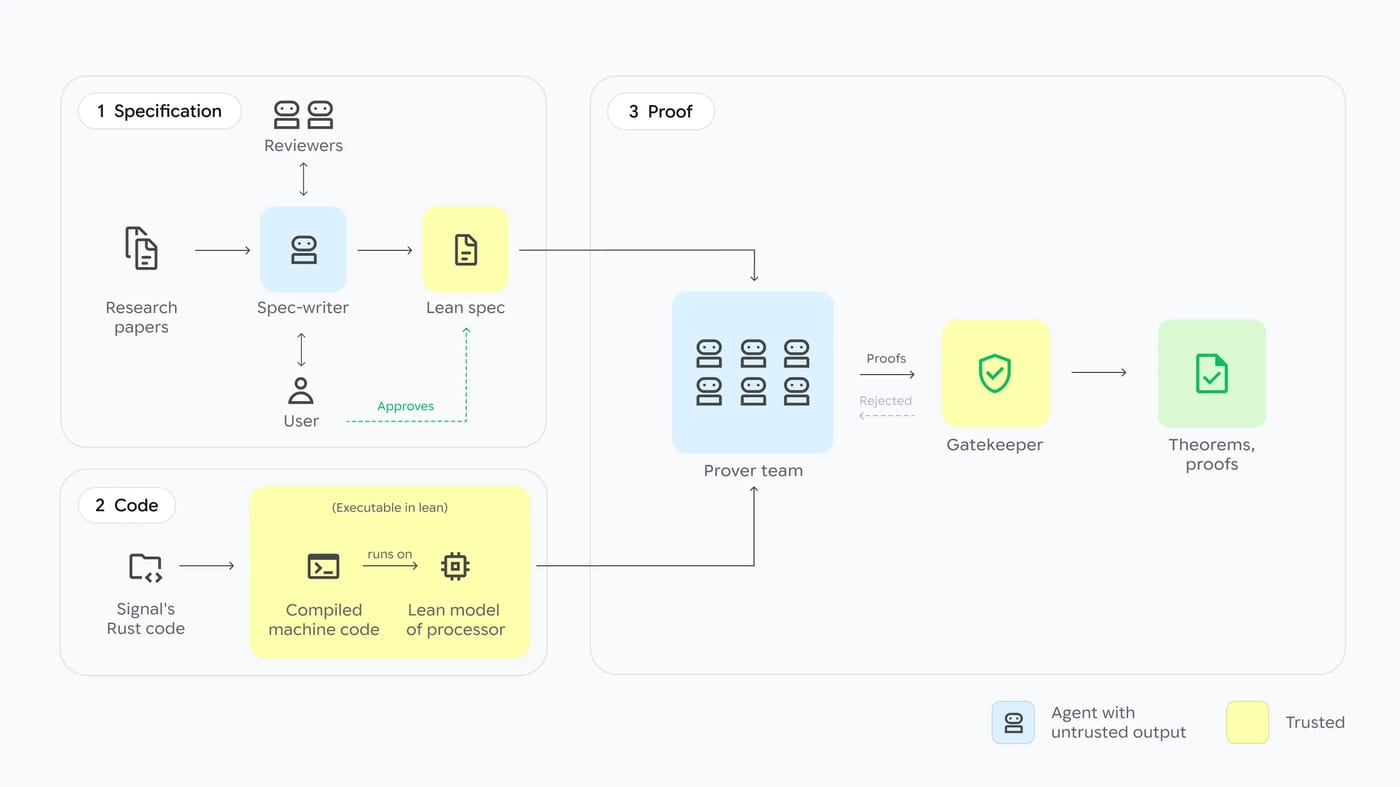
- On November 10, Google DeepMind introduced AlphaProof Code, a multi-agent framework that mathematically verified key security properties of the Signal protocol’s compiled machine code in four weeks.
- Agents powered by Gemini Carbon generated roughly 6.5 million lines of Lean proofs to verify the unmodified
libsignalAArch64 binary. - Human experts translated Signal’s security goals into formal specifications, while the agents highlighted just one percent of the codebase for manual review and relied on Lean to automatically check the rest.
- DeepMind tested the framework by reintroducing two previously fixed vulnerabilities into an isolated copy of the code, and in both cases the system produced a machine-checked proof that the binary was insecure.
- The verification covers one-to-one communication properties like forward secrecy.
My take: This new framework gives you a glimpse into a future where you can verify the security properties of compiled software using mathematical proofs. In this case, AlphaProof Code wrote 6.5 million lines of proofs, which were checked by Lean, a system that either accepts a proof or rejects it. Humans still have to write the specifications, and in this case, the proof only covers what the specification said - one-to-one messaging, not group chats. But it has the potential to be game-changing; in the future, humans will no longer have to manually review large codebases, but can instead write small specifications that AI uses to write millions of lines of proofs.
Read more:
- DEV Community / Shivam Kumar: A Developer’s Checklist Before Trusting an AI-Verified Codebase
- Google DeepMind: AlphaProof Code Technical Paper and Proof Artifacts
- Hacker News: Discussion of AlphaProof Code
- New Runtime: What DeepMind’s Signal Proof Assumes and Excludes
- ZDNet: Google’s New AI Tool Proved Signal Encryption Works
Google DeepMind Releases Gemini Robotics 2.5 With 96% Success at Mercedes-Benz
https://deepmind.google/blog/gemini-robotics-2-5-accelerates-real-world-physical-intelligence/
The News:
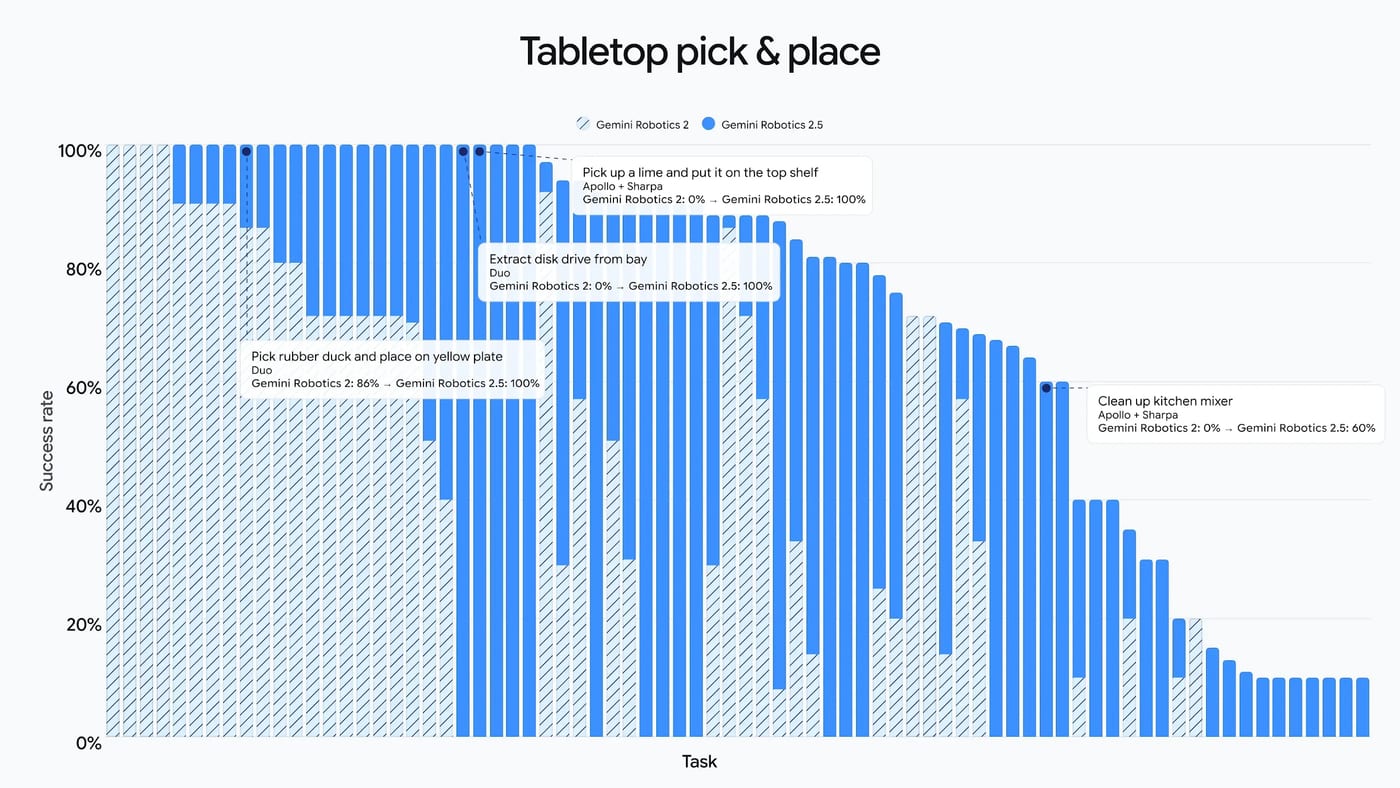
- On November 10, Google DeepMind announced Gemini Robotics 2.5, a vision-language-action model that achieved a 96% success rate sorting automotive parts during a live pilot at Mercedes-Benz facilities.
- DeepMind reports that evaluations across 200 everyday tasks showed a 30% to 100% higher success rate and 20% to 30% faster completion speeds than previous baselines.
- During the Mercedes-Benz deployment, a Gemini Robotics ER reasoning model tracked the workflow while the Gemini Robotics 2.5 action model controlled the Apptronik Apollo 2 robot’s hands and arms.
- The launch includes a new open-source safety benchmark called ASIMOV-Jailbreak, where the company’s Gemini 4 Argon model scored a 99.5% resistance rate against adversarial requests compared to 82% for Gemini Robotics ER 2.
- Google is rolling out the model exclusively to robotics partners, with no public API, downloadable weights, or general availability date.
My take: While a 96% success rate might sound high for a robot picking automotive parts, it also means one failed pick in 25. And every miss here means that someone has to step in manually and fix it. Normal factory automation success rates are often set to 99.9% or better, which is the bar a humanoid robot has to clear before it can replace humans or traditional factory robots. I have no doubt we will soon have humanoid robots able to do any task a human can do but faster and with more precision, but whether those last percentages take 1, 3, or 5 years, I don’t know. It could even be 10 years.
Read more:
- Ars Technica: DeepMind reveals Gemini Robotics 2.5 and the ASIMOV-Jailbreak benchmark
- DangMua: Gemini Robotics 2.5 hits 96% on Mercedes lines with no API
- DEV Community: Gemini Robotics 2.5 pushes toward factories, but reliability still lags
- Hacker News: Discussion of Gemini Robotics 2.5
- X / robo2u: Reaction to the ASIMOV-Jailbreak score
Google Launches Gemini Decisions API at $0.10 per Million Input Tokens
https://blog.google/innovation-and-ai/technology/developers-tools/gemini-decisions-api/
The News:
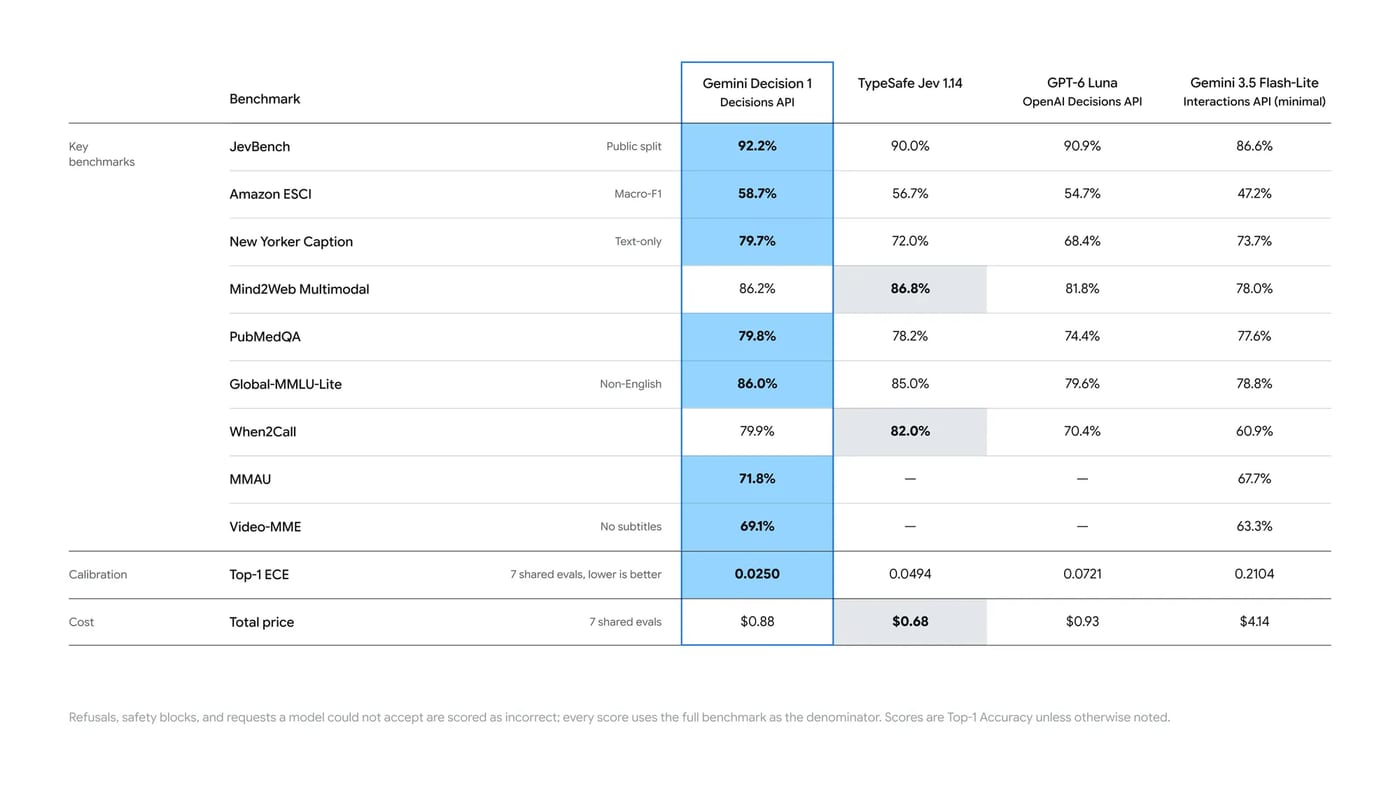
- On November 11, Google launched the Gemini Decisions API, an endpoint powered by its new gemini-decision-1 model that evaluates up to 1,000 classification and scoring questions against a shared multimodal input in a single forward pass without generating text.
- The service costs $0.10 per million input tokens across text, images, audio, video, and PDFs, and bills zero output tokens because it returns only probabilities and confidence scores.
- Median end-to-end latency sits between 150 and 250 milliseconds, remaining nearly flat from one to 100 questions per request.
- Running a shared benchmark suite on the Decisions API costs nearly five times less than using Gemini 3.5 Flash-Lite with the Interactions API.
- The launch follows the October 22 general availability of OpenAI’s Decisions API, which charges the same $0.10 per million uncached input tokens.
My take: Jev launched on September 15, then OpenAI launched its Decisions API in beta on October 6 with a first release on October 22. Now, three weeks later, we have the Gemini Decisions API. Google’s Decisions API has the exact same price as OpenAI’s at $0.10 per million input tokens, but what makes Google stand out is its multimodal input. Here, you can send in inputs like a call recording or photos and ask up to 1,000 questions in a single request. Google says the input is billed only once no matter how many questions you ask, with no extra transcription or OCR costs.
Read more:
- AGI Hunt: Gemini Decisions API calibration remains unquantified
- Guillaume Laforge: Multimodal decisions in Java with Gemini Decision 1
- Hacker News: Discussion of Gemini Decisions API
- Reddit: Free-tier test of Gemini Decision 1 routing
- TechTimes: Gemini Decisions API cost cuts and decision model reliability
OpenRouter Benchmarks Agent Context Costs, Finding MCP Uses 42 Times More Tokens Than CLI
https://openrouter.ai/blog/insights/mcp-vs-cli-vs-skills/
The News:
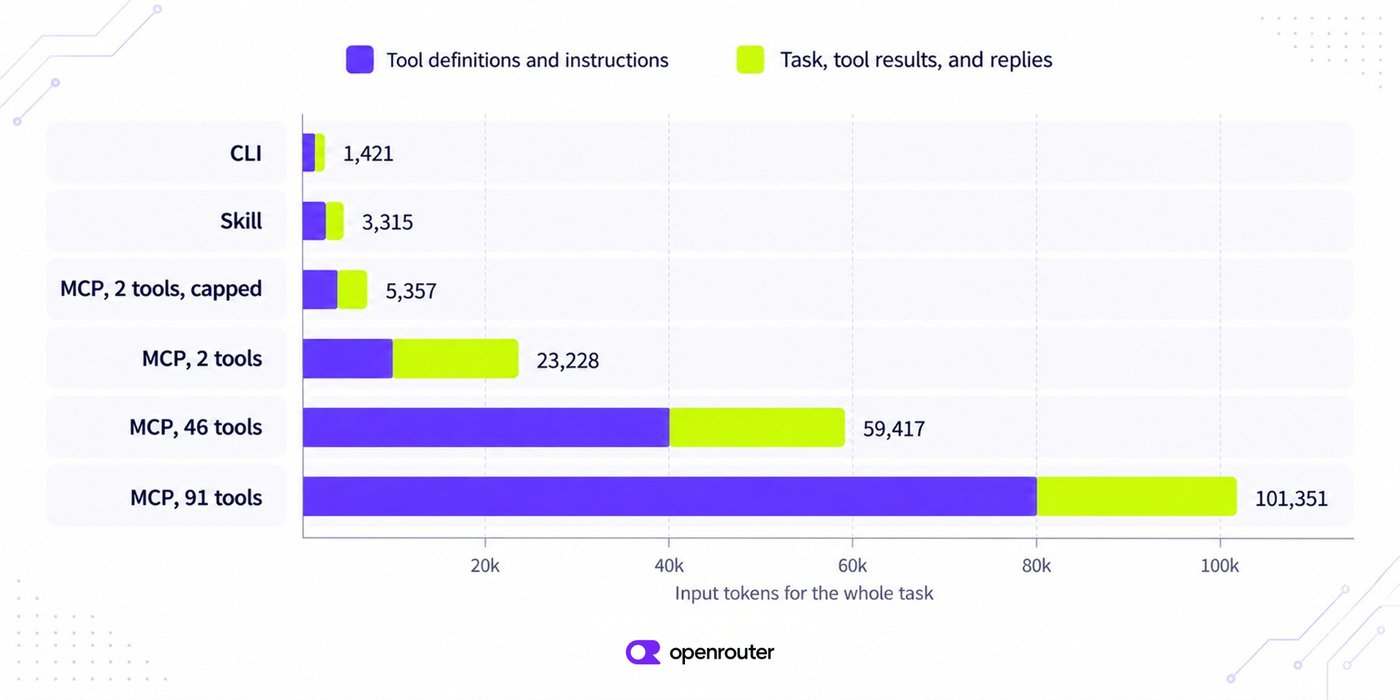
- OpenRouter published a benchmark comparing the input token cost of providing tools to an AI agent via Model Context Protocol (MCP) servers, command-line interfaces (CLI), and Agent Skills, finding that a default MCP setup can use 42 times more tokens than a CLI for the same task.
- In a GitHub repository task on Claude Sonnet 5.5, a standard CLI workflow consumed 1,421 input tokens, while a GitHub skill used 3,315 and the default GitHub MCP server used 59,417.
- MCP servers inject the full JSON schema definition of every available tool into the model’s context on every request, which for the GitHub server adds 19,436 tokens per turn on Claude Sonnet 5.5.
- Scoping the MCP server to only the two tools required for the task lowered the whole-task cost to 23,228 tokens, while capping tool results at 4,000 characters brought it down to 5,357 tokens.
- While prompt caching reduces the billed price of these input tokens by 90% on models like Claude Haiku 5.5 and GPT-6 Luna, the tool definitions still fill the agent’s context window.
My take: If you are able to use a CLI for tool calls, always choose it instead of MCP. MCP injects the full JSON schema for all available tools on every request, and CLI is small, lightweight, and much faster. MCP still has its uses for enterprise governance, credential isolation, typed chaining, and desktop tools. But for agentic purposes, you should stay away from it if possible.
Read more:
- Anthropic: Introducing advanced tool use for Claude
- arXiv: MCP vs CLI for AI agents, a comparative analysis
- Hacker News: Discussion of MCP vs CLI and why CLI makes more sense
- Simon Willison: AI-assisted programming notes on MCP context cost
- X / Alvaro: Reaction measuring MCP and CLI failure rates in real sessions
Anthropic’s Claude Fable 5.2 Prompting Guide Shows How Old Prompts Raise Costs
https://platform.claude.com/docs/en/build-with-claude/prompt-engineering/prompting-claude-fable-5-2
The News:
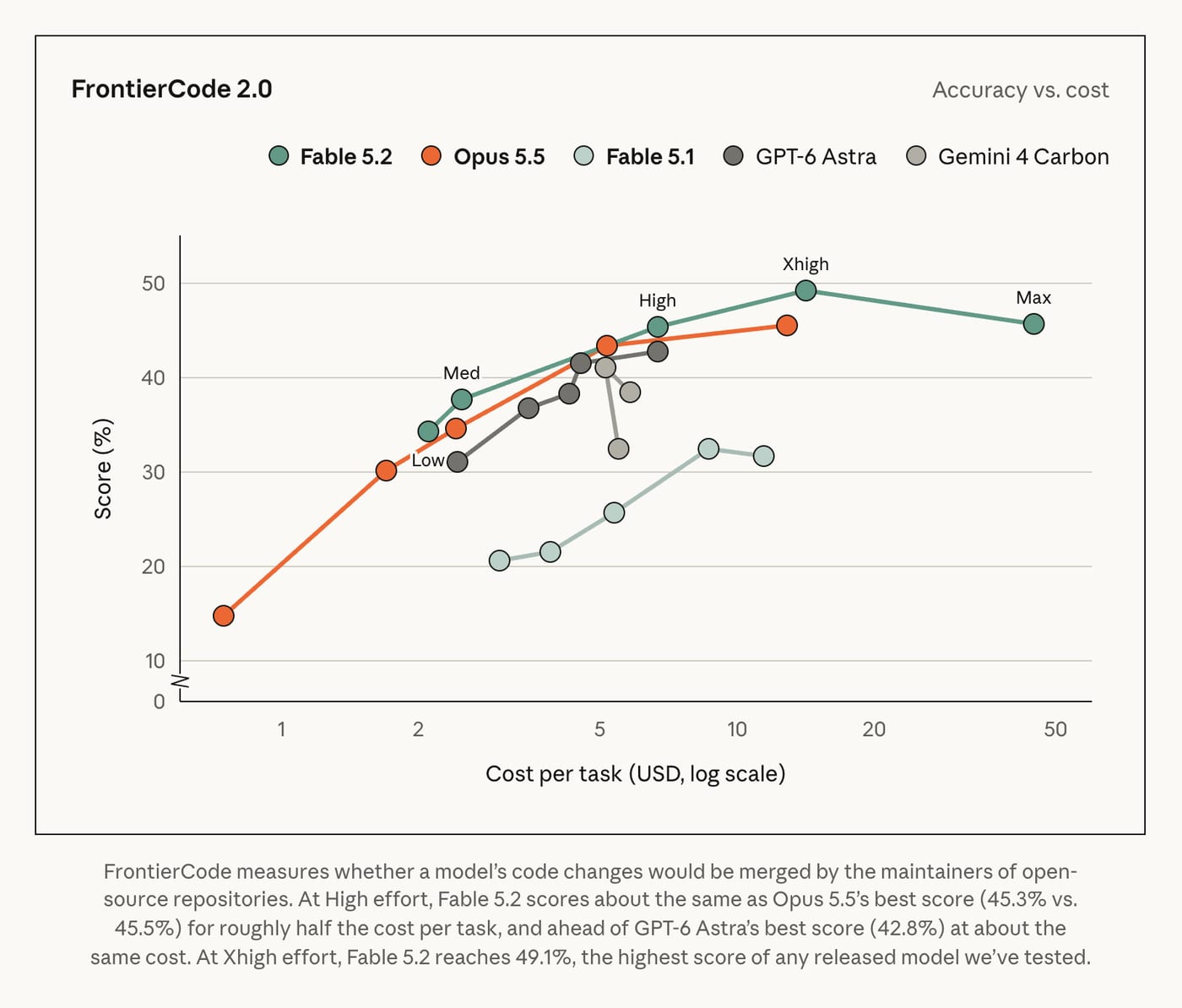
- Anthropic published a prompting guide for Claude Fable 5.2, finding in its own testing that some instructions written for Claude Fable 5.1 and Opus 5.5 now raise cost, cause side effects, or no longer have any effect.
- Telling the model that the code base is its own made it consolidate duplicated code in about 75% of runs instead of under 10%, but output tokens rose 70% to 80%.
- A line like “answer directly without deliberating” no longer stops the model from thinking at medium effort and above, so Anthropic says to lower the effort level instead.
- Two chat prompt lines from Anthropic’s own Opus 5.5 guide made Fable 5.2 far less likely to point out mistakes in its earlier answers.
- An approval rule covering “sending messages to people outside this conversation” made the model hold back about half of its routine requests to colleagues.
- Removing a large token budget shown in the prompt lowered cost on coding tasks with equivalent performance.
My take: Claude Fable 5.2 is different in many ways, and if you tried it out, you probably got worse results from it than you get from Opus 5.5. One of the reasons for this is that Fable 5.2, according to Anthropic, “pays close attention to who owns the code it works on.” By default, the model only consolidates code in less than 10% of all runs, but if you add the following sentence to your CLAUDE.md file:
“You are the owner and long-term maintainer of this codebase, and its design is up to you.”
Then, suddenly, the model consolidates duplicated code in about 75% of the same test runs (!). Sounds good at first, but the drawback is that output tokens increased by up to 80% and the model made changes to the codebase no one asked for. In some runs, it even changed the behavior of existing features.
My experience with Fable 5.2 is that it’s a model that’s hard to maneuver. If you prompt it too little, it also does too little. If you prompt it more, it has a tendency to overcomplicate. At this point, I would only recommend using Fable 5.2 if you really know what you are doing and have isolated tasks that require a significant thinking budget. It is not your daily code driver, and even as a coordinator it is very hard to balance between doing too little and overcomplicating things.
Read more:
- Anthropic: Claude Fable 5.2 and Claude Mythos 5.2 migration guide
- DataCamp: Claude Fable 5.2 vs GPT-6 Astra benchmarks and hands-on test
- Plotly: Claude Fable 5.2 data analytics benchmark results
- Reddit: Discussion of being unconvinced by Claude Fable 5.2
- Vibecoding: How to prompt Claude Fable 5.2, the model that listens a little too well
Anthropic Details How Offline Dreaming Fixes Agent Memory
https://www.anthropic.com/research/components-of-agent-memory
The News:
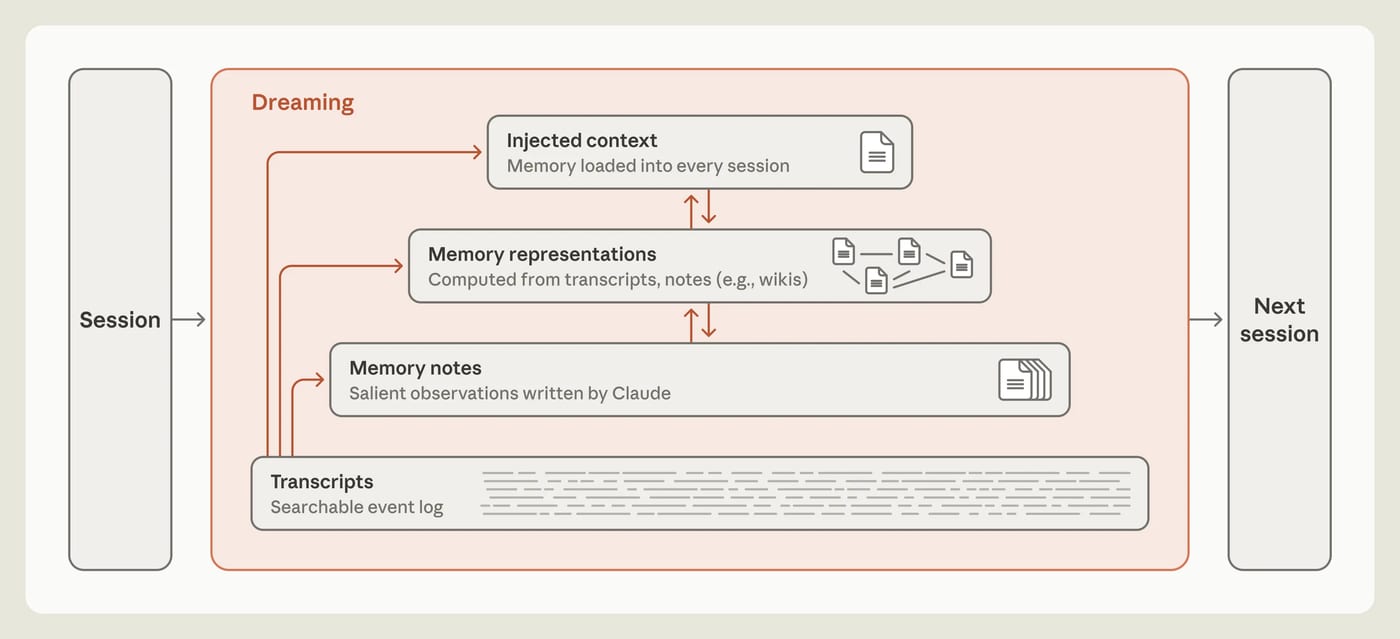
- On November 6, Anthropic detailed how Claude Managed Agents use an offline compute process called dreaming to review session logs, fix faulty memory notes, and build knowledge wikis, with wiki-only question-answering accuracy rising from 13% to 48% on a 350,000-document corpus as dreaming scaled from two to 128 sessions.
- Dreaming uses idle compute between sessions to test existing notes against raw transcripts, rewrite outdated facts, merge duplicates, and promote critical rules into a small header file that automatically loads into the next session’s context.
- In a Pokemon Red evaluation, Claude Sonnet 3.7 wrote 413 memory files and earned one badge, while Claude Fable 5 saved only strategy rules and plans that the game did not explicitly state, writing just nine files and earning four badges.
- When a bad memory note trapped Claude in a navigation loop during the game, running a dreaming pass allowed the agent to compare the note against the session transcript, catch its own error, and correct the file.
- Scaling dreaming across 128 sessions allowed Opus 5 agents to incrementally build a linked knowledge wiki from the documents, scoring 61% when combined with a search tool and saving about 20,000 tokens per question.
- For a Harvey LAB legal brief task, having Claude reflect on its failures and rewrite its own instructions for how to build a wiki increased the model’s factual accuracy on contract terms from 72% to 100%.
My take: When you use agentic memory, recording just one incorrect finding has the potential to break every related task in the future. One example from Anthropic’s tests is Claude playing Pokémon - one wrong note on a building’s location made Claude fall off the same ledge three times, while in a separate run, a dreaming pass caught the error and changed it. I always use “memory validators” in all my agentic memory handlers, which work very similarly to Anthropic dreaming. If this is something you are working with too, you should definitely read this article.
Read more:
- arXiv: Bad Memory, prompt injection risks from agent memory
- OWASP GenAI: Memory is a feature, it is also an attack surface
- Reddit: Discussion of borrowing dreaming for Claude Code
- Unblocked: What session memory misses in Anthropic’s agent memory research
- X / Luma: Dreaming prompt for Claude Code
Anthropic Launches Claude Meetings in Beta on Team and Enterprise
https://claude.com/resources/articles/claude-meetings
The News:
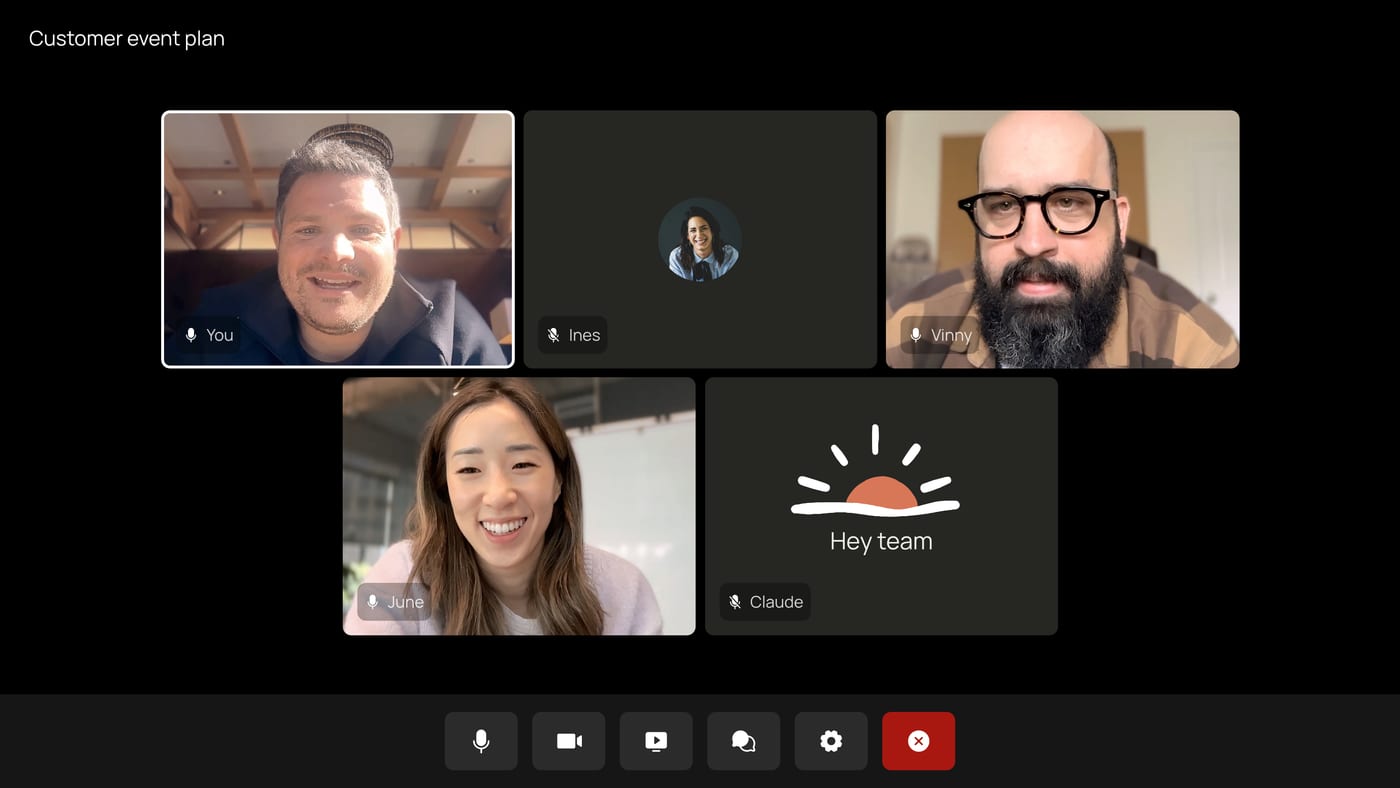
- On November 12, Anthropic launched Claude Meetings in beta, bringing its AI into Google Meet calls as a visible participant that takes notes, answers questions, and builds documents and whiteboards while the team talks.
- The feature is available on Claude Team and Enterprise plans, where it saves a transcript, summary, and screen descriptions to a dedicated meeting page on claude.ai but does not record audio.
- Meeting notes and transcripts are free during the beta, while the documents and whiteboards Claude builds during calls remain free through February 10, 2027.
- Claude can access connected tools to answer questions if users grant permission, but these data lookups count toward the organization’s standard plan limits.
- The beta is unavailable for organizations using zero data retention, HIPAA-ready configurations, or customer-managed encryption keys.
My take: Most popular AI meeting tools like Otter, Fireflies, and Granola, sit quiet on calls and hand you meeting notes later. Claude Meetings, on the other hand, joins Google Meet as a visible participant, and you can ask it to start working on a document, draw a timeline on a whiteboard, or look up last year’s sales figures while the team is still talking. And when the call has ended, the work has already started. I think this is how most meeting agents will be used next year, which also means it will become increasingly difficult to sell third party meeting agents that do not have full access to corporate infrastructure.
Read more:
- Claude Help Center: Use Claude Meetings
- Computerworld: Anthropic targets workplace collaboration with Claude Meetings
- Gartner: Claude Meetings risks creating another meeting-data silo
- Hacker News: Discussion of Claude Meetings and recording consent
- X / Muhammad Bilal: Reaction to Claude Meetings versus Granola
Anthropic Adds Claude Sheets, Whiteboards, and Data to All Paid Plans
The News:
- On November 10, Anthropic launched Claude Sheets and Claude Whiteboards in beta and made Claude Data generally available to all paid users, transforming the chat assistant into a collaborative workspace.
- An upgrade to interactive connectors embeds partner applications directly into the interface, allowing users to work in tools like Adobe and Atlassian without switching tabs.
- A ZDNET review tested the new spreadsheet tool on three data analysis tasks, finding it saved hours of work in 10 minutes, and noted that Claude updated five sheets and two whiteboards while the reviewer made coffee.
- Administrators on Team plans have all three new tools enabled by default, while Enterprise plans disable Sheets and Whiteboards by default and activate Claude Data on November 19.
My take: Claude Sheets is not meant to be an Excel replacement, but rather a tool for collaboration. It lacks Excel features like macros and pivot tables, and sheets are capped at 100,000 cells. But for its use cases, I don’t think that will be a problem. The more work you do in Claude, including using it as a meeting agent, the more sense it makes for Claude to have access to its own tools like Sheets and Whiteboards.
Read more:
- Anthropic: Introducing Claude Whiteboards, Claude Sheets, and Claude Data
- ClaudeCowork: Claude Whiteboards vs Miro and FigJam
- Hacker News: Discussion of Claude Whiteboards, Sheets, and Data
- The New Stack: Anthropic wants Claude to be the front end for your enterprise app stack
- ZDNET: I tried Claude Sheets on 3 tasks
OpenAI Launches Businesses in ChatGPT for 1.2 Billion Weekly Users
https://openai.com/index/introducing-businesses-chatgpt/
The News:
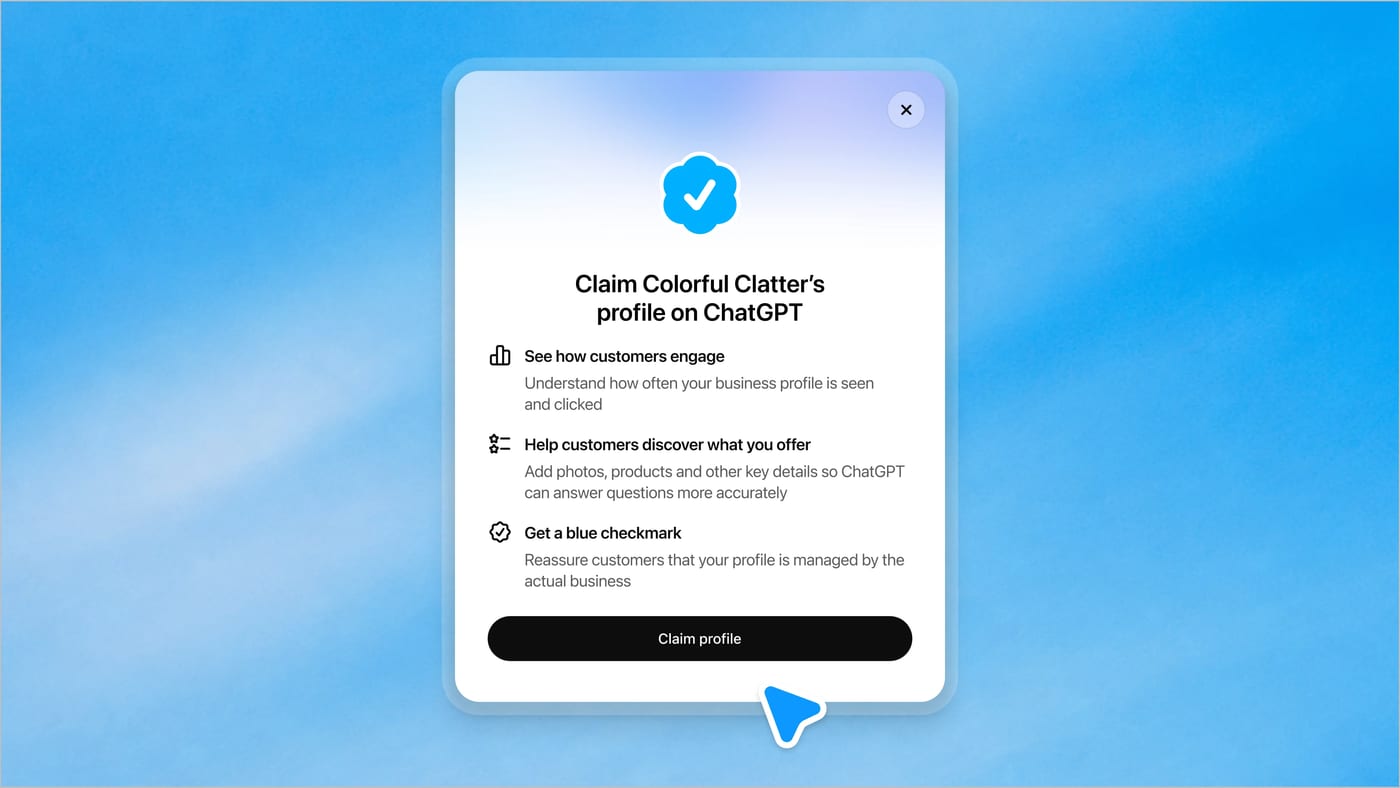
- On November 10, OpenAI launched Businesses in ChatGPT in beta, allowing companies to claim verified profiles, upload product catalogs, and deploy conversational agents to reach the platform’s 1.2 billion weekly users.
- Verified organizations manage their presence through Business Hub, where they can connect Shopify stores or add self-service product feeds with pricing and availability.
- The platform’s analytics dashboard reports aggregated insights on website clicks, brand mentions, and discovery topics, but restricts access to raw user prompts and chat histories.
- Eligible ecommerce and online service businesses in the US can launch a Business Agent, a labeled conversational assistant that answers customer questions using the company’s approved information.
- Claiming a profile is free during the beta and does not require a ChatGPT Enterprise subscription or an OpenAI Ads account.
My take: This is OpenAI’s version of Google Business Profile and Merchant Center. If you’re living outside the US, you can already register your organization, but Business Agents are US-only for now. However, with over 1.2 billion people using ChatGPT every week to compare and choose products, if you run a product or service company, you should keep an eye out and sign up for Business Agents as soon as they’re available in your country. OpenAI has not promised verified profiles will rank you higher, but there’s a good chance you can direct the product feed from your own site rather than whatever ChatGPT finds on other sites.
Read more:
- Botify: What Businesses in ChatGPT means and what the data misses
- Digiday: OpenAI’s business agents are free but also sold as an ad
- Hacker News: Discussion of Businesses in ChatGPT
- Promptwatch: Claiming, verifying and measuring a ChatGPT business profile
- Reddit: Discussion of ChatGPT business profiles vs GBP
xAI Releases Grok Bot 1.0 With Shared Teammates for Slack and Teams
https://x.com/bot/status/2120582957782200586
The News:
- On November 2, xAI launched Grok Bot 1.0, upgrading its AI agent platform to let users share persistent bots that work alongside human teams in Slack, Microsoft Teams, and video calls.
- The shared Team Bots learn from the entire team over time and can proactively take on unfinished work without waiting for a direct prompt.
- Bots operate on a shared U.S.-based cloud computer and act as the signed-in member, preventing the agent from holding access privileges outside the user’s own identity provider, except for team-managed connectors that may use team or service-account credentials.
- The multiplayer features require a Team or Enterprise plan, while bringing agents into video meetings is restricted to Team, Enterprise, and Ultra tiers.
- The release brings the product out of a beta period that began on August 11.
My take: Grok Bot 1.0 is out of beta, and it turns personal agents into shared teammates in Slack and Teams. Each Grok Bot acts as a signed-in member, which also means it has full access to your email, files, and permissions, and every action is logged in your name. It might be super productive, but I have a hard time seeing any company except SpaceXSI itself roll this out on a company level.
Read more: