Tech Insights 2026 Week 30
July 20, 2026

Goodbye Wordpress!
When I first launched Tech Insights in 2024, I set it up as most people did back then: a Wordpress site with the Newsletter plugin. But I was never quite happy with the choice. Configuring design templates was difficult, and I had to pay yearly fees for plugins for backups, SEO, file uploads, and newsletter publishing. It was also a lot of manual work. Every week I had to go in and create a new post and paste information from my markdown files. Image uploads often failed, so I had to manually review and re-upload them. In a world where AI now does most of my routine work, this no longer felt like the way I wanted to keep publishing my newsletters.
At TokenTek we also used Wordpress for our main website. It was simple to get up and running, but editing was hard. AI engines could not edit the site. Managing things like SEO optimization and multiple languages was so much manual work that we just ignored it. It was time for a change.
So last week I decided to let Fable and GPT-Sol migrate both websites over to a custom architecture. And the results were amazing!
The architecture I ended up with stores all files on GitHub, and all content is saved as markdown. This means that anyone with access can check out the repositories and edit the text using an editor like Obsidian. When content is pushed to GitHub, it is automatically compiled using Astro into the finished website. A worker on our web hosting provider Oderland runs every 15 minutes and polls the compiled site from GitHub. This means the number of exposed security risks has been reduced to zero.
Fable and GPT-Sol also wrote a complete newsletter engine, and today’s edition is the proof that it works (which I hope it did). All user data is stored safely in a secure SQL database in Sweden, and all mail is sent with Postmark. The engine handles templates, signups, unsubscribes, bulk transfers, and much more.
All this took just a few days of work. I now have two websites where AI models can actually work with the files, do SEO optimization, add translations, move things around, adjust layouts, add and modify pages, and so much more. None of this is possible with Wordpress. If you are running Wordpress sites today, check both tokentek.ai and techbyjohan.com. They are now completely built and maintained with custom AI agents.
Thank you for being a Tech Insights subscriber!
Listen to Tech Insights on Spotify: Tech Insights 2026 Week 30 on Spotify
Notable model releases last week:
- Inkling by Thinking Machines Lab. 975B-parameter open-weight multimodal MoE with 41B active parameters and 1M-token context, scoring 77.6% on SWE-bench Verified and 63.8% on Terminal Bench 2.1.
THIS WEEK’S NEWS:
- Anthropic Sets 50% Fable 5 Limits for Max and Team Premium
- Moonshot AI Introduces Kimi K3, Weights by July 27
- Suno Hack Exposes 2,013,545 YouTube Music Clips
- 26 Meta Employees Sue Over Alleged AI Layoff Picks
- European Commission Orders Google to Open Android, Share Search Data
- Anthropic Publishes Six-Step Claude Code Migration Guide
- Google Renames NotebookLM to Gemini Notebook
Anthropic Sets 50% Fable 5 Limits for Max and Team Premium
https://x.com/claudeai/status/2078302415804379218

The News:
- In a July 18 X post, Anthropic said the Claude Fable 5 model will be included in Max and Team Premium plans starting July 20 at 50% of plan limits, with Pro and Team Standard remaining on usage credits.
- Pro and Team Standard users will receive a one-time $100 credit.
- Anthropic said demand was hard to predict, so it rolled Fable 5 out to subscription plans in stages and extended access several times while adding capacity.
- Fable 5 launched on June 9, was suspended on June 12 after US export controls, and was redeployed on July 1.
- Anthropic prices Fable 5 at $10 per million input tokens and $50 per million output tokens.
My take: I really like Anthropic Fable and have used it every day since it was made available. It is the best model for design work and managing large documents and plans, and it is extremely good at finding issues in large source code repositories. I still prefer GPT-Sol-xhigh for writing code, as it is more disciplined and knows how to write code to avoid common issues.
So I was very happy to see Fable being included in all Max and Team Premium plans going forward. The 50% limitation however in practice means that your Max20 plan is now a Max10 plan, and the Premium plan which is a 6x plan is now effectively a 3x plan. As long as you use it carefully and do not spin off dozens of subagents on a large repo you should be fine. In my experience, the main issues people have with token usage happen when they let the model think for itself with little guidance, which is why a Reddit discussion focuses on using Fable 5 strictly as an orchestrator while cheaper models execute the work.
Read more:
- Anthropic: Claude Fable 5 and Claude Mythos 5
- Anthropic: Redeploying Claude Fable 5
- Reddit: Discussion of Fable 5 orchestration economics
- X / Mr Ash: Reaction to Fable 5 pricing
- YouTube: Hands-on Claude Fable 5 tests
Moonshot AI Introduces Kimi K3, Weights by July 27
https://www.kimi.com/blog/kimi-k3
The News:
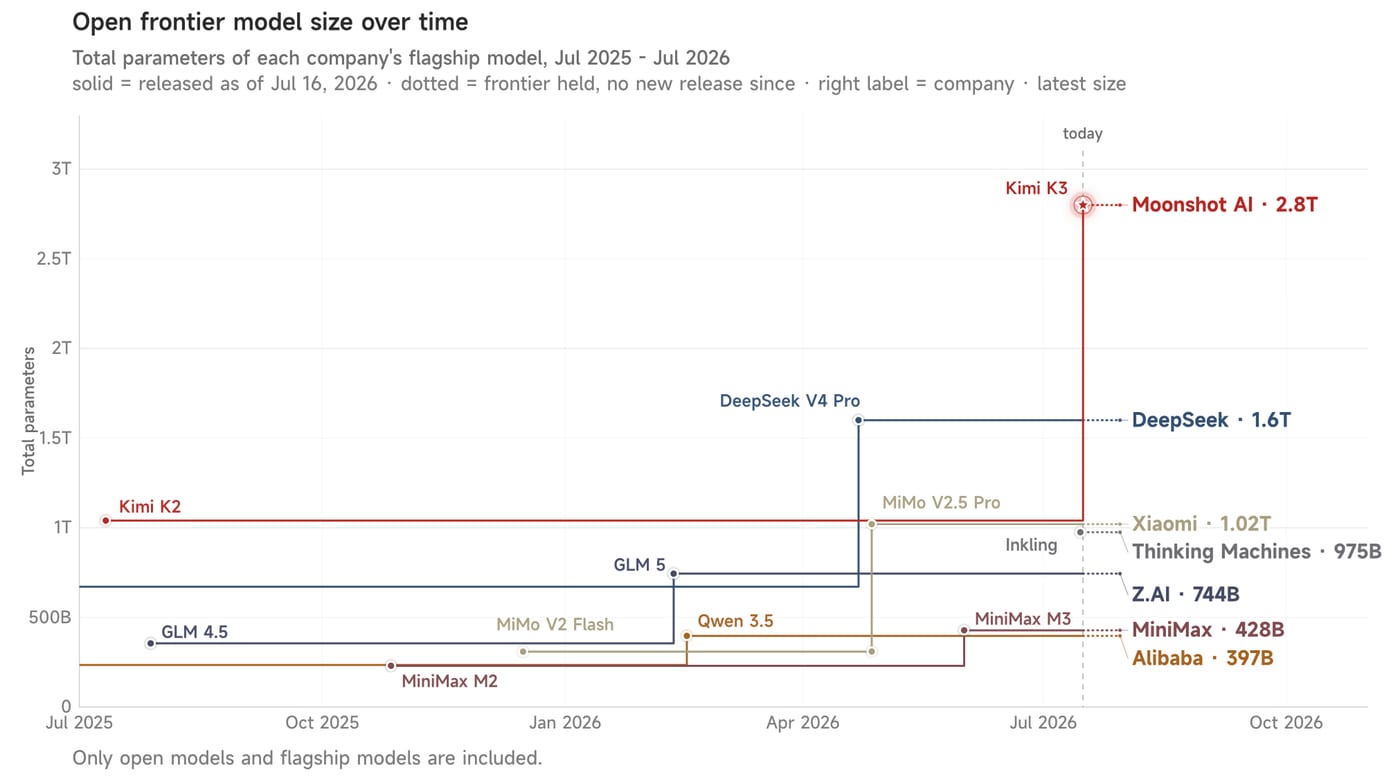
- Moonshot AI introduced Kimi K3, a 2.8T-parameter MoE model with native vision and a 1-million-token context window that is live across Kimi’s products and API, with full model weights due by July 27.
- API pricing is $3.00 per million cache-miss input tokens, $0.30 for cache-hit input, and $15.00 for output.
- Moonshot says K3 still trails Claude Fable 5 and GPT 5.6 Sol overall, but in its GPU kernel test it outperformed Claude Opus 4.8, GPT 5.6 Sol, and GPT 5.5.
- The model activates 16 of 896 experts, and Moonshot recommends supernode deployments with 64 or more accelerators.
- Moonshot lists “excessive proactiveness” as a limitation, saying ambiguous tasks can lead K3 to make unexpected decisions unless behavior is more tightly constrained.
My take: While full model weights will be released by July 27, this is the first time we have gotten a model from China that has actually caught up with all the best current models from Anthropic and OpenAI, including Fable and GPT-5.5-Sol. In benchmarks like DeepSWE and Terminal Bench the differences are extremely small, and in benchmarks like FrontierSWE and SWE Marathon it even outperforms most of the other top models.
I haven’t run Kimi K3 myself yet, and I would hesitate with any kind of recommendation before we know how it performs in actual real-life scenarios. Right now we only have benchmark performance numbers, and some commenters in the Hacker News discussion express benchmark fatigue, arguing that long-session usage reports matter more than additional bar charts. As we all know, AI models have a tendency to become very good at tests while still failing at everyday tasks. But the benchmarks really do look impressive, and if it performs equally well in everyday scenarios the global AI arena has suddenly changed significantly in just one week.
Read more:
- Hacker News: Discussion of the Kimi K3 launch
- Latent Space: Kimi K3 community and technical roundup
- NXCode: Kimi K3 benchmark evaluation guide
- Reddit: Discussion of Kimi K3 pricing
- X / Justin Gorya: Kimi K3 frontend demo
Suno Hack Exposes 2,013,545 YouTube Music Clips
https://www.404media.co/hack-reveals-suno-ai-music-generator-scraped-youtube-deezer-and-genius/
The News:
- 404 Media reported that hacked Suno source code and dataset comments indicate the AI music generator used 2,013,545 YouTube Music clips in its training data.
- A separate dataset summary listed 113,879 hours of youtube_music, 17,615 hours of genius_hq, and 12,287 hours of deezer.
- The same files also named Pond5, Jamendo, Freesound, IMSLP, and podcast RSS feeds, including 62,117 hours from Pond5.
- 404 Media says the hacker also accessed user information for hundreds of thousands of customers and Stripe payment information.
- The leak adds detail to Suno’s legal position, because the company previously said it trained on “essentially all music files of reasonable quality” on the open internet and argues that training on copyrighted works is fair use.
My take: Is anyone surprised that Suno scraped virtually every music service they could get access to in order to train their AI engine? I’m not. Suno is one of those services that I really would like to play around with myself, but which have chosen to not evaluate just because of their vague content licensing. According to Suno themselves they have just trained on “Open Internet files” but this hack made it very clear that it’s much more than that.
Read more:
- CNET: Suno source code hack reveals training data
- Forbes: How AI music licensing deals changed the business model
- GIGAZINE: Leaked Suno code and scraping methods
- The Verge: Suno training data exposed by hack
- X / ROXy: Reaction to using Suno stems in production
26 Meta Employees Sue Over Alleged AI Layoff Picks
The News:
- On July 13, a group of 26 Meta employees sued in federal court in Oakland, alleging that Meta used internal AI systems and employee-monitoring data to help choose who to cut in a May layoff affecting about 8,000 workers.
- The complaint says the selection process used keystroke and activity-monitoring data, AI token-usage dashboards, and algorithmically assisted performance rankings.
- All 26 plaintiffs had taken protected leave or requested or received a disability accommodation, and the suit says Meta did not account for that when using employee scores.
- The case invokes disparate impact liability, arguing that facially neutral metrics can still be illegal if they disproportionately burden protected workers and are not necessary for the job.
- Meta called the claims meritless and said workforce management and organizational decisions “were and are made by people, not AI”; the 26 workers remain employed for now, with separations set to begin July 22.
My take: Meta is one of few companies where I really cannot understand why people choose to work there. According to this case, Meta used recorded keystroke and activity-monitoring data to decide which employees should be fired when they cut down on staff. The employees filing this case all had taken protected leave or used disability accommodation, and they claim the automated AI-firing-agent did not consider this when choosing the people to let go based on efficiency. Looking at these metrics, one X user framed the reaction perfectly as a warning against technology that can “punish people for having bodies.”
For over 15 years we have all known that we as Facebook users are not their consumers but their product. If this case proves to be true it adds another dimension to how Facebook works with people. Many senior AI researchers employed at the Meta Superintelligence Labs left just months after employment started, despite walking away from billions in salaries. It just feels like there is a toxic culture across the entire company.
Read more:
- Business Insider: Meta faces lawsuit over AI-assisted layoffs
- Computerworld: Did AI decide who lost their jobs at Meta?
- Courthouse News: Meta employee complaint
- X / Gerald Wayne: Reaction to Meta’s alleged AI layoff process
European Commission Orders Google to Open Android, Share Search Data
https://ec.europa.eu/commission/presscorner/detail/en/ip_26_1634

The News:
- On July 16, the European Commission issued two binding specification measures under the Digital Markets Act telling Google how to open Android device features to rival AI assistants and how to share Google Search data with other search engines.
- One measure is meant to give competing AI services the same access to Android features available to Google’s own services, including voice activation similar to “Hey Google.”
- Third-party assistants should also be able to perform actions inside apps on a user’s behalf, such as booking a taxi or suggesting replies in chat apps.
- The search measure requires shared data to be anonymised with a multi-layered method the Commission says was developed with privacy experts.
- Google can assess whether sharing with a specific third party poses serious cyber security or data protection risks before any data is shared.
My take: Now this is a tricky decision. Google is forced by the European Commission to enable third-party voice assistants on Android, enabling the same functionality as “Hey Google” but for any other company. It sounds simple, but I really cannot even begin to fathom all the technical complexities involved with this, since all shared search data must be anonymized together with privacy experts. In a post on X, one user raises a useful governance objection by pointing out that anonymization at Google does not answer who audits the recipients or controls downstream use if the data is linked back to individuals. On top of that, Google is mandated to offer this Android interoperability for free to any third-party provider.
As you remember from last month, Apple has decided to not release Apple Intelligence in the EU, much thanks to this extremely restrictive Digital Markets Act. Now thanks to this order there is a good chance we will not be seeing any more Android updates either. The EU does this to open up for European companies to stay competitive, but I do not think this is the right way to do it.
Read more:
- ECIPE: The Commission’s DMA Specification Decisions on Google
- European Commission: Android AI Interoperability Q&A
- Reddit: Discussion of Google’s Android and Search Measures
- Tech Policy Press: Designing Europe’s Search Data Sharing Rules
- X / Elias: Privacy Reaction to Search Data Sharing
Anthropic Publishes Six-Step Claude Code Migration Guide
https://claude.com/blog/ai-code-migration
The News:
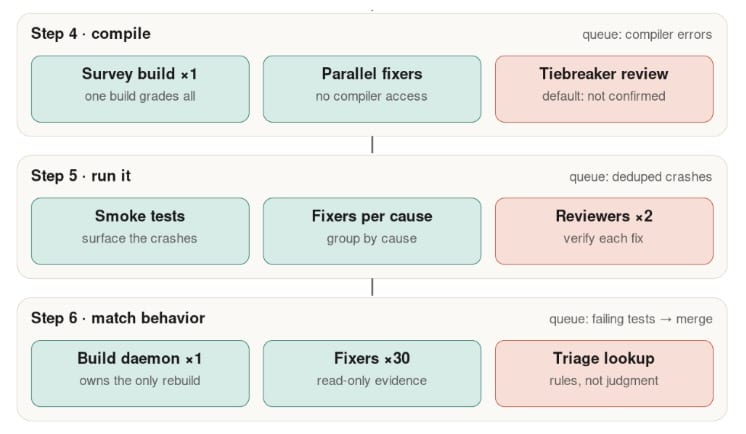
- Anthropic published a six-step guide for using Claude Code on large language-to-language migrations, starting with a portable test “judge” or parity harness and relying on adversarial review plus mechanical verification instead of hand-editing translated files.
- The core loop is implement, review, fix, and Anthropic says smaller models can handle the fan-out work, citing a main migration that used Claude Sonnet across 12 subagents while larger models reviewed.
- Repeated cross-file failures are treated as rule defects, so engineers amend the rulebook and regenerate the affected batch instead of hand-patching code.
- In later stages, a build daemon is the only process allowed to rebuild the binary, batching fixer patches and rerunning affected tests.
- Anthropic says Bun’s Zig-to-Rust port is 19% smaller on Linux and Windows, 2-5% faster across HTTP serving and workloads like next build and tsc, and cut one 2,000-build memory benchmark from 6,745 MB to 609 MB.
My take: This article begins saying that “individual developers at Anthropic migrated 10 code packages consisting of tens to hundreds of thousands of lines of code using Claude Fable 5, Claude Opus 4.8, and dynamic workflows”. So when you read this article, keep in mind that Anthropic has unlimited token access and all their workflows are based around that. Governance is also a major concern when scaling these setups, and a related Reddit discussion shows user support for approval gates rather than bypassing permissions entirely. I have used Fable extensively the past weeks, both through subscription and through the API. A single code review request running through the API is typically between 500 kr and 1000 kr, so how much does a migration cost using the “Anthropic subagent approach”? A lot.
From the article: “There still needs to be a justifiable business case. While million line migrations no longer cost $3 to $4 million in engineering resources over the course of a four year project, they still cost tens to hundreds of thousands of dollars or more to execute. The Bun migration, for example, consumed 5.9 billion uncached input tokens and 690 million output tokens - around $165,000 at API pricing.” At TokenTek we have migrated many code bases with millions of lines of code, both from legacy systems and modern mobile apps. We have super optimized workflows based around GPT-5.6, and our API costs for migrating source code are a fraction of the figures Anthropic mentions in the article. So before you read about all the amazing subagent strategies with dynamic workflows and build your migration strategy around that, feel free to contact me to find out alternative ways to migrate legacy code that do not cost millions in API token costs.
Read more:
- Anthropic: Claude Code cost management
- Anthropic: Code migration starter kit
- InfoQ: Claude Code dynamic workflows
- LogRocket: Claude Code and OpenCode refactor benchmark
- Reddit: Discussion of Claude Code permission bypass
Google Renames NotebookLM to Gemini Notebook
https://blog.google/innovation-and-ai/products/gemini-notebook/notebooklm-gemini-notebook/
The News:
- On July 16, Google renamed its standalone research tool NotebookLM to Gemini Notebook and began rolling out a secure cloud computer for native code execution, as the product passed 30 million users.
- Google says over 600,000 organizations now use it.
- The upgrade lets Gemini Notebook write and execute code for complex data analysis grounded in a notebook’s sources.
- Code execution is live for Google AI Ultra users and Workspace business customers with AI Ultra Access or AI Expanded Access.
- Pro users on the web are due to get the feature over the coming weeks.
My take: I use NotebookLM to generate the weekly podcasts of Tech Insights, and it is still the only podcast generator that genuinely sounds good and interesting enough to keep revisiting every week. While several commenters in a Hacker News discussion treat the change as another example of Google repeatedly repackaging products, Gemini Notebook is a much better name, so when you see someone talk about Gemini Notebook in the future you know what they are talking about.
Read more: